
SuperEx Educational Series: Understanding Multi-chain Account System

#SuperEx #EducationalSeries
Using Web3 today can feel like living in ten cities at once.
You may have an address on Ethereum, assets on Arbitrum, NFTs on Base, activity on Solana, and another account setup in the Cosmos ecosystem. You are still one user, but every chain feels like opening a new bank account, preparing new local cash, and learning new traffic rules.
A Multi-chain Account System tries to solve this fragmentation. Users should not have to constantly think, “Which chain am I on, which address am I using, which gas token do I need, and what am I signing?” The account system should connect the multi-chain world for them.
- Cick to register SuperEx
- Cick to downoad the SuperEx APP
- Cick to enter SuperEx CMC
- Cick to enter SuperEx DAO Academy — Space
What Is a Multi-chain Account System?
A Multi-chain Account System is an account architecture that allows users to manage identity, assets, permissions, signatures, gas, and activity across multiple blockchains in a unified way.
It is not simply “a wallet that supports many chains,” nor is it just a bridge. A multi-chain account system focuses on how users can keep a continuous account experience across different chains.
For example:
- Can users manage accounts across chains from one entry point?
- Can accounts on different chains share one permission policy?
- Can cross-chain actions be authorized once and executed automatically?
- Can gas be handled in a unified way?
- Can identity and risk controls work across chains?
In one sentence: a multi-chain account system does not erase the differences between chains. It connects the user experience across them.
How Does It Work?
The core idea is separating user identity from specific on-chain addresses.
In the traditional model, an address usually represents an account on one chain. If users operate across many chains, they must manage multiple addresses, gas tokens, permissions, and transaction histories.
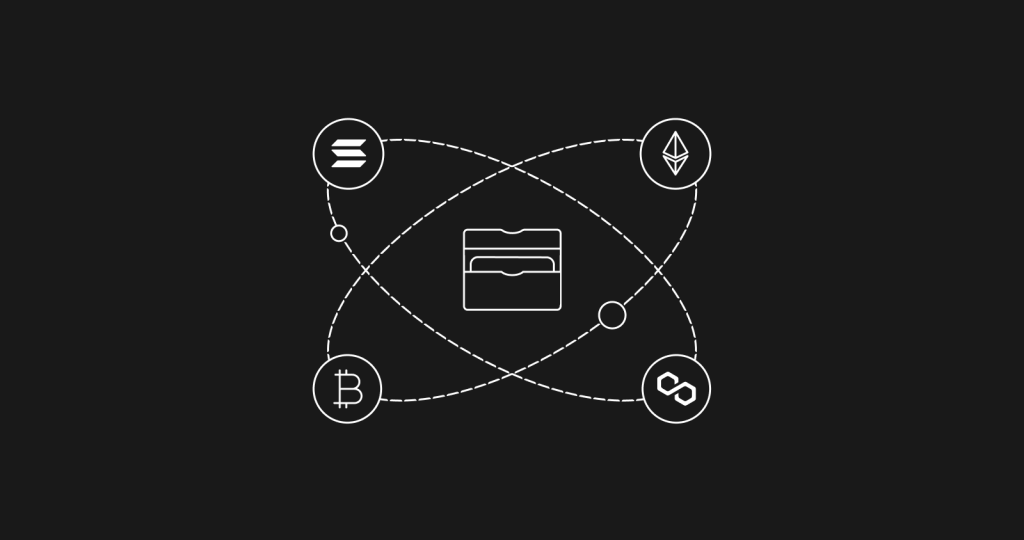
A multi-chain account system creates a unified account layer above individual chains. This layer can map to addresses on different chains, or coordinate actions through smart accounts, cross-chain messaging, account abstraction, unified identifiers, and permission policies.
There are several key modules.
First, chain and account identifiers. CAIP-2 identifies blockchains, while CAIP-10 identifies accounts across chains.
Second, account control. Smart Accounts, ERC-4337, and EIP-7702 enable flexible validation logic, batching, and permission control.
Third, cross-chain execution. Cross-chain messaging, IBC, Interchain Accounts, or similar protocols allow actions on one chain to affect accounts on another.
Fourth, gas and fee abstraction. Paymasters, sponsorship, and token-based fee payment reduce the need to hold native gas tokens on every chain.
Fifth, unified risk control and recovery. A multi-chain account needs cross-chain security rules, not isolated rules on every chain.
Why It Matters
Web3 is no longer a single-chain world. User assets, applications, and identity records are spread across different L1s, L2s, appchains, and ecosystems.
Without better account systems, multi-chain usage becomes a burden: users must remember where assets are, where gas is, where approvals exist, and where risks sit. The more chains there are, the more fragmented the experience becomes.
The value of a multi-chain account system is that users can stop managing chains and start managing their assets and permissions.
- For ordinary users, it reduces cross-chain friction.
- For applications, it improves retention and conversion.
- For institutions, it unifies permissions, approvals, audits, and treasury operations.
- For Web3 as a whole, it is a key foundation for chain abstraction and mass adoption.
Technical Approaches
The first approach is a unified wallet interface. The wallet displays multi-chain assets, transactions, approvals, and identity records in one place, so users do not constantly switch networks.
The second approach is multi-chain smart accounts. Users deploy or link Smart Accounts on different chains, but these accounts share one control policy, such as recovery rules, spending limits, allowlists, and session keys.
The third approach is controlling remote accounts from a source chain. Interchain Accounts, for example, allow an account on one chain to control an account on another chain through cross-chain communication.
The fourth approach is cross-chain gas abstraction. Users may hold funds in one place while the system handles fee payment, swapping, sponsorship, or settlement across chains, instead of forcing users to find gas on every chain.
The fifth approach is unified authorization and signing. Users should not repeatedly approve the same app on every chain. A multi-chain account system can clearly define scope, chain ID, app domain, spending limits, and expiration to reduce mis-signing and replay risks.
A Simple Case
Suppose Alice uses Ethereum, Base, and Arbitrum. She holds USDC, plays a game on Base, uses DeFi on Arbitrum, and keeps long-term assets on Ethereum.
In the traditional experience, Alice must switch networks, check gas on each chain, manage approvals separately, and remember where each asset lives. A simple action can become: bridge assets, swap for gas, approve, then transact.
With a multi-chain account system, the experience becomes more natural. Alice sees one unified account. She chooses “deposit 100 USDC into a yield strategy,” and the system determines where the funds are, where the target protocol is, how much gas is needed, whether cross-chain messaging is required, and whether a Paymaster should sponsor the fee.
Alice only confirms one clear intent. Under the hood, multiple on-chain and cross-chain steps may happen, but the account system handles that complexity.
That is the goal of a multi-chain account system: not making users forget blockchains exist, but preventing every chain’s details from interrupting them again and again.
Common Misunderstandings
The first misunderstanding is that a multi-chain account simply means using the same private key across chains.
Not exactly. The same private key may create address consistency, but it does not provide unified permissions, recovery, gas, risk control, or execution.
The second misunderstanding is that a bridge is a multi-chain account system.
It is not. A bridge mainly transfers assets or messages. A multi-chain account system manages accounts, permissions, and actions across chains.
The third misunderstanding is that a unified account is always safer.
Not necessarily. A unified account reduces usability complexity, but poor permission design can create a larger single point of risk. The more unified the system, the more it needs permission separation and risk isolation.
Risks and Limitations
A multi-chain account system is not magic. First, there are cross-chain security risks. Cross-chain messages, bridges, relayers, light clients, and verification mechanisms can all affect account execution if something goes wrong.
Second, replay and mis-signing risks matter. Multi-chain authorization must clearly bind chain ID, app scope, expiration, and action content. Otherwise, something signed for one chain may create unexpected consequences on another.
Third, there is a privacy risk. If designed poorly, a unified account can link a user’s behavior across many chains into a more complete profile. Account unification and identity masking must be considered together.
Finally, ecosystem compatibility is hard. Different chains use different virtual machines, signature schemes, address formats, gas models, and finality rules. A smooth multi-chain account experience requires cooperation across wallets, protocols, infrastructure, and standards.
Conclusion
The core value of a Multi-chain Account System is turning the multi-chain world from “users moving themselves everywhere” into “account systems coordinating actions across chains.”
It is not just a wallet feature, nor simply a bridge. It is a combination of identity, permissions, signatures, gas, recovery, risk control, and cross-chain execution.
If Web3 truly moves toward a multi-chain future, users cannot manually handle every chain’s details every day. The more mature direction is for accounts to become the unified entry point into the multi-chain world: chains coordinate in the background, while users express intent in the foreground.

Responses