
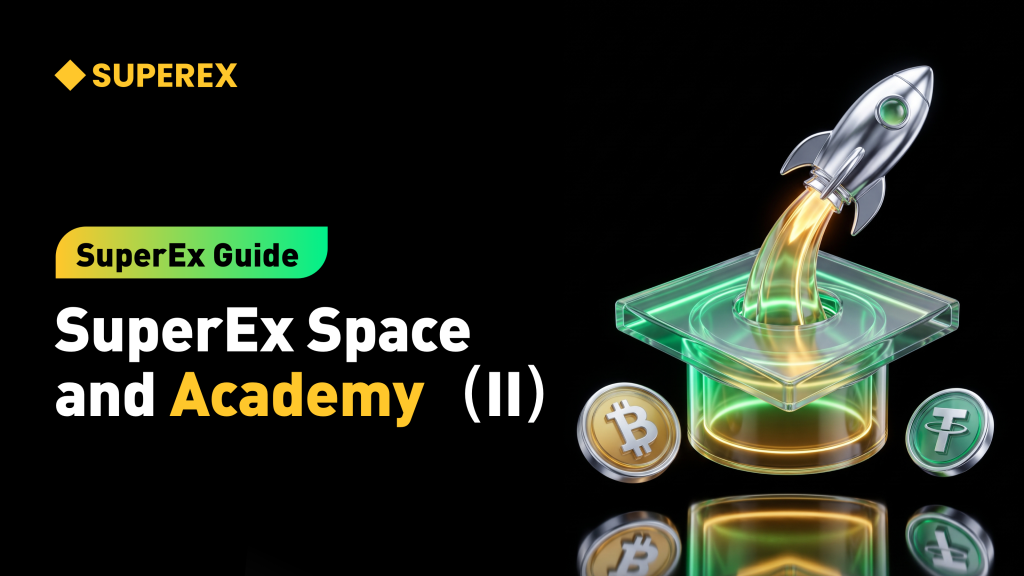
SuperEx Guide: How to Learn More Efficiently at SuperEx Academy


#SuperEx #Guide #SuperExAcademy
The crypto market has never lacked information. What is truly scarce is the ability to turn fragmented information into structured knowledge.
Many users read news, monitor prices, and follow market opinions on social media every day. Yet the more information they consume, the more confused their decisions may become. News tells you what happened, and charts show how prices changed, but neither necessarily explains the mechanisms behind those movements.
SuperEx DAO Academy was created to help users build a structured learning path covering blockchain fundamentals, market analysis, and trading practice. With a growing collection of courses, indicator tutorials, industry updates, and public classes, the key question is no longer whether learning materials are available, but rather:
- Where should I begin?
- Which content best matches my current level?
- How can I apply what I learn to real market conditions?
- How can I avoid learning a great deal without improving my analytical ability?
This guide explains, from a user’s perspective, how to use SuperEx DAO Academy more efficiently and build a sustainable learning system.

Step 1: Define Your Goal Instead of Starting with the Most Popular Course
Low learning efficiency is often not caused by difficult courses, but by unclear objectives.
Some users want to understand the blockchain industry, while others want to improve their trading skills or learn how to interpret on-chain data and project mechanisms. Starting everyone with the same course will naturally produce different results.
Before entering SuperEx DAO Academy, ask yourself three questions:
- What is my current level?
- What problem do I most want to solve?
- In what scenario will I apply this knowledge?
Based on your objectives, your learning path can be divided into four categories.
Blockchain Beginners: Build a Foundation First
This path is suitable for users who have not yet developed a structured understanding of blockchain, wallets, tokens, mining, or decentralization.
Recommended topics include:
- Basic concepts of blockchain and distributed ledgers
- Differences between centralized and decentralized systems
- Tokens, coins, and stablecoins
- Wallets, addresses, private keys, and seed phrases
- Consensus mechanisms and block confirmations
- Differences among spot, futures, and on-chain trading
The goal at this stage is not to search for immediate trading opportunities, but to build a foundational framework that makes you less vulnerable to misleading market information.
Traders: Learn Around Real Trading Problems
If you already have basic trading experience, you do not need to restart every introductory course. A more efficient approach is to study around the problems you encounter in actual trading.
For example:
- If you struggle to identify trends, study moving averages, trendlines, and market structure.
- If you cannot find suitable entries, study support and resistance, Fibonacci retracement, and volume.
- If you take profits too early, study trend continuation and trailing stops.
- If you frequently chase rallies or panic-sell, study position management and trading psychology.
- If you struggle with range-bound markets, study RSI, Bollinger Bands, and volatility indicators.
This problem-driven approach is more likely to produce useful and lasting knowledge than simply reading courses in publication order.
Web3 Professionals: Focus on Industry Mechanisms
Users who want a systematic understanding of Web3 can move into advanced blockchain courses and in-depth educational content covering:
- How smart contracts operate
- Layer 1, Layer 2, and blockchain scaling
- Cross-chain asset transfers and bridge risks
- DeFi lending, liquidity pools, and automated market makers
- DAO proposals, voting, and treasury governance
- Oracles, RWAs, modular blockchains, and other industry mechanisms
- Tokenomics and project incentive structures
When studying these topics, the goal should not be to memorize terminology. The real objective is to understand how capital, authority, data, and value move among different participants.
Research-Oriented Users: Combine the News and Data Centers
Users focused on market research can combine the Academy’s News Center and Data Center.
The News Center helps users follow policy, market, and industry developments across different countries and regions. The Data Center provides structured information on trading volume, capital flows, and on-chain behavior.
A more efficient research process is:
- Use news to identify what happened.
- Use data to determine whether the event had a measurable impact.
- Use price structure to observe how the market is pricing that impact.
Cross-checking news, data, and price action reduces the risk of making decisions based on a single piece of information.
Step 2: Build Your Own Course Sequence
SuperEx DAO Academy covers foundational courses, advanced knowledge, technical indicators, industry news, data analysis, video lessons, and public classes. Users do not need to complete everything at once. Learning should progress from basic concepts to practical application.
A suitable learning path for most users is:
- Stage 1: Blockchain, wallets, and trading fundamentals
- Stage 2: Candlesticks, trends, support and resistance, and volume
- Stage 3: Common technical indicators
- Stage 4: Position sizing, stop-losses, and trading psychology
- Stage 5: DeFi, cross-chain systems, DAOs, and on-chain mechanisms
- Stage 6: Integrated analysis using news, data, and public classes
The core principle is to understand the language of the market first, learn analytical tools second, and develop independent judgment last.
Step 3: Build a Small Indicator Toolkit Instead of Learning Everything at Once
SuperEx DAO Academy continuously publishes technical indicator lessons and places particular emphasis on crypto-native indicators. Faced with many available tools, users may assume that learning more indicators automatically leads to better analysis.
In practice, combining several indicators with similar functions does not necessarily improve accuracy. It may instead generate conflicting signals.
At the beginning, build a toolkit containing only four categories:
- Trend tools: moving averages or trendlines
- Momentum tools: RSI or MACD
- Volatility tools: Bollinger Bands or ATR
- Volume tools: trading volume or capital-flow indicators
For every indicator you study, answer the following questions:
- What problem is it designed to solve?
- Is it more suitable for trending or range-bound markets?
- Under what conditions does it produce false signals?
- What price information should be used alongside it?
- How should risk be controlled if the signal fails?
Effective indicator learning is not about memorizing parameters and formulas. It is about knowing when an indicator is useful and when it should be ignored.
Step 4: Use a Learn, Validate, and Review Cycle
Simply reading a course can create the illusion that the material has already been mastered. Turning knowledge into ability requires at least three steps.
Learn: Understand the Core Logic
When reading a course, record only three things:
- What problem does the tool or concept solve?
- What conditions are required for it to work?
- Under what conditions might it fail?
Validate: Find Examples on Real Charts
After studying trendlines, RSI, or another indicator, open the SuperEx chart and search for historical examples across different timeframes and assets.
Do not look only for successful examples. Actively search for failed signals as well, because they often reveal the real limitations of an analytical tool.
Review: Record Your Judgment and the Market Outcome
Create a simple learning journal containing:
- The market environment at the time
- The analytical tools used
- Your conclusion
- The actual market outcome
- Why the conclusion was correct or incorrect
Over time, reviewing your decisions is often more valuable than learning several additional indicators because it reveals recurring weaknesses in your analysis.
Step 5: Treat Public Classes as Integrated Training
SuperEx DAO Academy’s public classes use live sessions and AMAs to explain course material, industry trends, and market issues.
The value of a public class is not simply hearing the instructor’s conclusion. It is observing the analytical process:
- How a market question is broken down
- How useful information is selected
- How macro events, on-chain data, and price structure are combined
- How uncertainty is handled
- How risk boundaries are established
Before joining a public class, users can review the relevant course material and prepare questions. After the session, they can organize their notes using the recording and written materials. Users who miss the live class can review the course recording on Space.
The combination of preparation, live understanding, and post-class validation can significantly improve learning efficiency.
A Practical 30-Day Learning Plan
If you are unsure how to organize your learning, consider the following schedule:
- Week 1: Complete foundational courses on blockchain, wallets, spot trading, and futures.
- Week 2: Study candlesticks, trends, support and resistance, and volume.
- Week 3: Select three or four indicators and validate them on real charts.
- Week 4: Study position management, risk control, and trading psychology, then complete a full review.
You do not need to spend hours studying each day. A consistent 30 to 45 minutes of learning combined with one chart-based validation exercise is generally more effective for long-term retention.
The Academy Provides Knowledge, Not Decisions
The courses, data, news, and public classes provided by SuperEx DAO Academy are designed to help users understand the market, not to predict it on their behalf.
Technical indicators cannot guarantee that prices will rise or fall, and on-chain data alone cannot determine trading direction. Mature learning should lead to:
- Avoiding impulsive reactions to market trends
- Recognizing risk during periods of volatility
- Understanding the limitations of analytical tools
- Making decisions based on clear evidence
- Knowing how to control losses when a judgment is wrong
Conclusion
Efficient learning is not about completing the greatest number of courses in the shortest time. It is about ensuring that each learning session solves a real problem.
SuperEx DAO Academy has established a learning ecosystem that combines foundational courses, advanced content, technical indicator education, industry news, data services, video lessons, and public classes. Users can select content based on their experience level and gradually turn knowledge into analytical ability through chart validation, review journals, and public-class discussions.
In the crypto market, short-term information may create a temporary opportunity, but long-term, structured learning is what helps users develop judgment that can endure different market cycles.
SuperEx DAO Academy: https://news.superex.com/
Disclaimer: This article is intended solely for educational purposes and product information. It does not constitute investment, trading, or financial advice. Digital assets are highly volatile, and all trading strategies and technical indicators may fail. Users should make independent decisions based on their experience, financial circumstances, and risk tolerance.

Responses