
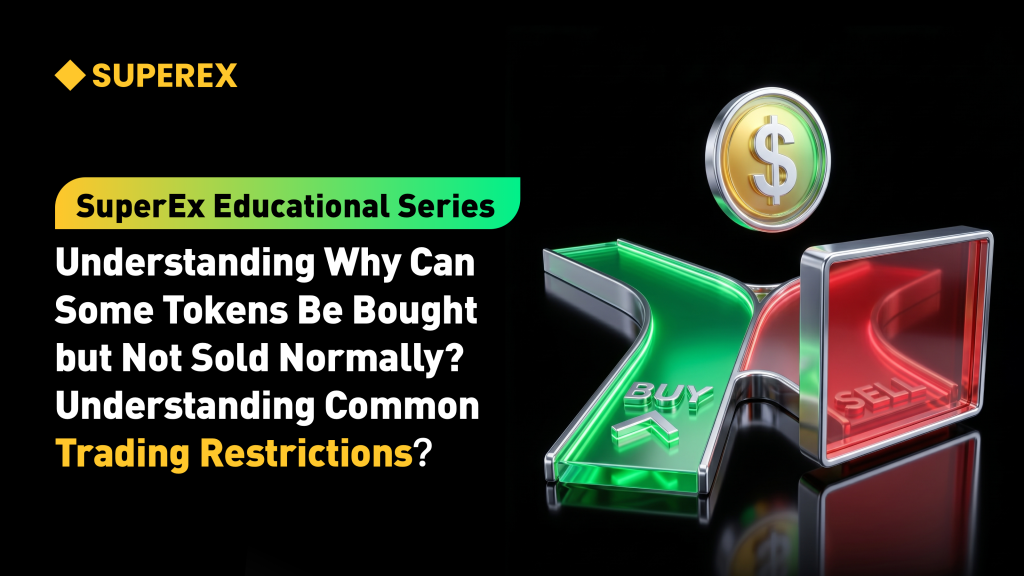
SuperEx Educational Series: Understanding Why Can Some Tokens Be Bought but Not Sold Normally? Understanding Common Trading Restrictions

#SuperEx #EducationalSeries #Tokens
After buying a token, its displayed price starts rising. You open your wallet and mentally begin calculating your profit.
Then you click Sell, and the transaction fails.
You increase the slippage, but it still fails. You switch to another DEX and increase the gas fee, yet nothing works. Other people appear to be buying, the chart keeps climbing, but the exit door seems to have been welded shut.
This situation is often described with one word: “honeypot.” But the real causes are more varied.
Some tokens deliberately block selling at the contract level. Some technically permit selling but use extreme taxes, blacklists, or transaction limits to make it practically impossible. Others are not intentionally malicious at all, but suffer from insufficient liquidity, incompatible routing, or incorrect transaction settings.
Being able to buy does not prove that you can sell. A displayed price does not mean the market is willing to absorb your tokens at that price.
On-chain markets do not offer unconditional returns. Before pressing Buy, the existence of an exit may matter more than how crowded the entrance appears.

Why Are Buying and Selling Not the Same Operation in Reverse?
Many users naturally assume that if a token can move from a liquidity pool into their wallet, it should also be able to move from their wallet back into the pool.
A smart contract, however, can identify and process these two directions differently.
In an automated market maker, a purchase generally involves the liquidity pool sending tokens to the buyer. A sale involves the user sending tokens back to the pool before the router completes the exchange.
The token contract can inspect both sender and recipient. If the sender is the liquidity pool, it can classify the transfer as a buy. If the recipient is the pool, it can classify it as a sell.
This means a contract can enforce asymmetric rules:
- Buying is allowed, but selling is rejected.
- Buying has a small fee, while selling has an extreme fee.
- Selected addresses can sell, while ordinary users cannot.
- The deployer’s wallets are exempt, while new buyers are automatically blacklisted.
Blockchain transparency does not prevent developers from writing such rules. Transparency means that code, state, and transactions can be observed. It does not guarantee that the code is fair.
Smart contracts faithfully execute their rules, including rules deliberately designed to trap users. “Code is law” sounds impressive, but if the law says only the project team may use the exit, that is not much of a free market.
How Is a Token Technically Prevented from Being Sold?
The most direct method is to reject sell transactions inside the token’s transfer logic.
When a user attempts to send tokens to a known liquidity pool, the contract can revert the transaction. The wallet may simply display “Transaction Failed,” “Unable to Estimate Gas,” or an error message that most users cannot reasonably interpret.
Another method is sell whitelisting.
The project team can maintain a list of approved trading addresses. The deployer, market-making wallets, and addresses used to generate transaction history can buy and sell normally, while ordinary users can only buy. The chart may still show sell transactions, making the token appear tradable.
Seeing another address sell successfully does not prove that your address has the same permission.
Attackers may use multiple wallets to simulate organic trading. Some addresses buy, others sell, and the chart moves in both directions. Once real users enter, restrictions can be applied specifically to them.
Another common design is a blacklist. An administrator can mark selected addresses as restricted, preventing them from transferring tokens or interacting with a liquidity pool.
A blacklist or pause function is not automatically malicious. Regulated assets may need to freeze stolen funds, while projects may pause transfers during an exploit.
The important question is not merely whether administrative power exists. It is who controls it, when it can be used, whether the rules are disclosed, and whether the authority is constrained by multisignature approval, timelocks, or governance.
If an anonymous administrator can blacklist any holder, change fees, or disable selling without disclosure or checks, users face more than market risk. They also face administrator risk.
A Sell Transaction Being Possible Does Not Mean Selling Is Economically Normal.
Some tokens do not reject selling outright. Instead, they make selling economically meaningless.
The clearest example is an extreme sell tax. If a user sells tokens nominally worth 1,000 USDT, the contract may deduct 90% or nearly 100% during the transfer, leaving only a small amount to reach the liquidity pool.
From an on-chain perspective, the sale may be “successful,” and the user may receive something. But this is clearly not a normal market exit.
Worse, the tax rate may be adjustable. An administrator can initially set a low rate so early tests and small trades succeed, then sharply increase it after more liquidity arrives.
Transaction limits can create a similar result.
A contract may impose a maximum sell amount, restrict users to one trade per block, require a waiting period after purchase, or cap wallet balances. Some of these rules may be intended as anti-bot measures, but if they are undisclosed or prevent a reasonable exit, they can trap holders in their positions.
Another form of “cannot sell” is not caused by a contract restriction. The market simply cannot absorb the order.
An automated market maker derives prices from the relationship between the assets held in its pool. The displayed price is generally a marginal price, not a guarantee that the entire position can be sold at that level. The larger the position and the shallower the pool, the greater the price impact.
For example, a wallet interface may value a user’s holdings at 100,000 USDT, while the pool contains only 5,000 USDT available on the other side. That valuation is extrapolated from the latest marginal price. It does not mean that 100,000 USDT is waiting in the pool.
If liquidity providers remove more liquidity, users may receive extremely poor quotes or lose the swap route entirely.
Increasing slippage tolerance may sometimes allow a transaction to execute, but it does not necessarily solve the underlying problem.
Slippage tolerance means the user is willing to accept a worse execution result. Raising it from 1% to 30% does not create liquidity. It merely tells the router, “I will accept a much worse price.” If the failure comes from a blacklist or a sell-blocking contract, higher slippage does nothing at all.
Some fee-on-transfer, rebasing, or non-standard tokens may also be incompatible with a particular router. A user might therefore buy successfully through one path but repeatedly fail when attempting to sell through another.
Using an official router that supports the token’s mechanism may solve such a problem. Until the cause is understood, however, users should not keep raising slippage or approving unfamiliar contracts. The market does not become reasonable merely because someone clicks Retry enough times.
Case Study: How Can a Chart Be Engineered to Only Go Up?
Suppose a new token called XYZ creates a trading pool. The project team adds 10,000 USDT and a quantity of XYZ as initial liquidity, then promotes it on social media as “the next 100x token.”
To make the market look organic, several team-controlled wallets execute small buys and sells. These addresses are whitelisted, so they can trade in both directions. The chart shows volume, and sell transactions genuinely appear on-chain.
Ordinary users see the rising price and confirm that “someone successfully sold,” so they begin buying.
Each purchase removes XYZ from the pool and adds USDT, pushing the quoted price higher. Wallet valuations rise, and more users post screenshots of their gains. The mood reaches the familiar stage of “buy now or regret forever.”
When an ordinary user attempts to sell, the XYZ contract detects that the recipient is the liquidity pool and that the sender is not whitelisted, so the transaction reverts.
From the outside, buy orders continue entering while ordinary sell orders cannot execute. The price naturally keeps rising. This is not evidence of endless demand. It is a market with only one open direction.
After more USDT accumulates in the pool, the project team can use exempt addresses to sell large quantities of tokens or remove the liquidity it originally provided.
The displayed price then collapses. More precisely, the earlier price may never have been fully realizable. It was a number users could observe, but not a price at which they could normally exit.
Before Buying, How Can Users Check Whether an Exit Exists?
The most effective approach is to look beyond the name, logo, and chart. Users should verify the contract address, trading rules, administrative powers, and actual liquidity.
Many tokens can share the same name, and logos can be copied. Users should obtain the contract address from verified project channels and confirm that it matches the address shown by block explorers, trading platforms, and liquidity pools.
Next, users should examine whether the contract can modify taxes, pause transfers, manage blacklists or whitelists, change transaction limits, or upgrade its implementation.
The existence of such functions does not automatically prove malicious intent. But the greater the authority, the more users need to know who controls it, whether it is protected by a timelock or multisignature wallet, and how those powers have been used historically.
Market capitalization must also be distinguished from liquidity.
A token can display a huge fully diluted valuation while having very little usable liquidity. When evaluating exit conditions, users should examine actual pool reserves, estimated price impact, whether liquidity is locked, and whether a few addresses control most tokens or liquidity positions.
A small test sale can provide useful information, but it is not absolute proof of safety.
A contract may allow only small sells, activate restrictions after a delay, or let an administrator change parameters after testing. Some malicious contracts apply different rules to whitelisted wallets and ordinary users.
A reasonable conclusion is not, “I tested with ten dollars, so it must be safe.” Test trades should be considered together with contract permissions, liquidity depth, holder concentration, and project transparency.
If a token cannot be understood or verified and its only safety evidence is “everyone in the group says it can be sold,” the most reliable risk control may be not buying it at all.
Taking SuperEx as an Example: Open Markets Still Need Review and Continuous Risk Control
Take SuperEx as an example. Its Free Market provides a more open trading entry for new assets, but openness does not mean abandoning risk identification.
According to SuperEx’s Free Market rules, assets undergo basic verification before listing, and non-compliant tokens may be rejected. If significant loss risks, false information, or other violations are identified during trading, the relevant trading pairs may be forcibly delisted. SuperEx Free Market FAQ
SuperEx also conducts ongoing reviews of listed projects and may suspend or delist trading based on project conditions and market performance. This reduces the chance that clearly abnormal assets remain available indefinitely and provides an additional layer of risk filtering compared with directly copying a contract address into an on-chain trading interface. SuperEx delisting announcement
No review process can reduce new-asset risk to zero. In an open market, tokens remain controlled by their own smart contracts, which may contain different fees, permissions, and trading mechanisms.
The platform provides basic review, risk monitoring, and abnormal-event response. Users must still verify asset information, understand trading rules, and size positions according to their risk tolerance. Mature risk management does not promise that nothing can ever go wrong. It improves detection before an incident and limits the impact afterward.
Conclusion
There are three fundamentally different reasons why a token may be purchasable but not normally sellable.
First, the contract may directly prevent ordinary users from transferring tokens to the liquidity pool through sell switches, whitelists, or blacklists.
Second, transactions may technically execute, but extreme taxes, maximum sell limits, or cooldown rules make exiting difficult or economically meaningless.
Third, the contract may permit selling, but shallow liquidity, removed liquidity, severe price impact, or router incompatibility prevents the sale from completing as expected.
All three situations may appear in a wallet as “Sell Failed,” but their risk profiles are very different. One is an access-control problem, one is an economic restriction, and one concerns market capacity or technical compatibility.
Users need to understand more than how much a token has risen. They need to know how its price is formed, who can change the trading rules, how much real exit liquidity exists, and whether ordinary holders operate under the same rules as the project team.
Ultimately, a healthy market is not one where the price can only rise. It is one where buyers and sellers can enter and exit under transparent rules.
A place that lets everyone enter but prevents them from leaving is usually not an opportunity. In simpler terms, it is a toll station with an entrance but no exit.
About SuperEx
SuperEx is committed to building a Web3-centered digital asset ecosystem, providing global users with crypto trading, Web3 wallet, DAO, earning, and educational services. Through trading infrastructure, asset review, continuous risk monitoring, and security education, SuperEx aims to help users understand digital asset markets and participate more responsibly.
Click to register SuperEx
Click to download the SuperEx APP
Click to enter SuperEx CMC
Click to enter SuperEx DAO Academy — Space


Responses