
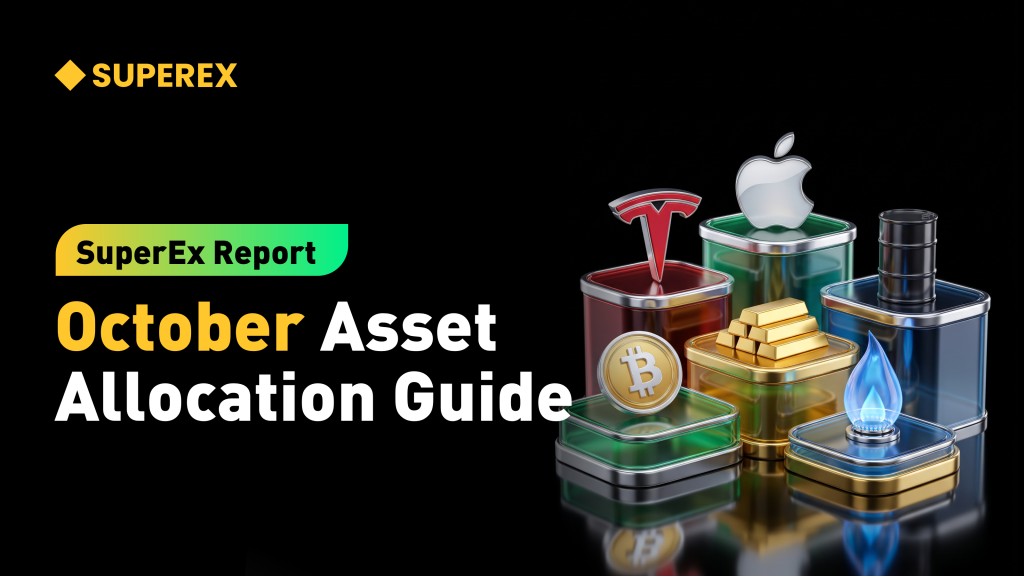
SuperEx Report: September Asset Allocation Guide


#SuperEx #Report #September
Data Scope
This article was prepared on September 3, 2026. U.S. equity data is based on the September 2, 2026 market close; crypto market data is based on CoinMarketCap’s live data on September 3; ETF flow data is based on Farside Investors figures available through September 2, 2026.
As September 2026 begins, the key question is no longer simply whether markets can continue rising, but how investors should rebalance after a sharp rebound.
Crypto assets saw a strong recovery in August. According to OpenBitcoin, BTC reached a monthly high of USD 81,354 and closed the month near USD 78,558. CoinMarketCap’s August 31 historical snapshot showed BTC at USD 78,548.63 and ETH at USD 2,466.82. Compared with August 1, BTC gained about 25.15%, while ETH rose around 33.82%.
However, after entering September, the market has moved into a more practical phase: high-level consolidation, macro repricing, and diverging capital flows. For users, September is not a month for one-way market assumptions, but for managing risk through asset allocation.

September Market Environment
As of the U.S. market close on September 2, AP News reported that the S&P 500 closed at 7,666.60, the Dow Jones at 53,061.95, and the Nasdaq Composite at 26,217.83, with all three major indexes rising around 0.5%–0.6% on the day. However, Treasury yields remained elevated, with the 10-year U.S. Treasury yield near 4.78%, while Brent crude settled at USD 95.63.
On the crypto side, CoinMarketCap data on September 3 showed total crypto market capitalization at approximately USD 2.63 trillion, with 24-hour volume of around USD 77.18 billion. BTC traded near USD 77,858.82, ETH near USD 2,404.48, BTC dominance stood at about 59.6%, ETH dominance at 11.2%, and the Fear & Greed Index was 72/100.
These figures show that the market has not entered a systemic downturn, but risk appetite is no longer expanding as one-sidedly as it did in late August. BTC’s pullback from above USD 81,000 to around USD 78,000 is a normal repricing after a strong rally. Meanwhile, a Fear & Greed reading of 72 suggests that users should avoid undisciplined buying when sentiment is already elevated.
ETF Flows: Institutions Remain Active, but Flows Are Diverging
spot Bitcoin ETFs recorded approximately USD 3.539 billion in net inflows in August, while spot Ethereum ETFs saw around USD 1.837 billion in net inflows. These flows were among the key drivers behind BTC and ETH strength in August.
After September began, ETF flows became more volatile. Bitcoin ETFs recorded USD 236.5 million in net outflows on September 1, then reversed to USD 101.1 million in net inflows on September 2. Ethereum ETFs saw USD 8.6 million in net inflows on September 1, followed by USD 48.2 million in net outflows on September 2.
This indicates that institutional capital has not left the market, but has shifted from August’s steady inflow pattern to a more cautious “wait-and-see” approach. For September allocation, whether ETF flows return to consistent net inflows will be a key signal for whether BTC and ETH can maintain higher price ranges.
Macro Variables: Rates Are the Real September Theme
At its July 29 meeting, the Federal Reserve kept the federal funds rate target range unchanged at 3.50%–3.75%. However, the vote was 9–3, with three members favoring a 25-basis-point hike. This shows that the Fed remains divided on inflation risks.
BLS data showed that U.S. CPI rose 0.1% month-over-month and 3.4% year-over-year in July, while core CPI rose 0.2% month-over-month and 2.5% year-over-year. Although inflation has cooled compared with earlier periods, the renewed rise in energy prices means the market cannot ignore the risk of re-acceleration.
Next, the U.S. August nonfarm payrolls report on September 4, PPI on September 10, CPI on September 11, and the September 15–16 FOMC meeting will jointly determine how markets reprice the interest-rate path.
September Asset Allocation Framework
SuperEx believes the core of September allocation is not choosing between offense and defense, but building a clearer portfolio structure: core assets for long-term exposure, stablecoins and cash-like assets for liquidity, and high-beta assets for opportunity capture.
- For conservative users, a higher allocation to stablecoins or cash-like assets may be appropriate, for example 40%–50%; BTC and ETH exposure around 30%–40%; stable yield products around 10%–20%; and high-beta assets limited to 0%–10%. The focus of this structure is capital protection and preserving the ability to reallocate during market pullbacks.
- For balanced users, BTC and ETH may account for 40%–50%, stablecoins or cash-like assets 25%–35%, equities or equity-like assets 10%–20%, and highly liquid altcoins 10%–15%. This structure suits users who want market participation while avoiding excessive volatility before key macro data releases.
- For aggressive users, BTC and ETH can remain the main positions, while part of the portfolio may be allocated to highly liquid assets such as SOL and LINK. However, short-term trading or futures strategies should not exceed 10%–15% of total assets. Around nonfarm payrolls, CPI, and the FOMC meeting, using high leverage to bet on direction is not recommended.
Key Asset Watch
BTC remains the core anchor of crypto allocation in September. After its strong August rally, BTC has pulled back from above USD 81,000 to around USD 78,000. The near-term focus is whether it can hold its high-level consolidation range and whether ETF flows can return to sustained net inflows.
ETH has shown higher upside elasticity than BTC, but also higher volatility. ETH outperformed BTC in August, suggesting that institutional and market capital has begun expanding from a BTC-only narrative toward a broader crypto portfolio. However, early September Ethereum ETF flows have been mixed, making phased allocation more appropriate than emotional chasing.
Stablecoins are not simply “cash on the sidelines”; they are strategic assets. During high-volatility months, stablecoins can be used for spot accumulation, futures margin management, yield allocation, and rapid redeployment when market dislocations appear.
U.S. technology assets still have long-term logic, but are more rate-sensitive in the short term. AI, semiconductors, and large-cap technology stocks remain important equity themes, but with the 10-year Treasury yield near 4.8%, high-valuation assets face stronger valuation pressure.
SuperEx September Allocation View
SuperEx believes September is not necessarily a signal that the bull market has ended, but rather a macro stress test after assets have reached elevated levels. For most users, it is more important to reduce single-asset concentration, preserve stablecoin liquidity, lower leverage, and wait for key data to confirm market direction.
If September employment data weakens, CPI does not rebound meaningfully, and Treasury yields retreat, risk assets may regain support.
But if oil prices continue pushing inflation expectations higher and the Fed sends a more hawkish signal, both equities and crypto assets may face deeper corrections.
Therefore, the more practical allocation principles for September are: avoid going all-in, avoid overconcentration in a single asset, avoid high-leverage trades before macro data, preserve stablecoin liquidity, build core positions in phases, and increase offensive exposure only after data confirms the direction.
Conclusion
The essence of asset allocation is not predicting every daily move, but improving capital resilience and efficiency amid uncertainty.
Opportunities still exist in September, but they will come with volatility. For most users, a practical strategy is to maintain market exposure through BTC and ETH, preserve optionality through stablecoins, improve idle-capital efficiency through yield products, and use a smaller allocation for high-beta opportunities.
In a month of market repricing, those who control drawdowns are more likely to capture the next trend.
Disclaimer
The content of this article is for market research and informational purposes only and does not constitute investment advice, trading advice, financial advice, or legal advice. Crypto assets, equities, and related financial products are highly volatile and may be affected by macro policies, market liquidity, regulatory changes, technical risks, and unexpected events.
Users should make independent decisions based on their own financial situation, risk tolerance, and investment objectives, and consult professional advisors when necessary. SuperEx shall not be liable for any direct or indirect losses arising from the use of this content.
About SuperEx
As the world’s first Web3-powered cryptocurrency exchange, SuperEx has remained committed to building the Web3 ecosystem. Over the years, it has introduced a comprehensive range of products and services, including SuperEx DAO, SuperEx Web3 Wallet, Super Start, SuperEx P2P, SuperEx Stock Markets, SuperEx Copy Trading, SuperEx Earn, and SuperEx DAO Academy, creating a full-spectrum ecosystem that spans every major sector of Web3.
Today, SuperEx serves over 10 million users, with a social media community of more than 600,000 followers across 166 countries and regions worldwide. The platform supports 1,000+ cryptocurrencies for both spot and futures trading. Seamlessly integrated with Super Wallet, SuperEx provides decentralized asset custody while combining the trading efficiency of a centralized exchange (CEX) with the security of a decentralized exchange (DEX).
Click to register SuperEx
Click to download the SuperEx APP
Click to enter SuperEx CMC
Click to enter SuperEx DAO Academy — Space



Responses