
SuperEx Educational Series: Understanding Data Tokenization

#SuperEx #EducationalSeries #DataTokenization
When people hear “Data Tokenization,” the first reaction is often: turn data into tokens and trade them. Easy.
Not quite. Data is not a gold bar that can simply be split into 100 pieces. Data can be copied, expire, leak, be recombined, and become legally sensitive. It looks like an asset, but managing it can quickly become a full drama series.
So let’s go deeper:Data Tokenization is not about “putting files on-chain,” nor is it about casually financializing data. It is about turning the rights, access, usage, revenue, and restrictions around data into programmable, verifiable, and tradable on-chain structures.
What Is Data Tokenization?
In the Web3 context, Data Tokenization means representing data assets or data-related rights as on-chain tokens, so access rights, usage rights, revenue rights, governance rights, or computation rights can be managed, transferred, priced, and composed.
Importantly, what is tokenized is usually not the raw data itself. The raw dataset may still live in cloud storage, decentralized storage, enterprise databases, APIs, or privacy-preserving compute environments. The token is more like a key, credential, license, revenue claim, or operation permission.
It is like buying a concert ticket. The ticket is not the concert itself. A movie ticket is not the movie file. The ticket represents the right to access something under certain conditions. Data Tokenization follows the same logic, but makes the “ticket” programmable.
Two Meanings of Tokenization
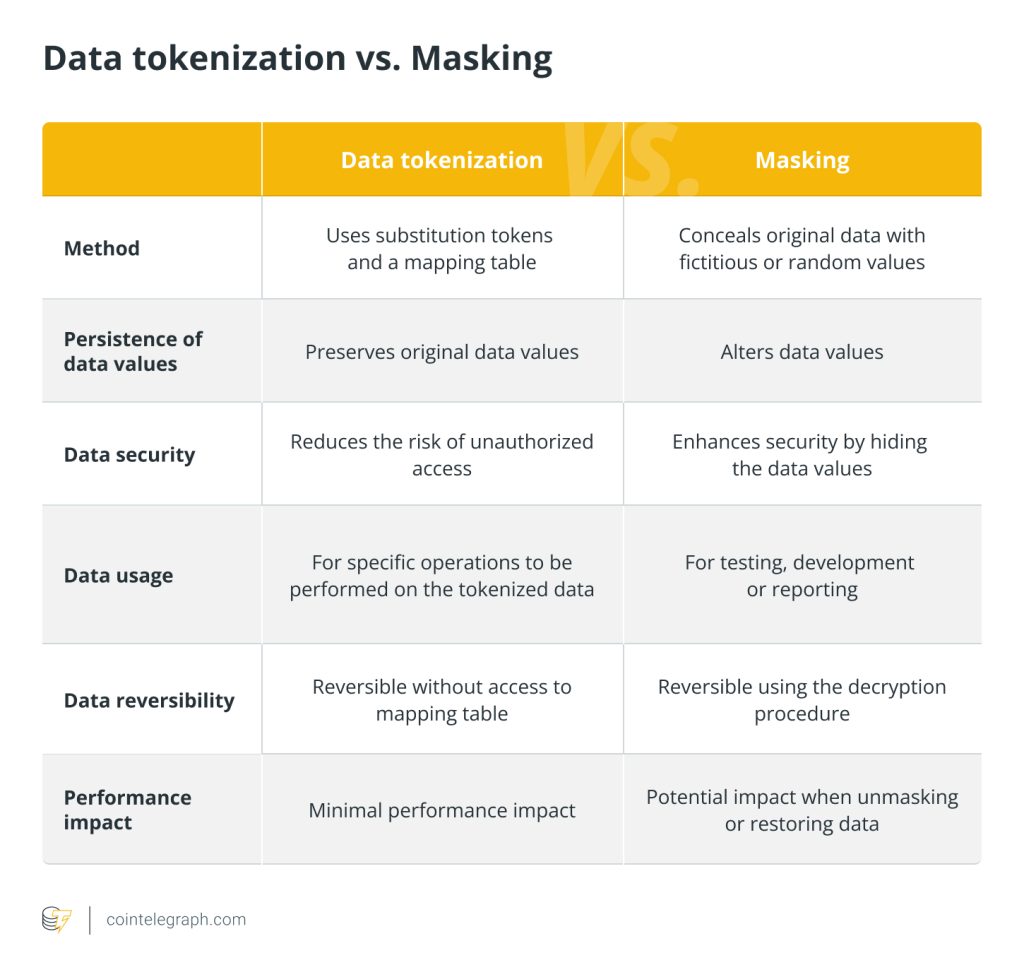
We need to separate two meanings. In traditional data security, tokenization often means replacing sensitive data. For example, credit card numbers, ID numbers, or phone numbers are replaced with tokens, while the raw sensitive values are stored separately and protected.
The goal is to reduce exposure risk and compliance scope. Google Cloud and AWS both describe tokenization as a method for sensitive data protection, de-identification, and reducing security scope.
But in Web3, Data Tokenization usually means tokenizing data assets. It focuses on who can access the data, who can use it, who can compute on it, who receives revenue, and who can transfer those rights.
They are not the same, but they can work together. A mature data tokenization system needs both Web3-based rights representation and traditional security tools like pseudonymization, encryption, key management, and access auditing. Not every token is a tradable coin. Technology has more layers than that.
Concept Interpretation
The core of data tokenization is splitting “data” into multiple manageable rights layers.
The first layer is ownership.
Who published the data? Who owns the underlying IP? Who can update metadata, change the data source, revoke service, or adjust license terms? These rights can be represented through structures like Data NFTs. Ocean Protocol uses ERC-721 data NFTs to represent base control over data assets.
The second layer is access rights.
Who can access the data or call the service? These rights can be represented by ERC-20, ERC-1155, or permissioned tokens. Ocean’s datatoken is a classic example: holding the relevant datatoken grants access to a specific data service.
The third layer is usage rights.
Access does not mean unlimited use. A user may be allowed to view but not download, research but not resell, train an internal model but not a public commercial model. Data Tokenization needs to make license terms machine-readable, enforceable, or at least auditable.
The fourth layer is revenue rights.
When data is purchased, called, or computed on, how is revenue distributed? Should providers, labelers, storage providers, model builders, referrers, or DAO treasuries receive shares? Tokens can split revenue rights, making the data economy more than one-time sales.
The fifth layer is computation rights.
For sensitive data, the best model may not be “download the dataset,” but “bring your algorithm, and run it in a controlled environment.” This is the logic of Compute-to-Data: the data stays, computation moves closer to it, and only results leave.
How It Works
A complete data tokenization flow usually has six steps.
First, data publishing.
The provider uploads or connects a data source and creates metadata, including description, source, format, update frequency, license scope, price, and access method.
Second, rights minting.
The system creates a token representing base control over the data asset, such as a Data NFT, and may also create one or more tokens representing access, subscription, or computation rights.
Third, permission binding.
Smart contracts, access gateways, or data services check whether the user holds the correct token, meets identity conditions, is still within the license period, and has not exceeded usage limits.
Fourth, payment settlement.
Users buy tokens, subscribe to services, or pay per call. Smart contracts can automatically split revenue among providers, maintainers, and ecosystem participants.
Fifth, access or computation.
The user uses the token to access data, call an API, subscribe to a stream, or submit an algorithm to a privacy-preserving compute environment.
Sixth, audit and updates.
The system records who accessed what, when, under which permission, whether revocation happened, and whether data was updated. A data market without auditing becomes a giant “nobody knows what happened” situation when things go wrong.
Why It Matters
Data Tokenization matters because the data economy has long been stuck in a contradiction: data is valuable, but once it is handed over, it is difficult to control.
Traditional data transactions look like one-time delivery. Sellers worry about copying, resale, and misuse. Buyers worry about accuracy, freshness, and compliance. Platforms worry about unclear responsibility. Everyone gets tired, and data liquidity stays low.
Tokenization provides a more granular control model. You do not have to sell the raw data itself; you can sell access. You do not have to allow downloads; you can allow computation. You do not have to charge once; you can charge by usage. You do not have to make rights open to everyone; you can add permission conditions.
This is important for AI, DeFi, RWA, on-chain risk control, and the Agent Economy. AI needs high-quality data, DeFi needs real-time state, RWA needs external proof, and agents need continuous information input. Without a manageable data rights layer, systems end up scraping data, guessing permissions, and hoping responsibility never becomes a problem.
Token Design: The Real Hard Part
The hardest part of data tokenization is not minting a token. It is defining what the token actually represents.
- If the token represents ownership, can the holder delete the data? Change license prices? Move the data to another storage network? If multiple holders co-own it, who governs it?
- If the token represents access, is it permanent or time-limited? One download or repeated calls? Personal use or enterprise use? Can it be transferred? If transferred, does the old holder lose access?
- If the token represents revenue rights, where does revenue come from? Data purchases, API calls, model training, sublicensing, or derivative products? Is revenue split by fixed percentages or dynamic contribution?
- If tokens are freely tradable, they gain liquidity. But if the data involves compliance, privacy, or copyright, free transfer can be dangerous. Some scenarios need permissioned tokens. Standards like ERC-3643 provide frameworks for identity conditions, compliance rules, and transfer restrictions.
This is the deep water: Data Tokenization is not “launching a coin.” It is closer to designing an operating system for data rights.
A Simple Case
Suppose SuperEx wants to build a Web3 risk dataset containing address risk labels, phishing address records, abnormal transaction patterns, bridge failure records, and smart contract risk scores.
In a traditional model, the platform might sell the database directly to institutional clients. But problems appear quickly: will customers resell it? How are updates handled? Who corrects false labels? If data is used outside the license scope, how can anyone detect it?
With Data Tokenization, the design could look different.
SuperEx first mints a Data NFT for the risk dataset. This NFT does not mean anyone can download the data. It represents control over publishing, management, updates, and license configuration.
Then different access tokens are issued.
- A basic token may allow single-address risk checks.
- A professional token may allow batch API calls.
- An institutional token may allow real-time risk stream integration.
- A research token may only allow analysis inside a sandbox.
For sensitive data, SuperEx does not allow raw downloads. Instead, it provides Compute-to-Data. Research institutions can submit models or queries, and the system returns statistics or risk scores without exposing all raw labels.
For revenue, smart contracts can automatically distribute income: part to the data maintenance team, part to contributors who submit valid risk intelligence, and part to an ecosystem fund. The data is not merely “sold”; it becomes part of a sustainable economic loop.
This is what mature data tokenization looks like: clear rights, layered access, controlled data, divisible revenue, and auditable processes.
Common Misunderstandings
The first misunderstanding: Data Tokenization means putting data on-chain.Wrong. Most raw data should not be directly stored on-chain. Blockchains are better for hashes, permissions, payment records, proofs, and token states. The raw data usually belongs off-chain or in specialized data networks.
The second misunderstanding: buying the token means owning the data.Not necessarily. Many tokens only represent access rights or usage licenses, not ownership of the underlying IP. Buying a movie ticket does not mean you own the cinema.
The third misunderstanding: the more tradable the data token, the better.Not always. Liquidity matters, but compliance matters too. Data involving personal information, medical records, financial data, or business secrets may require identity verification, transfer restrictions, and revocation mechanisms.
The fourth misunderstanding: tokens solve data quality problems.Tokens express rights; they do not automatically guarantee accuracy. Data quality still requires source verification, version management, audits, reputation mechanisms, and dispute resolution. Otherwise, bad data just gets a nicer wrapper.
Risks and Limitations
The first risk is legal risk. Data rights are not determined only on-chain. A token may claim to represent ownership, but the data may involve user consent, copyright, trade secrets, or regulatory restrictions. On-chain rights must align with off-chain legal reality.
The second risk is privacy risk. Once data is downloaded, it is hard to truly take back. Even if a token is burned, the buyer may already have copied the data. Sensitive data is better handled through access control, privacy-preserving computation, and watermarking rather than simple downloads.
The third risk is valuation risk. Data value depends heavily on freshness, scarcity, accuracy, and composability. A dataset may be valuable today and outdated six months later. The phrase “data asset” does not automatically mean a wealth machine.
The fourth risk is enforcement risk. On-chain contracts can verify tokens, but off-chain data servers must enforce permissions correctly. Otherwise, a beautiful smart contract can be ruined by one public backend link.
The fifth risk is over-financialization. Data tokenization can improve liquidity, but if speculation matters more than data quality, real demand, and compliance boundaries, the data economy becomes a concept economy. Loud, exciting, and hollow.
Conclusion
The deeper value of Data Tokenization is not turning data into coins. It is turning data-related rights into programmable structures.
It can give data assets clearer ownership, more flexible access rights, automated revenue distribution, controlled usage, and stronger auditability.
But it is not a magic key. Data tokenization only works when combined with privacy protection, compliance rules, identity verification, off-chain enforcement, and data quality management.
In plain words: Data Tokenization is not putting a token skin on data and calling it innovation. Its real job is to turn data from an uncontrollable file into a manageable rights system. That is the infrastructure AI, Web3, RWA, and the Agent Economy actually need.
About SuperEx
As the world’s first Web3-powered cryptocurrency exchange, SuperEx has remained committed to building the Web3 ecosystem. Over the years, it has introduced a comprehensive range of products and services, including SuperEx DAO, SuperEx Web3 Wallet, Super Start, SuperEx P2P, SuperEx Stock Markets, SuperEx Copy Trading, SuperEx Earn, and SuperEx DAO Academy, creating a full-spectrum ecosystem that spans every major sector of Web3.
Today, SuperEx serves over 10 million users, with a social media community of more than 600,000 followers across 166 countries and regions worldwide. The platform supports 1,000+ cryptocurrencies for both spot and futures trading. Seamlessly integrated with Super Wallet, SuperEx provides decentralized asset custody while combining the trading efficiency of a centralized exchange (CEX) with the security of a decentralized exchange (DEX).
- Cick to register SuperEx
- Cick to downoad the SuperEx APP
- Cick to enter SuperEx CMC
- Cick to enter SuperEx DAO Academy — Space

Responses