
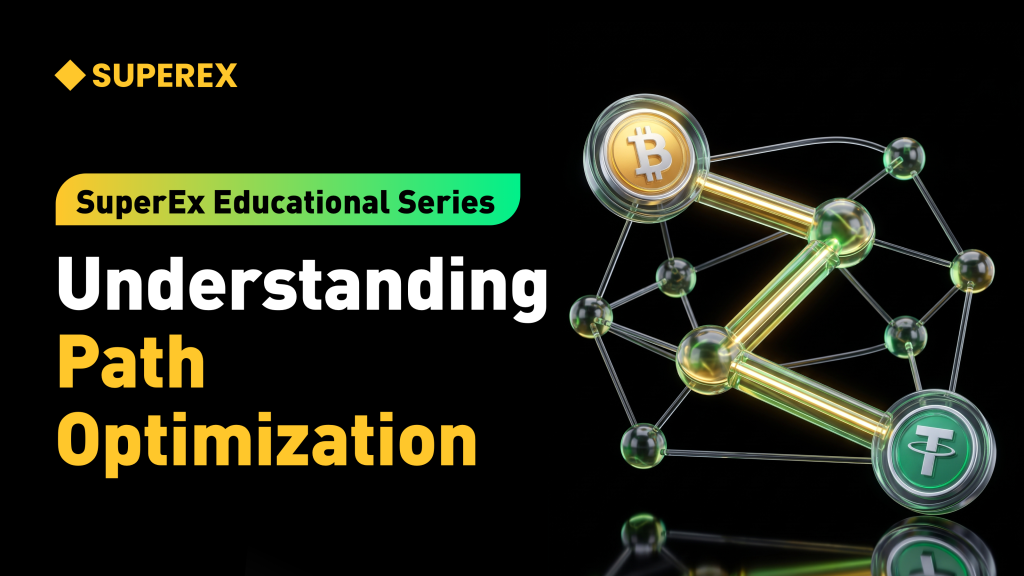
SuperEx Educational Series: Understanding Path Optimization

#SuperEx #EducationalSeries
Path optimization in Web3 is a lot like ordering food delivery.
You think you are just ordering lunch. Behind the scenes, the platform is calculating which restaurant is closer, which one cooks faster, which rider is nearby, which road is less crowded, whether coupons apply, and whether the food will arrive cold. The user sees “estimated delivery: 28 minutes.” The system has already done the spreadsheet gymnastics.
Cross-chain and DeFi work the same way. The user simply says, “I want to swap USDC on Ethereum into ETH on Base.” But the system has to consider bridges, DEXs, gas, slippage, liquidity, message verification, arrival time, security models, and whether a route may suddenly get stuck.
Path Optimization is about exactly this: not just “can it arrive,” but “how can it arrive cheaper, faster, safer, and with fewer surprises.”

What Is Path Optimization?
Path Optimization means selecting the best route, or combination of routes, among many possible trading paths, cross-chain routes, liquidity sources, and execution plans.
Here, “best” does not always mean cheapest. It may mean:
- highest received amount;
- lowest fees;
- fastest execution;
- lowest failure risk;
- stronger security model;
- lower slippage;
- better fit for user or app preferences.
In one sentence: Path Optimization is not just finding a route. It is choosing the least painful route among many possible routes.
How Does It Work?
Think of the multi-chain world as a map.
Chains are cities. DEXs are transfer stations. Bridges are highways. Liquidity pools are gas stations. Solvers are people willing to run the errand for you. Hubs are major transit centers. Every edge has a cost: gas, fees, time, slippage, risk, and failure probability.
Path Optimization turns the user’s goal into a routing problem.
The user says: “I want to turn Token X on Chain A into Token Y on Chain B.”
The system then asks:
- Swap first or bridge first?
- Which bridge?
- Which DEX?
- Should the order be split?
- Should a solver fill it?
- Which route has lower gas?
- Which route gives more output?
- Which route has the right security model?
The system is not choosing by vibes. Good path optimization checks real-time quotes, liquidity, gas, chain status, protocol fees, and reliability data before selecting a route.
In plain English: if the navigation app says “smooth traffic ahead,” it had better have actually checked the road.
Why It Matters
Path Optimization matters because the multi-chain world is already too complicated for users to manually build routes.
Without path optimization, users must decide:
- which bridge is cheaper;
- which DEX has better liquidity;
- whether to swap first or bridge first;
- whether the destination chain has gas;
- what slippage to set;
- whether the route may fail.
That is not user experience. That is an exam.
The value of Path Optimization is that users express intent instead of studying execution details. Users say what they want to receive; the system figures out how to get it done.
This is why intents, solvers, cross-chain aggregators, and smart routing are becoming more important. Future Web3 should not turn users into routers. Users just want to complete actions, not accidentally take a course in cross-chain engineering.
Technical Approaches
The first approach is quote aggregation.
The system queries multiple DEXs, bridges, liquidity networks, and routing services, comparing output, fees, time, and availability. Services like LI.FI provide quotes for same-chain or cross-chain token transfers, including estimated output, minimum output, gas costs, and transaction requests.
The second approach is smart order routing.
A trade does not have to use only one pool. The system can split an order across multiple liquidity sources to reduce slippage and improve output. 1inch Pathfinder and Uniswap Smart Order Router are classic examples: do not force one pool to do all the work; route where execution is better.
The third approach is cross-chain route planning.
A route may be “swap first, then bridge,” or “bridge first, then swap,” or a combination of bridge, DEX, solver, and hub. The system must sequence these steps properly and handle fees, failures, and execution logic.
The fourth approach is split routing.
A large order may move prices badly if executed through one route. Splitting it across routes can produce a better average price. In plain English: do not stuff everyone into one taxi. Sometimes several cars are better.
The fifth approach is solver competition.
The user submits an intent, and multiple solvers compete to execute it. Whoever offers better pricing, faster execution, or lower risk wins. This can create smooth UX, but systems must watch for opaque quotes, failed execution, and centralization.
The sixth approach is policy-based routing.
Some apps do not want the cheapest route. A finance app may prioritize safety. A game may prioritize speed. An institution may require compliant routes. Path optimization should support policies, not blindly chase the lowest fee.
Relation to Hub Routing and Liquidity Networks
Hub Routing solves how messages and actions are forwarded through hubs.
Liquidity Networks solve whether destination liquidity can fulfill the user first.
Path Optimization solves which route should be chosen among many options.
They are not the same thing, but they often work together.
For example, an optimal path may swap through a DEX first, bridge through a liquidity network, then send a state message through a hub.
The user sees one button.
The system is doing layered complexity behind the curtain.
Do not ask whether the user understands it. The user only asks: did it arrive?
A Simple Case
Suppose Alice wants to swap 1,000 USDC on Ethereum into ETH on Base.
The system may see several routes:
- Route A: swap USDC into ETH on Ethereum first, then bridge ETH to Base.
- Route B: bridge USDC to Base first, then swap into ETH on Base.
- Route C: use a liquidity network where a solver sends ETH to Alice directly on Base.
- Route D: split the order, with part through a bridge and part through a solver.
- Route E: looks cheap, but destination liquidity is shallow and slippage is emotionally damaging.
Path Optimization compares:
- how much ETH Alice receives;
- total cost;
- estimated time;
- failure probability;
- whether extra approvals are needed;
- whether the security model is acceptable;
- whether refunds or retries are possible if something fails.
In the end, the system may not choose the route with the lowest visible fee. It may choose the route with the best overall result.
It is like buying a flight. The cheapest one may leave at 3 a.m., include an 18-hour layover, and charge extra for luggage. Cheap, yes. Good life choice, maybe not.
Common Misunderstandings
First misunderstanding: path optimization just means finding the lowest fee.
No. Fees are only one metric. Final output, slippage, gas, time, success rate, and security model all matter. Only watching fees is how people save pennies and step into holes.
Second misunderstanding: shorter routes are always better.
Not necessarily. A short route may have poor liquidity, bad pricing, or higher failure risk. One extra step may sometimes be safer and cheaper.
Third misunderstanding: the aggregator route is always optimal.
Not always. Quotes are real-time snapshots. Chain state changes, gas changes, liquidity changes, and MEV may show up. A route may be optimal at quote time, but not at execution time.
Fourth misunderstanding: split routing is always better.
Not necessarily. Splitting can reduce slippage, but it may increase gas, complexity, and failure points. “Advanced” does not mean free.
Risks and Limitations
First, quote expiration risk.
The market may look one way when the quote is shown and another way when execution happens. Price, gas, and liquidity can all move. DeFi can change very fast.
Second, route failure risk.
In a complex route, one failed step can break the experience. In cross-chain scenarios, failure handling, refunds, retries, and state tracking must be clearly designed.
Third, mixed security-model risk.
A route may pass through a DEX, bridge, messaging protocol, solver, and hub. Every extra component adds trust assumptions and attack surface. Do not only ask “can it route?” Ask “who am I trusting?”
Fourth, black-box risk.
If users cannot understand the route at all and only see “best route,” that is also a problem. Good path optimization should show enough information: expected output, fees, time, major protocols, and failure handling, not just a mysterious button.
Finally, objective-function risk.
When a system says “optimal,” optimal for whom? The user? The protocol? The solver? The integrator’s rebate? If this is unclear, things can get spicy.
Conclusion
The core value of Path Optimization is turning multi-chain and DeFi execution from “users manually researching routes” into “systems selecting better execution plans for users.”
It is not simply finding the shortest route or the lowest fee. It balances cost, speed, received amount, slippage, success rate, security model, and user preference.
If Web3 wants to become truly usable, users should not need to become traffic planners every time they interact. They should express intent: I want to go from here to there, receive this asset, not wait forever, not overpay, and not get wrecked.
Path Optimization hands that job to the system.In plain words: stop making users find the route themselves. They are busy enough.
About SuperEx
As the world’s first Web3-powered cryptocurrency exchange, SuperEx has remained committed to building the Web3 ecosystem. Over the years, it has introduced a comprehensive range of products and services, including SuperEx DAO, SuperEx Web3 Wallet, Super Start, SuperEx P2P, SuperEx Stock Markets, SuperEx Copy Trading, SuperEx Earn, and SuperEx DAO Academy, creating a full-spectrum ecosystem that spans every major sector of Web3.
Today, SuperEx serves over 10 million users, with a social media community of more than 600,000 followers across 166 countries and regions worldwide. The platform supports 1,000+ cryptocurrencies for both spot and futures trading. Seamlessly integrated with Super Wallet, SuperEx provides decentralized asset custody while combining the trading efficiency of a centralized exchange (CEX) with the security of a decentralized exchange (DEX).
- Cick to register SuperEx
- Cick to downoad the SuperEx APP
- Cick to enter SuperEx CMC
- Cick to enter SuperEx DAO Academy — Space


Responses