
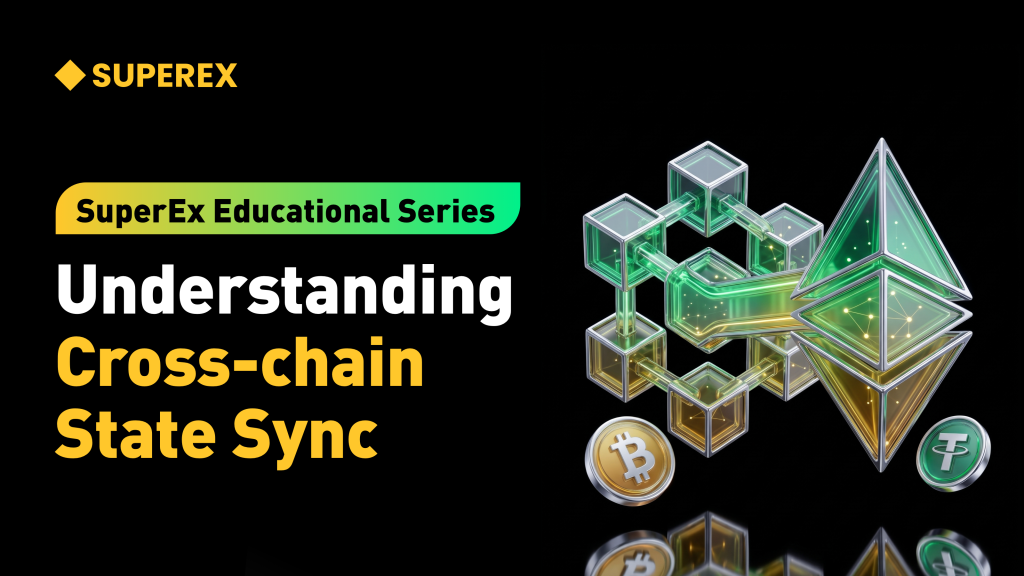
SuperEx Educational Series: Understanding Cross-chain State Sync

#SuperEx #EducationalSeries
A very real problem in the multi-chain world is this: how does Chain B know what happened on Chain A?
You staked assets on Ethereum, and an app on Base wants to give you benefits. You voted on Arbitrum, and a governance contract on another chain wants to read the result. You repaid a loan on one chain, and a credit system on another chain needs to update your record. It sounds like “just sync it,” but blockchains do not naturally share a group chat.
Cross-chain State Sync solves exactly this problem: it allows state changes on one chain to be securely and verifiably recognized and used by another chain.
- Cick to register SuperEx
- Cick to downoad the SuperEx APP
- Cick to enter SuperEx CMC
- Cick to enter SuperEx DAO Academy — Space

What Is Cross-chain State Sync?
Cross-chain State Sync means synchronizing state, events, proofs, or execution results from one blockchain to another, so smart contracts on the destination chain can continue executing logic based on that information.
Here, “state” does not only mean balances. It can include:
- whether an address holds an NFT;
- whether a user has passed KYC;
- whether a governance proposal passed;
- whether a loan has been liquidated;
- whether a cross-chain message has been executed;
- whether an asset has been locked or burned on the source chain.
In one sentence: cross-chain state sync is not just moving assets. It lets one chain trustlessly or trust-minimizedly understand what happened on another chain.
How Does It Work?
The core idea is sending both “what happened” and “how to prove it happened.”
The process usually has four steps.
- First, the source chain produces a state change, such as locking assets, completing a vote, or updating an identity credential.
- Second, that change is recorded as an event, message, state root, or commitment.
- Third, a relayer, oracle network, or cross-chain protocol delivers the information to the destination chain.
- Fourth, the destination chain verifies it through a light client, Merkle proof, validator signature, ZK proof, or risk-management network, then updates its local state.
The key is not merely that “the message arrived.” The key is why the destination chain should believe it. If a centralized server simply says, “I saw it,” the trust cost is high. If the destination chain can verify a proof from the source chain, the security model is stronger.
Why It Matters
The real difficulty of multi-chain apps is not only fragmented assets. It is fragmented state.
If state cannot sync, users have to start over on every chain. A membership on Ethereum is invisible on Base. A credit record on Arbitrum is not recognized on Optimism. A liquidation result on one chain may not be reflected on another.
Cross-chain State Sync moves multi-chain applications from isolated systems toward coordinated operation. It is foundational for cross-chain lending, governance, multi-chain accounts, on-chain identity, RWA compliance, cross-chain gaming, and omnichain applications.
Technical Approaches
The first approach is light clients and state proofs.
The destination chain runs or references a light client of the source chain, using headers, consensus states, and Merkle proofs to verify source-chain state. IBC is a classic example: it uses light clients and relayers to transmit and verify cross-chain packets.
The second approach is cross-chain messaging.
A protocol delivers messages from a source chain to a destination chain, where a receiving contract executes logic based on the message. For example, CCIP supports arbitrary messaging, token transfers, and programmable token transfers that combine tokens with data.
The third approach is ZK state proofs.
Source-chain state or execution results can be compressed into a verifiable zero-knowledge proof. The destination chain verifies the proof without re-executing the full process.
The fourth approach is optimistic sync.
The destination chain accepts a message first, but leaves a challenge window. If someone detects an invalid update, they can submit a fraud proof or challenge.
The fifth approach is oracle or indexer-based sync.
Off-chain nodes observe source-chain state and submit results to the destination chain. This is flexible and cost-efficient, but its security depends on the node network, signature threshold, risk controls, and governance design.
Difference from Bridges
A bridge usually focuses on moving assets from Chain A to Chain B through locking, minting, burning, or releasing.
Cross-chain State Sync is broader. It does not only sync assets. It may sync voting results, identity status, order state, contract variables, NFT ownership, or account permissions.
In simple terms: a bridge is one application of cross-chain state sync, but state sync is not the same as a bridge.
A Simple Case
Suppose Alice holds a SuperEx membership NFT on Ethereum. SuperEx wants Alice to receive fee discounts on Base as well, but the contract on Base does not naturally know what happened on Ethereum.
Without cross-chain state sync, Alice may need to manually submit screenshots, or the platform may record her membership in a centralized database. That is neither very on-chain nor very trust-minimized.
With cross-chain state sync, Alice’s membership status on Ethereum can be proven and delivered to Base. The contract on Base verifies it and updates Alice’s local benefit status. Later, when Alice trades on Base, the system can automatically recognize her membership.
Now consider DeFi. A user deposits collateral on one chain and borrows on another. The borrowing chain must know whether the collateral still exists on the collateral chain, whether its value changed, and whether it has been liquidated. What gets synced is not just balance, but risk state.
Common Misunderstandings
The first misunderstanding is that cross-chain state sync just copies data.
It does not. Verifiability is the key. The destination chain needs to know where the data came from, whether it is finalized, whether it was tampered with, and whether it has already been executed.
The second misunderstanding is that relayers decide whether state is true.
Not exactly. Relayers usually deliver information; they should not be the final source of truth. A better design is: relayers deliver messages, and the destination chain verifies proofs.
The third misunderstanding is that faster sync is always better.
Not always. There is a tradeoff between speed and safety. Waiting for more confirmations can reduce reorg risk, but increases latency. Different apps need different sync speeds.
Risks and Limitations
Cross-chain state sync is not magic. First, there is finality risk. If the source-chain state is not stable yet and the destination chain syncs too early, it may face reorgs or state rollback.
Second, verification has costs. Light clients, ZK proofs, signature checks, and Merkle proofs all require resources. Stronger security may mean higher on-chain verification cost.
Third, message ordering and duplicate execution matter. Cross-chain messages may be delayed, arrive out of order, or be submitted more than once. Systems need nonce, message IDs, timeouts, and replay protection.
Finally, trust models differ. Light clients, oracle networks, multisigs, ZK proofs, and optimistic challenges all have different assumptions. Applications should not only ask “can we sync?” They must ask “who are we trusting?”
Conclusion
The core value of Cross-chain State Sync is turning the multi-chain world from isolated islands into a network where state can be proven and responded to across chains.
It is not simply cross-chain transfer, nor casually moving data around. It allows a fact on one chain to verifiably affect logic on another chain.
Future Web3 applications will become increasingly multi-chain. Accounts, identities, assets, and governance will all exist across chains. Mature infrastructure must make these states sync securely, clearly, traceably, and smoothly.

Responses