
SuperEx Educational Series: Cross-DEX Aggregation

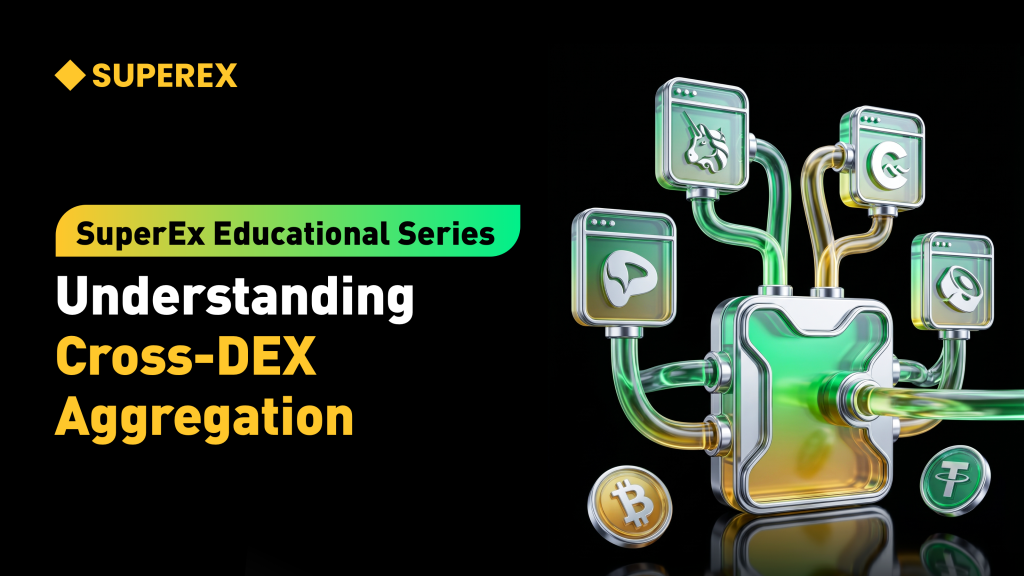
Guys, today we’re going to talk about something that quietly saves crypto users from a lot of bad trades:Cross-DEX Aggregation.
Sounds fancy, right?
Like one of those terms that appears in a DeFi dashboard and makes everyone pretend they totally understand what’s happening.
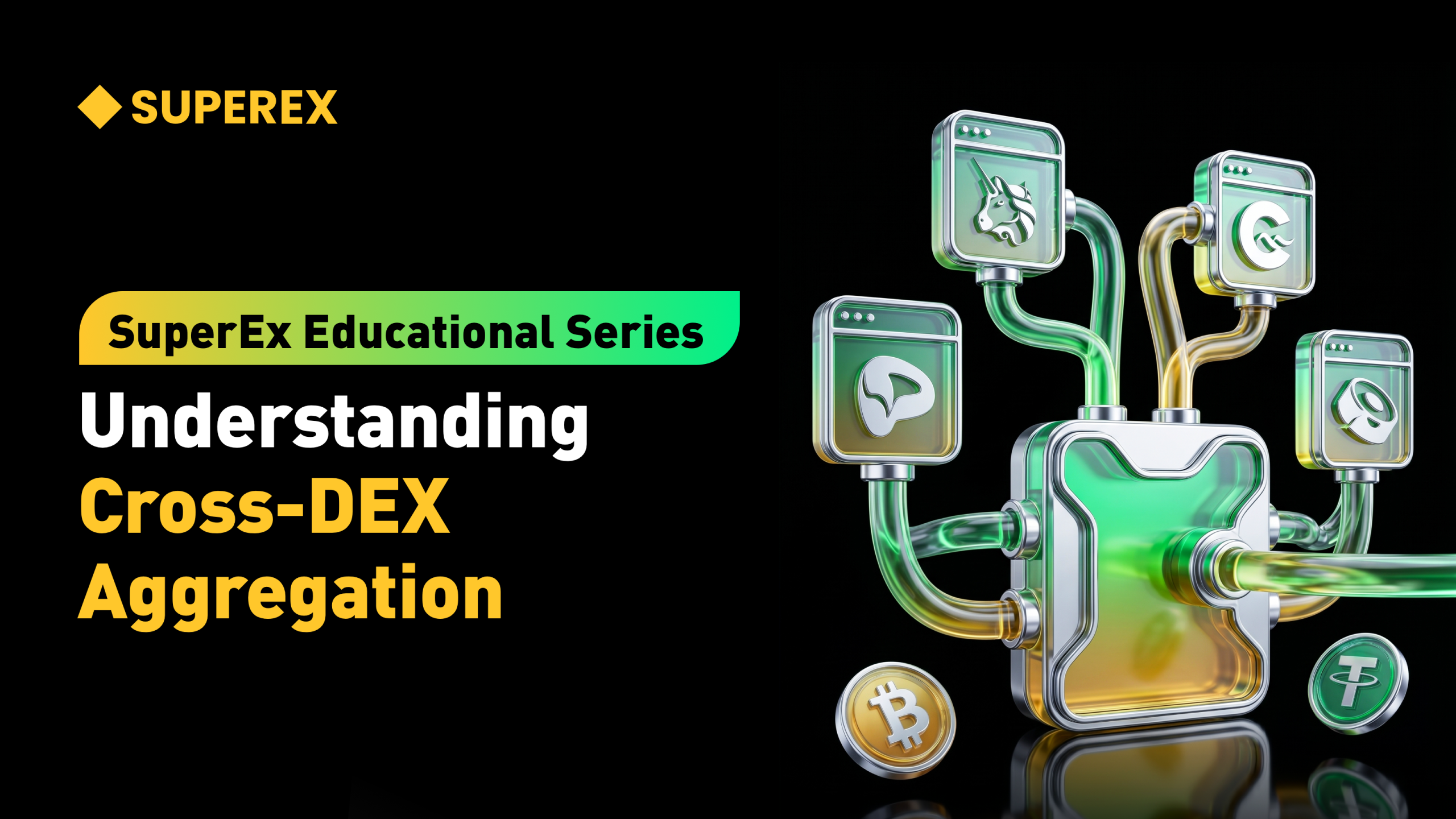
But the idea is actually simple:Instead of checking one decentralized exchange, the system checks multiple DEXs and tries to find the best trading route for you.
That’s cross-DEX aggregation.
And if you’ve ever wondered why two swap platforms show different prices for the same token trade, this is one of the reasons.
- Cick to register SuperEx
- Cick to downoad the SuperEx APP
- Cick to enter SuperEx CMC
- Cick to enter SuperEx DAO Academy — Space
First, What Is a DEX?
A DEX, or decentralized exchange, is a platform where users can trade crypto assets directly through smart contracts.
Unlike centralized exchanges, DEXs usually do not rely on a central order-matching company to hold user assets. Instead, trades happen through on-chain liquidity pools, order books, or other decentralized mechanisms.
Popular DEX models include:
- AMM-based exchanges
- On-chain order book exchanges
- Hybrid liquidity systems
- RFQ-connected DEX routes
The key idea is simple:
Users trade through decentralized infrastructure.
But here’s the problem,There is not just one DEX.
There are many.
The Real Problem: Liquidity Is Fragmented:Crypto liquidity is not sitting peacefully in one giant pool waiting for users.It is scattered everywhere.
- One token might have liquidity on Uniswap.
- Another pool might be deeper on Curve.
- A better route might exist on PancakeSwap.
- A different chain might have lower costs.
- Another DEX might offer better pricing for only part of the trade.
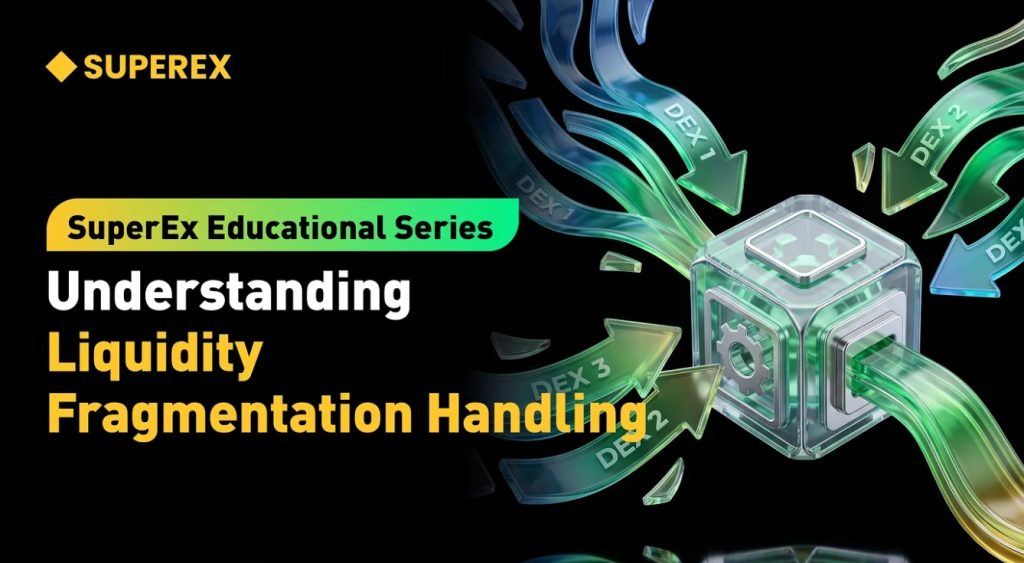
This is what we call liquidity fragmentation.
And liquidity fragmentation creates a very real problem:If you only trade through one DEX, you may not be getting the best price.
Not because the DEX is bad.
But because the best liquidity might simply be somewhere else.
So What Is Cross-DEX Aggregation?
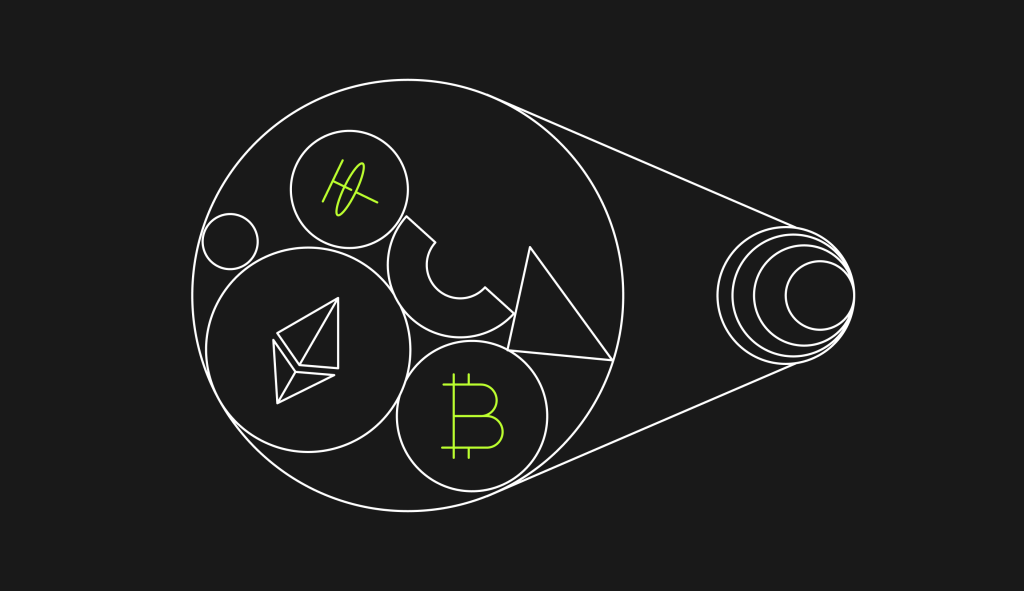
Cross-DEX aggregation is a mechanism that connects multiple decentralized exchanges and liquidity sources, then searches for the best way to execute a trade.
- Instead of asking one DEX:“What price can you give me?”
- An aggregator asks many DEXs:“Who can give the best final result for this trade?”
It may compare:
- Token prices
- Pool depth
- Trading fees
- Gas costs
- Slippage
- Route complexity
- Execution risk
- Available liquidity across different DEXs
Then it selects one route or splits the trade across multiple routes.
In simple terms:A DEX aggregator is like a price comparison engine for decentralized trading.
But smarter, because it does not just compare prices.It also compares paths.
A Simple Example
Let’s say Alice wants to swap 10,000 USDT into ETH.
If she uses only one DEX, she gets whatever price and liquidity that DEX can provide.
But if she uses a cross-DEX aggregator, the system may check several DEXs at once.
- DEX A has a good price for the first 3,000 USDT.
- DEX B has deeper liquidity for the next 5,000 USDT.
- DEX C has a slightly better route through USDC.
- Another route may go through WETH.
The aggregator may decide:
- Part of the trade goes through DEX A.
- Part goes through DEX B.
- Part uses a multi-hop route through another token.
Alice just sees one swap result.
Behind the scenes, the aggregator is doing the heavy lifting.
Why Not Just Pick the DEX With the Best Displayed Price?
Because displayed price can be misleading.
A DEX might show a good price for a tiny trade, but once your trade size increases, the price impact becomes painful.
That’s where slippage comes in.
Slippage is the difference between the expected price and the actual execution price.
A pool with shallow liquidity may look fine at first glance. But when a larger trade enters, the price moves against the trader.
A good cross-DEX aggregator does not only ask:“Which DEX has the best price right now?”
It asks: “Which route gives the best final amount after fees, slippage, and execution costs?”
That is a much better question.
Route Splitting: One Trade, Many Paths
One of the most powerful features of cross-DEX aggregation is route splitting.
Instead of sending the full order to one DEX, the aggregator can divide the trade across multiple liquidity sources.
Why?
Because liquidity is uneven.
One pool may be excellent for a small amount but bad for a large amount. Another pool may have deeper liquidity but slightly higher fees. A third pool may be useful only as part of a multi-hop route.
Route splitting helps reduce price impact and improve the final execution result.
Think of it like buying a large amount of something from several suppliers.
If one supplier raises the price after the first batch, you don’t keep buying everything there. You check the others.
That is what the aggregator does automatically.
Multi-Hop Routes: The Best Path Is Not Always Direct
Sometimes the best trade is not Token A directly into Token B.
Sometimes the better path is:Token A → USDT → Token B Or: Token A → ETH → Token B
Or even: Token A → USDC → WETH → Token B
Why would extra steps help?
Because some assets have much deeper liquidity against major tokens like ETH, USDT, or USDC.
So even with extra swaps, the final result can be better.
Of course, more hops can also mean more gas costs and more execution complexity.
That’s why aggregation matters.
The system needs to calculate whether the improved price is worth the extra cost.
Cross-DEX Aggregation Is Not Only About Price.This is the part many people miss.
A good aggregator does not simply chase the highest output number.It also needs to consider execution quality.
That includes:
- Gas fees
- Smart contract risk
- Failed transaction risk
- Slippage tolerance
- MEV exposure
- Route reliability
- Pool freshness
- Token transfer rules
- Bridge or cross-chain complexity
Sometimes the route with the highest quoted output is not the best practical route.If it is too risky, too expensive, or too likely to fail, the user may end up worse off.
So real aggregation is not just price hunting.
It is execution optimization.
What About Gas Fees?
Gas matters a lot.
A route that gives you $5 more in token output but costs $20 more in gas is not actually better.
This is especially important on networks where transaction fees can change quickly.
A strong cross-DEX aggregator should evaluate the net result:Final token output minus execution cost.
- For smaller trades, gas can completely change which route makes sense.
- For larger trades, slippage and liquidity depth may matter more.
That is why route selection is dynamic.
The best path depends on trade size, chain conditions, liquidity depth, and market volatility.
Cross-DEX Aggregation and MEV
Now let’s touch on a slightly more advanced point: MEV.
MEV stands for Maximal Extractable Value. In simple terms, it refers to value that can be extracted by reordering, inserting, or manipulating transactions around a user’s trade.
If your trade is visible in the mempool before execution, bots may try to take advantage of it.
This can lead to worse execution through front-running or sandwich attacks.
Cross-DEX aggregators may use different methods to reduce MEV exposure, such as private routing, protected transactions, better slippage controls, or RFQ-based execution.
This is another reason why aggregation is not just about finding liquidity.
It is also about protecting execution quality.
Cross-DEX Aggregation vs Single DEX Trading
Single DEX trading is simple.
- You choose a DEX.
- You choose a pair.
- You swap.
That can work perfectly well for many trades.
Cross-DEX aggregation is broader.
It checks multiple liquidity sources and tries to optimize the result.
Single DEX trading is like going to one store and accepting its price.
Cross-DEX aggregation is like checking several stores, comparing total cost, and sometimes buying different portions from different places.
- For casual small trades, the difference may be small.
- For larger trades, less liquid tokens, or volatile markets, the difference can be significant.
Why It Matters for DeFi Users
Cross-DEX aggregation matters because it improves how users interact with fragmented liquidity.
It can help users:
- Get better swap rates
- Reduce slippage
- Access deeper liquidity
- Avoid weak pools
- Compare routes automatically
- Improve trade success probability
- Reduce manual searching across DEXs
Without aggregation, users may have to manually check multiple DEXs.
That is slow, inefficient, and easy to get wrong.
With aggregation, the system does the search.The user gets a simpler experience.
But Aggregators Are Not Magic
Let’s be honest.
Cross-DEX aggregation is powerful, but it is not perfect.
Problems can still happen.
For example:
- Liquidity data may change before execution
- Gas fees may spike
- A route may fail
- Slippage settings may be too loose
- Smart contract risks may exist
- Some routes may include hidden or unclear costs
- The aggregator may prioritize certain sources
- Token mechanics may affect the final result
That is why users should still pay attention.
A good aggregator makes trading easier, but it does not remove all risk.
In crypto, convenience should always come with awareness.
How SuperEx Academy Looks at Cross-DEX Aggregation
At SuperEx Academy, we see cross-DEX aggregation as one of the key building blocks of modern DeFi trading.
It helps users understand a bigger truth:The best price is not always in one place.
In DeFi, liquidity is distributed across protocols, pools, chains, and market makers. Aggregation exists because users need a smarter way to access that liquidity.
Once you understand cross-DEX aggregation, you start asking better questions:
- Where is my trade being routed?
- Is the route direct or multi-hop?
- Is the order being split?
- Are gas fees included in the estimate?
- How much slippage am I exposed to?
- Is the route protected from MEV?
- What happens if part of the route fails?
That is the difference between simply clicking “swap” and actually understanding what your trade is doing.
Final Thoughts
Cross-DEX aggregation is a mechanism that searches across multiple decentralized exchanges and liquidity sources to find a better execution route for a trade.
Its main value is:
- Better pricing
- Lower slippage
- Deeper liquidity access
- Smarter route selection
- More efficient DeFi trading
- Better execution across fragmented markets
In one sentence:Cross-DEX aggregation helps users find the best available path through the messy liquidity map of DeFi.
Because in crypto, liquidity is not one lake.It is a network of rivers, pools, bridges, and hidden channels.
The aggregator’s job is to find the route that gets your trade where it needs to go with the best possible outcome.

Responses