
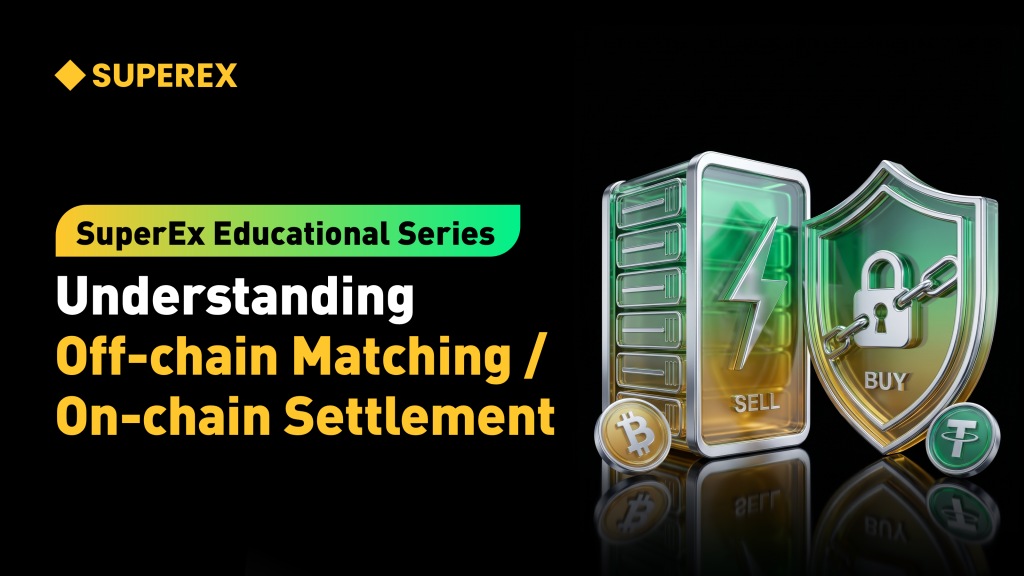
SuperEx Educational Series: Understanding Off-chain Matching / On-chain Settlement

#SuperEx #EducationalSeries #blockchain
Guys, today we’re talking about something that sounds painfully technical at first: Off-chain Matching / On-chain Settlement.
Yeah, I know.
It sounds like the kind of phrase someone would drop in a whitepaper right before everyone quietly closes the tab.
But stay with me, because this idea actually explains one of the biggest questions in crypto trading:How can a trading platform be fast, cost-efficient, and still keep the trust advantages of blockchain?
That answer often starts here.
The Problem: Blockchains Are Powerful, But Not Always Fast
Let’s be honest.
Blockchains are amazing because they are transparent, verifiable, and difficult to tamper with. But when it comes to trading, they can also feel slow and expensive.
If every order, cancellation, price update, and trade execution had to happen directly on-chain, the experience could become painful very quickly.
- You place an order.
- You wait for confirmation.
- Gas fees move around.
- The market moves faster than your transaction.
- Not exactly ideal.
Trading needs speed. Prices change in seconds. Sometimes in milliseconds. So the industry started asking a very practical question:What if we handle the fast-moving part off-chain, but keep the final asset settlement on-chain?
That is the basic idea behind Off-chain Matching / On-chain Settlement.
- Click to register SuperEx
- Click to download the SuperEx APP
- Click to enter SuperEx CMC
- Click to enter SuperEx DAO Academy — Space

Off-chain Matching: The Fast Part Happens Off-chain
Matching simply means connecting buyers and sellers.
- You want to buy.
- Someone else wants to sell.
- The system matches the two orders based on price, amount, and order priority.
In an off-chain matching model, this matching process does not happen directly on the blockchain. Instead, it happens in a high-performance off-chain system.
Why?
Because order books move fast.
Traders place orders, cancel orders, adjust orders, and react to market changes constantly. If every one of those actions required an on-chain transaction, the system would become slow, expensive, and difficult to use.
Off-chain matching allows the platform to process orders quickly, more like a traditional exchange experience.
In simple terms: Off-chain matching is built for speed.
On-chain Settlement: The Final Result Goes Back On-chain
Now you might be thinking:“Wait. If matching happens off-chain, doesn’t that just make it centralized?”
Fair question.
That is why the second half matters: on-chain settlement.
The matching engine may decide which orders are matched, at what price, and in what quantity. But the final settlement, meaning the actual confirmation of asset movement or trade results, is handled on-chain.
So the division is simple:
- Matching happens off-chain for efficiency.
- Settlement happens on-chain for trust and verification.
Think of it like a restaurant.
Ordering food, changing your order, asking for water, and checking what is available can all happen quickly and casually. But when the bill comes, the numbers need to be final and clear.
- Off-chain matching is the fast conversation.
- On-chain settlement is the final bill.
Why This Model Matters
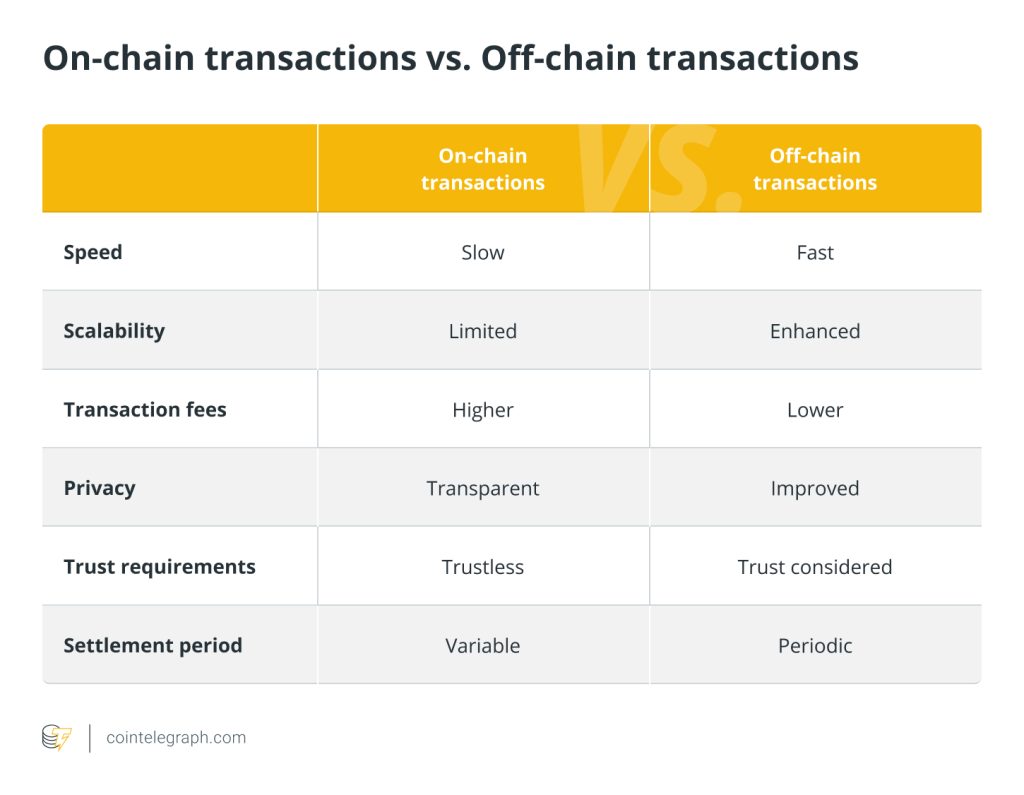
This model tries to combine two things the crypto industry has always wanted at the same time:
- The speed of centralized systems.
- The transparency of blockchain systems.
Centralized exchanges are usually fast and smooth. But users must trust the platform’s internal records.
Fully on-chain systems are more transparent, but they can be slower and more expensive, especially during network congestion.
Off-chain Matching / On-chain Settlement sits somewhere in the middle.
It says:Not every action needs to be written to the blockchain immediately. But the important final result should be verifiable on-chain.
That balance is why this architecture is used or discussed in many hybrid exchanges, Layer 2 systems, derivatives platforms, and advanced trading infrastructures.
A Simple Example
Imagine Alice wants to buy 100 USDT worth of a token. Bob wants to sell that token.
In a fully on-chain model, Alice’s order may go on-chain, Bob’s order may go on-chain, and the trade execution may also require on-chain confirmation.
That can work, but it may be slower and more expensive.
In an off-chain matching / on-chain settlement model:
- Alice submits her order to the trading system.
- Bob submits his order to the trading system.
- The platform matches them off-chain.
- The final trade result is settled or recorded on-chain.
From the user’s perspective, the trade feels faster.
From the blockchain’s perspective, the final outcome remains verifiable.
That is the key.
Off-chain Does Not Mean “Hidden in the Dark”
A lot of people hear “off-chain” and immediately get suspicious.
And honestly, that instinct is not completely wrong. In crypto, you should always ask where trust is coming from.
But off-chain matching does not automatically mean something shady is happening. In a well-designed system, off-chain matching is used to improve performance, while on-chain settlement helps preserve accountability.
The important questions are:
- Can users verify the final result?
- Are settlement rules clear?
- Is there a smart contract involved?
- How are disputes or abnormal situations handled?
- Can the platform prove that trades were settled correctly?
Different platforms may use different designs, such as signed orders, smart contracts, batch settlement, proofs, or Layer 2 mechanisms.
You do not need to memorize every technical term.
Just remember this:
- Off-chain matching is about efficiency.
- On-chain settlement is about final trust.
Why Should Regular Users Care?
Because architecture affects your trading experience.
You may not care how the engine works under the hood, but you definitely care about what it does to your trading.
- You care whether orders are fast.
- You care whether fees are reasonable.
- You care whether settlement is reliable.
- You care whether your assets are handled transparently.
- You care whether the platform can perform during market volatility.
That is why this concept matters.
It is not just a technical detail. It shapes the user experience and the risk model of the platform.
Once you understand it, you stop judging exchanges only by surface-level claims like “fast” or “secure.”
You start asking better questions:
- Fast because of what?
- Secure in which part of the process?
- Where does matching happen?
- Where does settlement happen?
- What can I verify on-chain?
That is a much smarter way to look at trading infrastructure.
Where Is This Model Useful?
Off-chain Matching / On-chain Settlement is especially useful in trading environments that need high performance, such as:
- Order book exchanges
- Perpetual futures platforms
- Derivatives trading
- High-frequency trading systems
- Layer 2 trading protocols
- Hybrid CEX/DEX models
- Markets with frequent order placement and cancellation
In highly volatile markets, speed matters.
No one wants to submit a trade and then sit there watching a wallet confirmation spin while the price runs away.
We have all seen enough of that movie.
But It Is Not Magic.Let’s be clear.
Off-chain Matching / On-chain Settlement is not a perfect solution to everything.
It improves speed and efficiency, but it also requires strong system design.
For example:
- Is the off-chain matching engine fair?
- Can order priority be trusted?
- Is settlement timely?
- What happens during extreme volatility?
- Can users verify that the final results are correct?
- Are there protections against manipulation or delays?
These questions matter.
A platform should not just throw around technical terms and expect users to be impressed. The real value comes from transparent rules, reliable settlement, and strong risk controls.
In crypto, fancy architecture is only useful if it actually protects users and improves the experience.
Final Thoughts
Off-chain Matching / On-chain Settlement can be summed up in one sentence:
The fast order-matching process happens off-chain, while the final settlement happens on-chain.
Its value is simple:
- Faster trading
- Lower on-chain pressure
- Better user experience
- More efficient order processing
- On-chain confirmation for final settlement
- A balance between performance and transparency
So the next time you see a platform mention Off-chain Matching / On-chain Settlement, do not let the phrase scare you away.
Just think of it like this:The trading engine moves fast off-chain, but the final result lands on the blockchain.
That is the beauty of the model.
- Fast where speed matters.
- Verifiable where trust matters.

Responses