
SuperEx Educational Series: Understanding Gas Abstraction

#SuperEx #EducationalSeries
Gas is something every crypto user has to deal with. And for beginners, it can feel like an absolute nightmare — just like I mentioned in the previous educational article: Why do I need to keep some ETH ready just to transfer a token?
Likewise,A lot of people are not pushed away from Web3 because blockchain is too hard to understand. They are pushed away by one sentence:“You have funds in your wallet, but you still need some gas first.”
In real life, this would feel absurd. You go to buy coffee, you have money on your card, but the cashier says, “Sorry, you first need to buy a special fee token.” Ordinary users will not see this as a technical detail. They will just think the product is awkward.
Gas Abstraction tries to solve exactly this awkwardness. It does not make gas disappear. It makes users less exposed to gas complexity.
- Cick to register SuperEx
- Cick to downoad the SuperEx APP
- Cick to enter SuperEx CMC
- Cick to enter SuperEx DAO Academy — Space
What Is Gas Abstraction?
Gas Abstraction means hiding or simplifying the gas-payment process through account abstraction, Paymasters, smart accounts, token-based fee payment, gas sponsorship, or off-chain settlement.
In traditional on-chain transactions, users must pay gas with the chain’s native token. On Ethereum, that means ETH. On some L2s, it means that network’s gas token. The problem is that users may have USDT, USDC, or other assets, but still cannot do anything because they lack the native gas token.
The goal of Gas Abstraction is to let users complete actions more naturally: the app can pay gas, the user can pay gas in stablecoins, or the wallet can automatically handle gas conversion and payment.
In one sentence: Gas Abstraction does not mean “no cost.” It means users should not be blocked by fee mechanics before they can even use the product.
How Does It Work?
The core idea of Gas Abstraction is separating who initiates the transaction, who pays the gas, what asset is used for payment, and how the cost is settled.
In traditional EOA wallets, these things are usually tied together. The user signs, the user sends the transaction, the user holds the native token, and the user pays the gas.
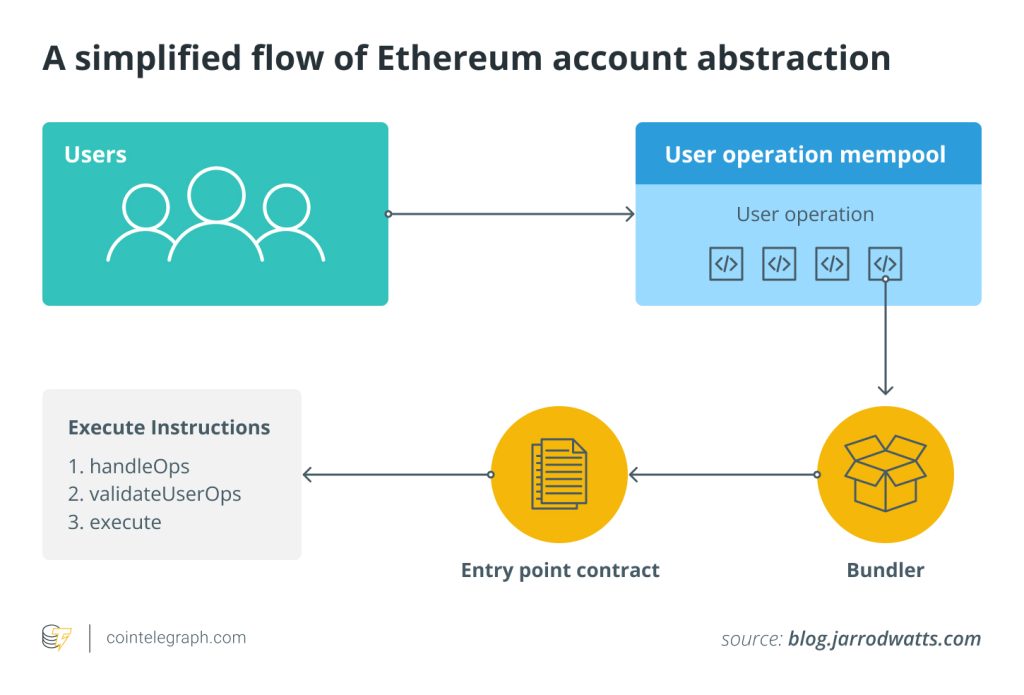
In an account abstraction system, the flow becomes more flexible. The user submits a UserOperation. A Bundler packages operations on-chain. The EntryPoint verifies and executes them. A Paymaster can pay gas based on rules, or allow users to settle fees with ERC-20 tokens.
It is like a ride-hailing app. The passenger does not need to know how the driver settles with the platform or how the platform clears payment. The passenger just completes the ride and pays. Gas Abstraction tries to bring a similar experience to on-chain interaction.
Why It Matters
Gas Abstraction matters because gas is one of the most obvious technical barriers in Web3 user experience.
New users do not understand why they need ETH first. Cross-chain users do not want to prepare different gas tokens for every chain. Game users do not want wallet pop-ups for every click. Institutions do not want every employee managing transaction fees manually. Apps also do not want users to drop off at step one.
The value of Gas Abstraction is shifting Web3 apps from “users must learn chain mechanics first” to “users complete their actual goal first.”
This is critical for mass adoption. Ordinary users will not study gas price, nonce, native tokens, bridges, failed transactions, and fee volatility just to use a product.
Technical Approaches
The first approach is gas sponsorship.
An app uses a Paymaster to pay gas for users, often for onboarding, campaigns, gaming actions, NFT minting, or low-cost interactions.
The second approach is paying gas with ERC-20 tokens.
Users do not need ETH directly. They can pay fees with USDT, USDC, or another token. A Paymaster or service pays native gas first, then charges the user in the selected token.
The third approach is batching through smart accounts.
A user may previously need separate approve, swap, and stake transactions. A Smart Account can combine multiple actions into one execution, reducing gas friction and signatures.
The fourth approach is EOA enhancement such as EIP-7702.
It allows traditional EOAs to gain some smart-account-like abilities, such as batching, sponsored transactions, and privilege de-escalation, helping gas abstraction reach existing users.
The fifth approach is wallet automation.
Wallets can handle gas estimation, swapping, bridging, sponsorship, or reminders in the background, so users see “confirm action” instead of a pile of low-level parameters.
Relation to Paymaster
Paymaster is a key component of Gas Abstraction, but Gas Abstraction is not the same as Paymaster.
A Paymaster is more like the executor: it checks whether a UserOperation meets certain rules and decides whether to pay gas. Gas Abstraction is the broader experience goal: users should not need to directly manage native gas tokens or understand fee-settlement details.
Simply put, Paymaster is a tool. Gas Abstraction is the user-facing outcome.
A Simple Case
Suppose Alice uses a Web3 social app for the first time. She creates a smart account with email or a passkey. Her account has no ETH, and she does not know what gas is.
Without Gas Abstraction, she may get stuck immediately: to post her first message, she must buy ETH on an exchange, withdraw it to the right network, then return to the app. Any step in this flow can make her leave.
With Gas Abstraction, the app can sponsor her first few actions through a Paymaster. Alice clicks post, her wallet creates a UserOperation, the Bundler packages it, the EntryPoint executes it, and the Paymaster pays gas. What Alice feels is simple: I clicked post, and it worked.
Now consider trading. Bob only has USDC in his wallet, not ETH. He wants to make a swap. Gas Abstraction can let Bob pay fees in USDC, or let the app front the gas and deduct the cost from the transaction result.
The on-chain rules have not disappeared. The complexity is simply handled by the wallet, Paymaster, and account abstraction system.
Common Misunderstandings
The first misunderstanding is that Gas Abstraction means free transactions.It does not. Gas still exists, and validators or sequencers still process transactions. Gas Abstraction only changes how users see and pay for gas.
The second misunderstanding is that if an app sponsors gas, the experience is automatically good.Not necessarily. If sponsorship rules are complex, transactions often fail, or limits are unclear, users will still be confused. Good gas abstraction must be clear, stable, and predictable.
The third misunderstanding is that Gas Abstraction is only for beginners.
It is not. Institutional fee management, high-frequency gaming, subscriptions, cross-chain apps, DAO tools, and enterprise wallets all need gas abstraction to reduce operational cost and complexity.
Risks and Limitations
- First, it can create abuse risks. If a project sponsors operations for free, attackers may spam transactions and drain the Paymaster.
- Second, it adds system dependencies. The user experience may depend on Bundlers, Paymasters, wallet services, off-chain risk checks, and fee-quote services. If these components fail, transactions may fail or slow down.
- Third, it can hide costs. If users do not directly see gas, the cost still exists. Apps that sponsor gas need a sustainable business model. Users paying with ERC-20 tokens should understand pricing and fee logic.
- Finally, gas abstraction should not sacrifice security. Over-permissioning, unclear signing messages, or bypassing user confirmation can turn UX improvements into security risks.
Conclusion
The core value of Gas Abstraction is turning on-chain interaction from “prepare gas before you can start” into “complete the action first, while the system handles fees properly.”
It means users do not need to stock native tokens for every chain, study fees before their first action, or get blocked by the classic problem of “having assets but no gas.”
For Web3, this is an important step. Smart Accounts make accounts programmable. Paymasters make gas payment programmable. Gas Abstraction turns these abilities into a smoother experience that ordinary users can actually feel.
Future Web3 apps should not require users to understand the underlying fee system before they can use the product. A more mature direction is for gas to work like server costs in internet products: it exists, someone pays, rules settle it, but it no longer stands in front of the user.

Responses