
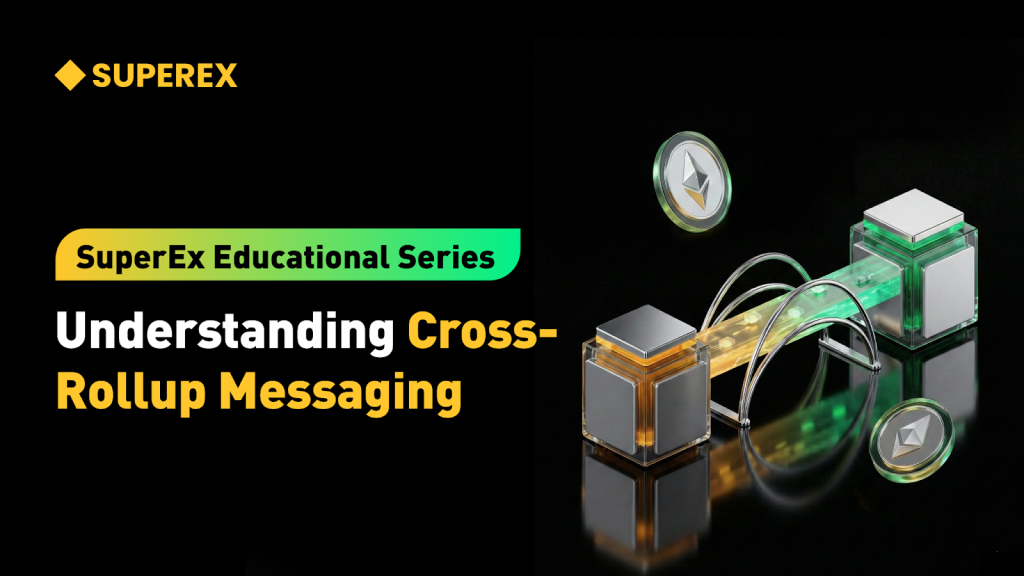
SuperEx Educational Series: Understanding Cross-Rollup Messaging

#CrossRollup #EducationalSeries
Before today’s educational piece begins, let me first state a viewpoint: The real bottleneck Rollups are facing is not on-chain, but “between each other.”
In fact, when Rollups first emerged, the industry’s attention was focused on only two core questions:Can they be faster? And can they be cheaper?
This was entirely natural. Every industry, at its early stage, goes through a period of rapid and sometimes crude expansion. As a result, we saw the rise of Optimistic Rollups, ZK Rollups, and various separations between execution layers and DA layers.
But once the number of Rollups truly started to grow, a new question became impossible to ignore: If every Rollup is an “island,” does scalability really hold?
The reality today is:
- Assets are scattered across different Rollups
- Applications are deployed on different Rollups
- User behavior spans multiple Rollups
Yet between them, there is a lack of a native, trustworthy, low-friction communication mechanism.
Today’s topic — Cross-Rollup Messaging — exists precisely to address this problem.
https://news.superex.com/articles/30261.html

What Is Cross-Rollup Messaging?
Intuitively speaking, it is not an “upgraded cross-chain bridge,” but rather a more fundamental capability: It allows a state change that occurs on one Rollup to be securely, verifiably perceived and used by another Rollup.
The key here is not “moving assets,” but:
- Transmitting messages
- Transmitting state
- Transmitting results
For example: a contract on Rollup A executes an operation, and a contract on Rollup B needs to continue execution based on that result. Without Cross-Rollup Messaging, such a workflow is almost impossible to complete securely.
At this point, many people’s first reaction is:“Isn’t this just a cross-chain bridge?”
It’s not the same thing.
Traditional cross-chain bridges are designed primarily to transfer assets, not to compose state. They usually rely on:
- Multisig or validator sets
- External relayers
- Event listening plus manual or semi-automated confirmation
This may be acceptable when simply “moving money from A to B,” but in the Rollup context, it exposes three fatal problems:
First, inconsistent trust models
The security of Rollups comes from L1 consensus or ZK / Fraud Proofs, whereas bridge security often comes from a small validator set. This directly lowers the overall security floor of the system.
Second, non-composable state
Bridges can move assets, but they struggle to move “logical results.” For example, you cannot atomically complete: execution on A → continued execution on B. There is always a break in between.
Third, uncontrollable latency and complexity
Cross-bridge operations are often accompanied by:
- Multiple confirmations
- Waiting periods
- Human intervention
This runs directly counter to the “near real-time experience” Rollups aim to achieve.
What Cross-Rollup Messaging Really Wants to Solve: Cross-Chain Execution
Cross-Rollup Messaging is not about “moving money faster.”Its core goal is to ensure that Rollups are no longer isolated execution environments.
Its objective is singular: to make interactions between Rollups feel as natural as contract calls on the same chain.
This implies:
- Messages are verifiable
- Ordering is deterministic
- State is traceable
- Failures are reversible
In other words, Cross-Rollup Messaging attempts to transform “cross-Rollup interactions” from external system operations into native system capabilities.
The Path by Which Messages Become “Trusted”
Different implementations vary, but their underlying logic is highly consistent. We can break Cross-Rollup Messaging into three layers:
1. Message Creation
On Rollup A, after a contract executes, a message is generated. This message is then written into A’s state or logs and eventually submitted to L1 (or the DA layer).
The key point here is: the message itself becomes part of a verifiable state.
2. Message Proof
Next comes a critical question:Why should Rollup B believe this message actually happened?
This brings us back to each Rollup’s security model:
- Optimistic Rollups rely on challenge periods and Fraud Proofs
- ZK Rollups rely on validity proofs
- The DA layer ensures the message data is available
Once a message has passed the security checks of its originating Rollup, it earns the qualification to be referenced.
3. Message Consumption
When Rollup B executes, it references the verified message from Rollup A and uses it as an input to continue its own logic. If anything goes wrong, L1 or the underlying consensus layer always retains final adjudication authority.
From this three-layer structure, it becomes clear that the core of Cross-Rollup Messaging is not “whether there is a relayer,” but whether the message can be included within the system’s consensus and security boundary.
This is also the most fundamental difference from traditional cross-chain solutions: Messages are no longer “forwarded,” they are “proven.”
Once a message becomes part of a Rollup’s verifiable state, its fate no longer depends on whether some intermediary service is honest or online, but on whether the system’s overall security assumptions hold.
This means that as long as the Rollup itself is secure, messages cannot be forged, tampered with, or rolled back.
Ordering Determinism and Failure Reversibility
Ordering determinism is equally critical.
In a single-chain environment, contract calls naturally have a deterministic execution order.
In a multi-Rollup environment, if message ordering is not explicitly constrained, the following issues arise:
- Inconsistent state reads
- Unpredictable logic branches
- Expanded opportunities for cross-Rollup arbitrage or attacks
As a result, Cross-Rollup Messaging is often tightly bound to block heights, state roots, or batch ordering, ensuring that the “before-and-after” relationship of messages is itself verifiable.
This determines whether cross-Rollup interactions can truly support complex applications, rather than merely asset transfers.
Failure reversibility is another frequently overlooked but critically important design goal.
In external cross-chain models, once a step fails, it often means:
- State has already changed on the source chain
- The destination chain cannot continue execution
- Users must rely on compensation mechanisms or manual intervention
In the native Cross-Rollup Messaging model, failure is no longer an “accident,” but an expected system state. If a message cannot be correctly consumed by the target Rollup, it simply will not be finalized, and the related state remains under the control of the underlying consensus.
This is why L1 or the DA layer always retains final adjudication authority: it does not participate in execution, but ensures that all Rollups share a consistent view of the same facts.
From Parallel Rollups to an Execution Plane
Viewed this way, Cross-Rollup Messaging is not about “communication efficiency,” but about a deeper problem:How to maintain a unified, verifiable, and composable state view across multiple execution environments.
Once this holds, Rollups are no longer isolated scaling solutions, but freely composable modular execution units.
This is the critical step in Rollups evolving from “parallel scaling solutions” into an “execution-layer network.”
What practical changes does this bring?
Once Cross-Rollup Messaging exists, many designs that were previously “impossible” become feasible, such as:
- Modular applications split across multiple Rollups
- Cross-Rollup liquidity sharing
- Atomic arbitrage between Rollups
Applications can be deployed across multiple execution environments while maintaining unified logic. More importantly, the user perspective changes: Users no longer “enter a specific Rollup,” but enter an execution network composed of multiple Rollups.
From “Many Rollups” to “One Execution Plane”
This represents the next stage of Rollup evolution:
- Stage one: move computation off L1
- Stage two: let individual Rollups thrive independently
- Stage three (enabled by Cross-Rollup Messaging):Recombine Rollups into a larger execution plane
In this plane:
- Security still converges to L1
- Execution is horizontally split
- Applications are no longer locked into a single Rollup
This is why more and more new architectures no longer talk about “a specific Rollup,” but about Rollup networks.
Closing Thoughts
If Rollups solve “who computes and how computation happens,” then Cross-Rollup Messaging solves:After computation is done, how the results can be safely used by other systems.
Without it, Rollups can only scale single-point performance With it, Rollups gain true system-level scalability
That is why Cross-Rollup Messaging is not a “nice-to-have” feature, but an essential milestone on the path to Rollup maturity.

Responses