
From “learing” to $thenickshirley: On-Chain Becomes the Best Capital Magnet

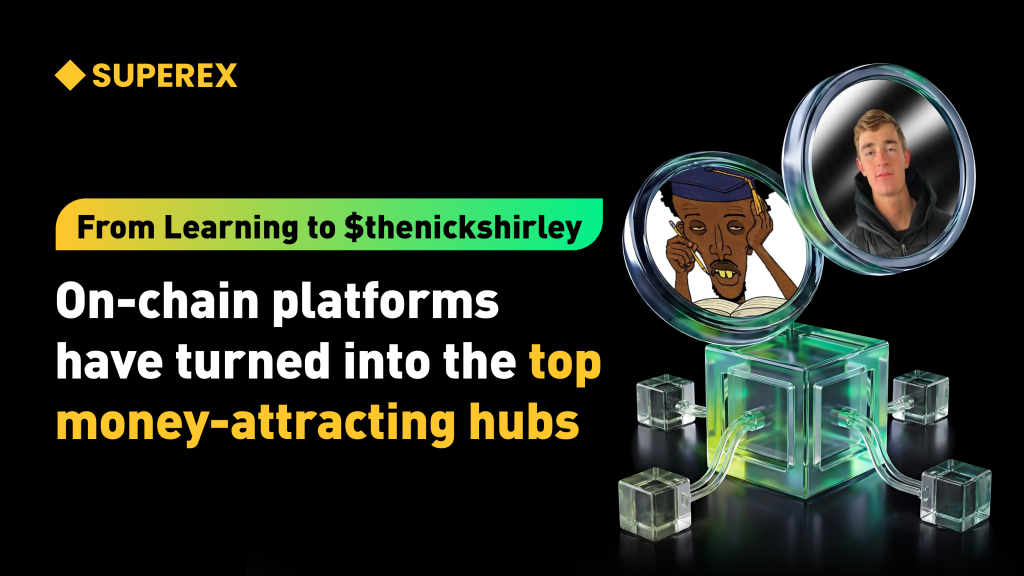
#$thenickshirley #learing
Originally, today’s topic was supposed to continue our 2025 review series. However, the heat around $thenickshirley has simply been too high. Driven by the direct participation of numerous public figures, this token reached a peak market capitalization of nearly USD 10 million within a very short period of time.
Unexpectedly, at the very end of 2025, we once again witnessed a Meme-driven wealth myth — and once again verified the on-chain world’s almost insane ability to absorb capital.
- Click to register SuperEx
- Click to download the SuperEx APP
- Click to enter SuperEx CMC
- Click to enter SuperEx DAO Academy — Space
It All Starts With a Piece of News
The whole story starts with a single word: “learing.” I know everyone must be confused — what kind of word is “learing”? It feels like something you’ve never seen before. Of course you haven’t, because before this incident, you could not have seen it at all. It is simply a misspelling, missing an “n.” The correct word should have been “learning.”
Spelling mistakes themselves are nothing rare. But when such an error appears on the front-facing sign of a supposedly formal institution, it suddenly makes that institution look extremely unprofessional.
The incident happened on December 27.
An independent investigative journalist named Nick Shirley published multiple on-site investigation videos across platforms such as X, Instagram, and YouTube, accusing the state of Minnesota of rampant fraud and corruption.
In the videos, Nick Shirley stated that he visited a daycare center located in Minnesota. According to public records, this daycare had 99 registered students and had long been receiving government subsidies totaling USD 1.9 million. Logically speaking, such a daycare should have had a pleasant environment, complete facilities, and children happily studying and living there.
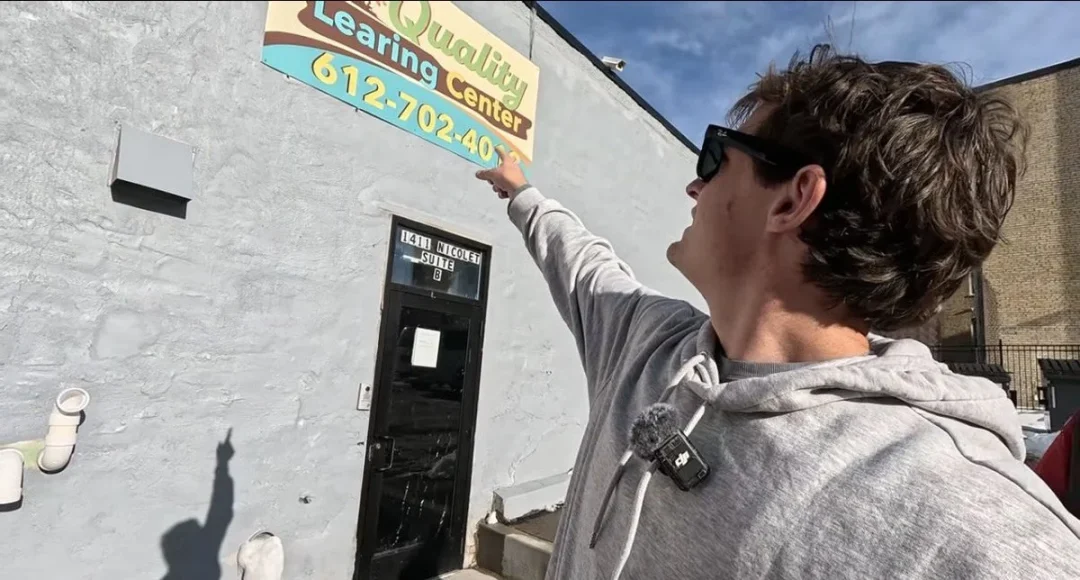
But the reality was this: during official operating hours, the daycare was not open at all, and not a single one of the 99 students could be seen.
Nick Shirley then interviewed a local resident who had lived in the area for eight years. The interviewee said:“I’ve lived here since 2017, and I’ve never seen any children.”
At this point, the story probably felt very familiar to many people. Isn’t this just a classic shell company scenario?
Nick Shirley said in the video:“This is one of hundreds of ‘daycares’ that have received millions of dollars in government funding. A daycare that can’t even spell learing (which should be learning) correctly received USD 1.9 million in tax-free funding… and this is just one case among thousands of businesses in Minnesota suspected of fraudulent operations. Minnesota Governor Tim Walz knows about these fraud cases, but has never reported them.”
As one of the regions most sensitive to where taxpayer money goes, this incident hit a nerve across the United States.
Within just two days, Nick Shirley’s videos accumulated hundreds of millions of views across the internet. On X alone, the 42-minute full investigation video surpassed 100 million views.
Of course, this also had a lot to do with the fact that public figures such as U.S. Vice President Vance and Elon Musk personally reposted and amplified the content. Naturally, their motivations for stepping in were highly political, which is outside the scope of our discussion here.
It Was a Social Hot Topic — Until Meme Got Involved
On its own, this was already a major social event. But once Meme culture entered the picture, things became interesting.
How should we describe Meme community participants?
- A group of onlookers who love chaos and don’t mind things getting bigger?
- A group of news junkies who chase every hot topic?
Both descriptions are accurate.
This incident, combining social outrage and political attributes, was something the on-chain world simply could not ignore. The Meme community spontaneously began speculating around the most absurd detail of the investigation — the misspelled word “learing.” What they underestimated was just how absurd this story could become.
Nick Shirley himself seemed almost naturally suited for the Meme space.
Just as the Meme community began its spontaneous hype, he immediately registered on Zora’s creator platform and launched his personal creator token $thenickshirley on Base.
That speed. That instinct. You can only say: not bad for an investigative journalist.
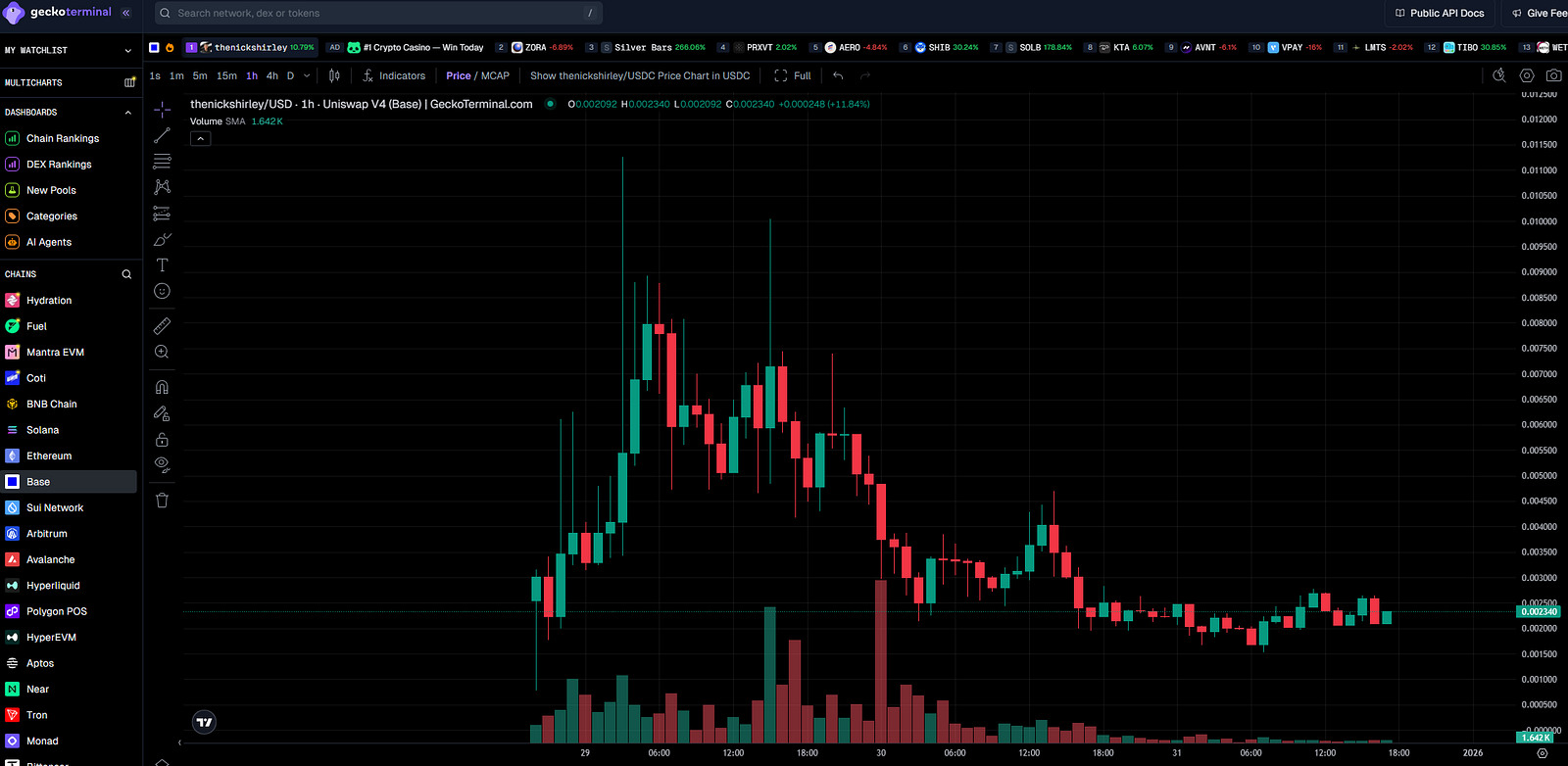
Soon after, with public acknowledgment and amplification from Coinbase founder Brian Armstrong, $thenickshirley completely exploded.As of writing, its market capitalization stands at approximately USD 2.34 million (having peaked at USD 9.02 million), with a maximum increase of 342%.
On-Chain Momentum + Prediction Markets = Full Acceleration
As on-chain momentum continued to build, prediction markets quickly followed, further pushing the event’s visibility.Shortly afterward, Nick Shirley posted his Venmo account and crypto wallet address on X, openly signaling tips.
It can be said that within a strictly time-limited attention window, monetization was pushed to the absolute extreme.
Final Thoughts
In this on-chain experiment ignited by $thenickshirley, what we are seeing is no longer just another cycle of Meme hype, but the emergence of an entirely new narrative structure: When individual influence meets open financial infrastructure, content no longer depends on platforms. Instead, it begins to directly connect with markets, emotion, and capital.
Rather than calling this another speculative carnival, it may be more accurate to view it as a real-world sample of the creator economy moving on-chain.
Creators no longer need brand endorsements, advertising revenue sharing, or institutional matchmaking. Within an open and transparent rule framework, social attention can be converted directly into part of asset pricing itself. That mechanism may be far more worthy of attention than price volatility.
More importantly, it raises an open question: In a decentralized context, is content regaining its own pricing power? If the answer is yes, then what happened today may become an early footnote in the future restructuring of the relationship between media and finance.


Responses