
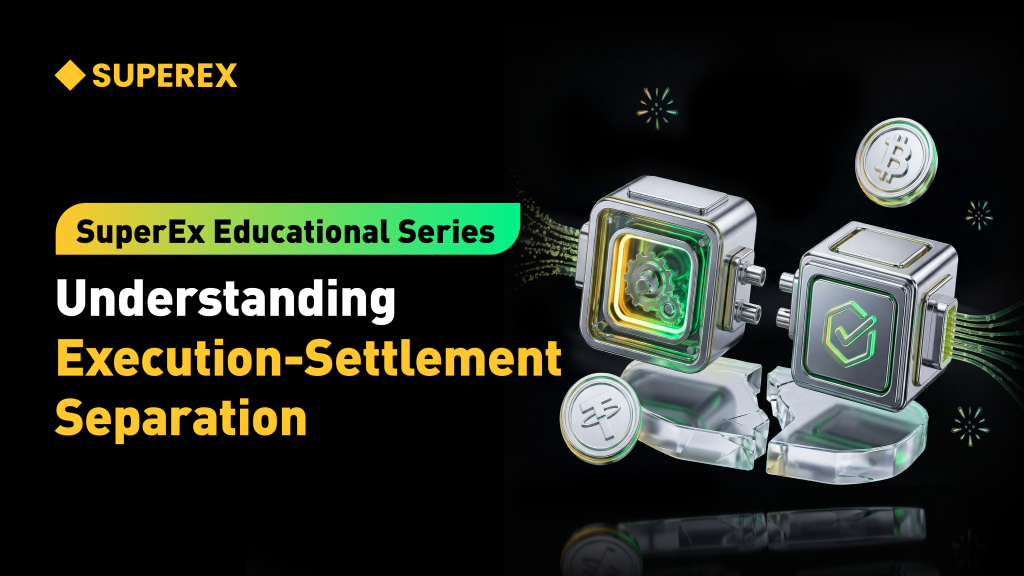
SuperEx Educational Series: Understanding Execution-Settlement Separation

#SuperEx #EducationalSeries
Today is a special day. Our SuperEx Educational Series has reached 300 episodes, and today marks Episode 301 — officially entering the third stage. Looking back:
The first stage focused on the most fundamental concepts in the crypto industry, such as mechanisms, tokens, spot, futures, etc.
The second stage explored more advanced concepts, mainly around interaction and project-level topics, such as cross-chain bridges and Tokenomics.
Now we enter the third stage — a completely new knowledge domain. It is more in-depth than the previous two stages and focuses on operational-level understanding.
This transition marks a shift in our exploration of blockchain technology — from “what it is” and “how to use it” to “how it actually works.”
Within this operational framework, Execution-Settlement Separation is undoubtedly one of the most revolutionary architectural evolutions today. It is also the core design philosophy behind many high-performance blockchains and Layer2 solutions.
This stage is more complex, but also more exciting — read carefully.
https://news.superex.com/articles/33726.html

What is Execution-Settlement Separation
As we mentioned, this architecture is considered revolutionary. If we think in reverse, we can arrive at an important conclusion:
Execution and settlement were originally bound together — because only when they are bound does separation become necessary.
And this is also one of the core reasons why blockchains become slower and more expensive.
Let’s start with a simple definition: Execution-Settlement Separation means separating “transaction processing” from “transaction finalization.”
There are two key components:
1. Execution
Execution refers to how a transaction happens, such as:
- user placing an order
- order matching
- state changes
Simply put, it is how a transaction is processed.
2. Settlement
Settlement refers to final confirmation, such as:
- asset transfer
- writing state onto the blockchain
- irreversible finality
Simply put, it is whether the transaction is finalized and cannot be changed.
The Problem with the Traditional Model
In many early blockchains, execution and settlement happen together.
This means every transaction must complete both steps simultaneously.
This leads to several issues:
- Limited performance: everything must go through the slowest step
- High cost: every action consumes on-chain resources → higher fees
- Poor scalability: improving performance requires upgrading the entire system
The Logic After Separation
The core idea of Execution-Settlement Separation is simple:
Separate fast tasks from slow tasks.
Execution Layer
Responsible for:
- processing transactions
- performing computations
- delivering high performance
Its priority is speed.
You can think of the execution layer as the “frontend”, where most user actions occur.
For example:
- placing trades
- performing swaps
- interacting with DeFi protocols
These actions require fast responses. If every step is slow, user experience suffers.
So the execution layer focuses on being fast, while maintaining basic correctness — not absolute security.
That’s why many execution layers adopt more flexible designs.
Settlement Layer
Responsible for:
- final confirmation
- security
- immutability
Its priority is security.
You can think of it as the “backend”.
It does not need to process every detail but must ensure that the final result is correct.
For example:
- final asset ownership
- validity of state
- whether results can be reversed
Since errors here are critical, the settlement layer is designed to be slower but more secure.
A Key Shift in Thinking
One crucial change: Not every step needs the highest level of security.
In traditional systems, every operation goes through the full process, making everything slow.
After separation:
- daily operations happen in the execution layer
- final results are submitted to the settlement layer
Only critical moments require on-chain confirmation.
The result:
- from the user’s perspective → faster interactions
- from the system’s perspective → security is preserved
This is why more and more projects adopt this architecture.
Benefits of Separation
- Improved performance: execution layer can optimize for speed and handle more transactions
- Lower costs: not every operation needs to be on-chain
- Greater flexibility: different execution layers can be tailored for different applications
Real-World Applications
This architecture is already widely used in:
- Rollups
- Layer2 solutions
- Modular blockchains
They share common traits:
- execution happens off-chain or on secondary layers
- settlement happens on the main chain
Challenges of This Model
Despite its advantages, it also introduces new challenges:
- Increased complexity: system architecture becomes more complex
- New trust models: separation requires new security mechanisms
- Data availability issues: execution results must remain verifiable
Conclusion
The evolution of blockchain is essentially about solving one core problem:
How to achieve both performance and security at the same time.
Execution-Settlement Separation is one of the key answers.
It does not make systems simpler — but it makes them more rational:
Different layers handle different responsibilities. And only in this way can the system scale further and go farther.




Responses