
SuperEx Educational Series: Understanding Omnichain Application

#SuperEx #OmnichainApplication
In the previous two articles, we discussed the new interaction paradigm and the new asset distribution landscape in the multi-chain ecosystem. But the problems of the multi-chain world do not stop there.
We all know that each chain has its own users, assets, applications, and liquidity. Switching between these chains still results in a poor user experience.
As a result, a new concept in the same series as Omnichain Token has begun to attract increasing attention — today’s topic: Omnichain Application.
- Click to register SuperEx
- Click to download the SuperEx APP
- Click to enter SuperEx CMC
- Click to enter SuperEx DAO Academy — Space

What Is an Omnichain Application?
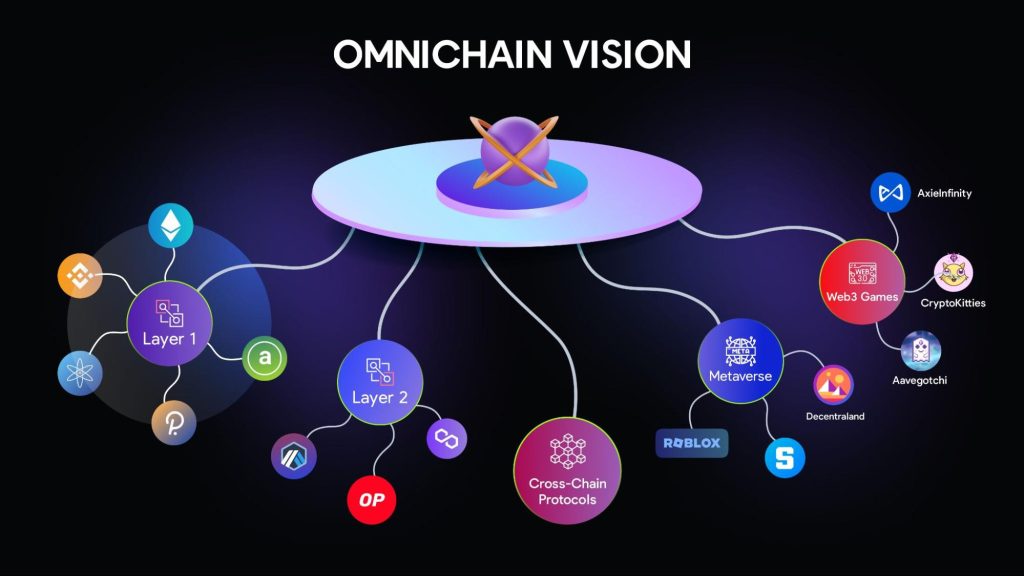
Simply put: an Omnichain Application is an application that can run simultaneously across multiple chains, with data and state fully interconnected between them.
There is a crucial distinction here: it is not just Multichain Deployment.
Many projects simply deploy separate contracts on different chains, with almost no connection between them. That does not qualify as true Omnichain.
A real Omnichain Application is more like one application with multiple chain entry points. No matter which chain a user enters from, they are using the same system.
For example: if a user performs an operation on Chain A, the state on Chain B is synchronized accordingly. The entire application logic is unified.
That is the core of Omnichain.
Why Is the Industry Paying Attention to Omnichain Applications?
The reason is straightforward: Web3 will not exist on just one chain.
Different blockchains excel in different areas:
Some have high transaction speed
- Some offer stronger security
- Some have lower fees
- Some have more mature ecosystems
The future trend is likely multi-chain coexistence, not single-chain dominance.
But if applications cannot coordinate across chains, the user experience becomes fragmented.
For example:
- Assets must be bridged
- Data is not interoperable
- Liquidity is fragmented
That is why more and more infrastructure providers are pushing toward Omnichain solutions.
For example:
- LayerZero Labs
- Axelar Network
- Wormhole
These projects are solving one key issue: enabling direct communication between chains. Once communication is solved, Omnichain Applications become truly possible.
Omnichain Application vs. Traditional DApp
At first glance, this concept can be confused with traditional DApps. Let’s compare them:
Traditional DApp
- Deployed on a single chain
- Users must enter that specific chain to use it
- Assets and data circulate mainly within that chain
- Cross-chain operations usually rely on bridges
Omnichain Application
- Exists simultaneously across multiple chains
- Users can interact from any chain
- System automatically synchronizes state
- Application logic is unified
In other words, a traditional DApp is like a service in one city, while an Omnichain Application is like a globally connected system.
How Omnichain Applications Work
A typical Omnichain application usually includes three core components. These three parts must operate closely together — none can be missing. Only when communication, logic, and state are fully connected can the application achieve real cross-chain coordination rather than simple multi-chain duplication.
1. Cross-Chain Communication Layer
This is the most critical layer in the Omnichain architecture — essentially the “highway” between chains. Its function is to transmit messages, instructions, and state changes across different blockchains.
For example, when a user performs an operation on Chain A, the system generates a cross-chain message. Through a cross-chain protocol, the message is sent to Chain B, which then updates its state or executes the corresponding action.
In this process, cross-chain communication protocols play a central role. Common infrastructures in the industry include:
- LayerZero Labs
- Axelar Network
- Wormhole
Their core function is enabling reliable “dialogue” between blockchains. Without communication, Omnichain applications cannot function.
2. Unified Application Logic
Although Omnichain applications are deployed across multiple chains, they are not separate systems. They share the same core logic rules.
All chains run identical contract logic, ensuring consistent application behavior regardless of the chain a user interacts with.
For example, in an Omnichain DeFi application, whether a user operates on Ethereum or another chain, the trading rules, fee model, and asset logic remain the same.
This brings clear benefits:
- Consistent user experience
- Consistent asset states
- Consistent system behavior
- Liquidity not fully fragmented
This is the biggest difference between Omnichain and traditional multi-chain deployment. Traditional multi-chain applications simply “replicate” an application, while Omnichain represents a “unified system.”
3. State Synchronization Mechanism
If cross-chain communication solves whether information can be transmitted, state synchronization solves how the system maintains consistency.
This is technically the most challenging part of the Omnichain architecture because different blockchains operate independently.
An Omnichain application must ensure:
- No data conflicts
- No duplicated token supply
- Cross-chain operations can be verified
- Global state consistency
To achieve this, most Omnichain applications combine multiple mechanisms, such as:
- Message confirmation
- Cross-chain verification
- Validator networks
- Delayed confirmation and rollback mechanisms
Simply put, when a state change occurs on one chain, the system verifies the message through a validation network and synchronizes it to other chains, ensuring consistent state across the entire application.
Only when communication layer + unified logic + state synchronization are fully integrated can a true Omnichain Application exist.
This is why many believe Omnichain represents one of the key technological directions for the next stage of Web3.
The Future Impact of Omnichain Applications
If the Omnichain model matures, the Web3 experience could change dramatically.
For example, users may no longer need to care about which chain they are on. They simply open an application, and the system automatically handles:
- Chain selection
- Asset routing
- Cross-chain execution
For users, the process becomes seamless.
This also connects to another emerging trend: Chain Abstraction.
In the future, Web3 may evolve into a model where users interact only with applications, while chains operate automatically in the background.
Omnichain Applications are a key step toward realizing this vision.
Summary
In one sentence: an Omnichain Application is not an application deployed on multiple chains — it is an application that runs across multiple chains as one unified system.
Its core characteristics include:
- Cross-chain communication
- Unified logic
- State synchronization
- Seamless user experience across chains
In the long term, Omnichain is likely to become one of the foundational infrastructures of Web3.
As cross-chain technologies continue to mature, the applications we use in the future may no longer belong to a single chain — but to the entire multi-chain world.

Responses