
SuperEx Educational Series: Understanding Chain Abstraction


#SuperEx #EducationalSeries
Today’s topic is a bit abstract — just like its name, “Chain Abstraction.” Many people hear it for the first time and think it sounds like some kind of math problem. In reality, Chain Abstraction is infrastructure created to deal with multi-chain interaction and switching in a multi-chain environment.
Simply put, over the past few years, blockchain has moved from a single-chain structure into a true multi-chain era. As scaling demands increased, more and more new networks emerged, such as the modular ecosystem of Cosmos, the shared security model of Polkadot, as well as various Layer2 networks, application chains, and high-performance public chains.
From a technical perspective, this represents industry progress. But from a user perspective, it has created a real problem: blockchain is becoming increasingly complex.
For example, users constantly need to switch networks, bridge assets, manage different addresses, and even prepare different Gas tokens for different chains.
As a result, Chain Abstraction has begun to attract attention. Many industry insiders believe it may be the key to the next stage of Web3 experience upgrades.
https://news.superex.com/articles/32487.html

Chain Abstraction Is Not Hard to Understand
The core goal of Chain Abstraction is actually very simple: let users not have to care about the blockchain itself.
In traditional Web3 usage, users must know:
- Which chain they are on
- Which chain their assets are on
- Which chain the application is on
Otherwise, they cannot complete operations.
But in a Chain Abstraction design, the user only needs to initiate an action.
For example:
- Transfer
- Trade
- Participate in DeFi
- Purchase NFTs
The system automatically completes everything behind the scenes, including:
- Selecting the most suitable blockchain
- Completing cross-chain communication
- Paying Gas
- Handling asset mapping
In other words, what the user sees is the application — not the blockchain itself. It’s like the internet: when you send a message, you don’t need to know how many servers the data passes through.
Chain Abstraction aims to make blockchain feel the same way.
Chain Abstraction Is Becoming Necessary
Chain Abstraction is not just a “nice-to-have” concept. It is gradually becoming essential infrastructure.
1. Multi-Chain Is Becoming the Norm
Today’s Web3 is no longer single-chain. Assets are distributed across different networks. A user may simultaneously use:
- Layer1
- Layer2
- Application chains
- Modular blockchains
For example, ETH might be on the mainnet, USDT on another chain, and a DeFi application on Layer2. If the user wants to operate, they must handle: bridging → swapping → Gas management.
For ordinary users, this barrier is extremely high. Many new users give up at this stage.
So what Chain Abstraction aims to solve is this: make multi-chain look like a single chain to users.
2. Liquidity Fragmentation Is Getting Worse
Another problem brought by multi-chain architecture is liquidity fragmentation.
The same asset may exist simultaneously on multiple chains, which leads to:
- Price differences
- Fragmented trading depth
- Higher slippage
- Lower capital efficiency
For example, a token may have strong liquidity on one chain but weak liquidity on another. If users are unfamiliar with this, they may have a poor trading experience.
One of the goals of Chain Abstraction is to present unified liquidity to users.
The system can automatically select:
- The optimal chain
- The optimal trading path
- The optimal cost
3. Web3 User Experience Issues
If you observe new users entering Web3, you’ll notice a common pattern: their biggest difficulties are not trading itself, but infrastructure complexity, such as:
- Network selection
- Cross-chain operations
- Insufficient Gas
- Wallet management
Chain Abstraction essentially does one thing: move complexity from the user side to the system side.
Core Mechanisms of Chain Abstraction
To achieve chain abstraction, multiple technical modules must work together. It is not a single technology, but an entire architectural design.
1. Unified Account System
In traditional blockchains, each chain has its own address system. This means users may have:
- Multiple addresses
- Multiple signatures
- Multiple asset records
Chain Abstraction attempts to provide a unified account system. Users see only one account, while the system manages in the background:
- Multi-chain wallets
- Asset mapping
- Signature execution
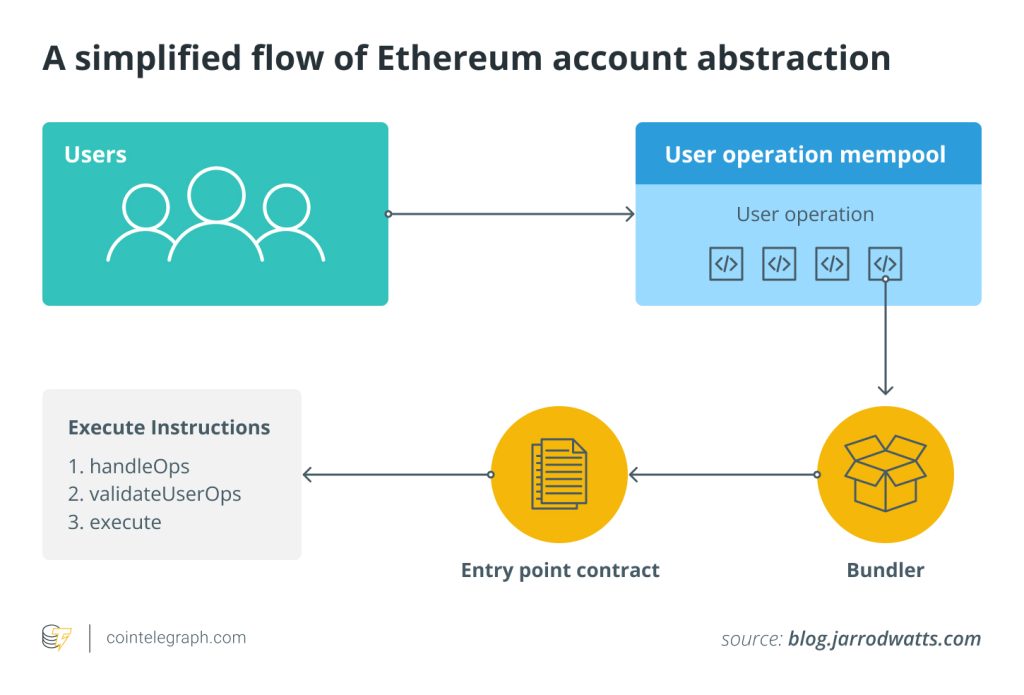
Many projects are implementing this through Account Abstraction, which is currently an important direction in Web3 infrastructure.
2. Automatic Cross-Chain Execution
In a chain abstraction environment, users do not manually bridge assets. When a user initiates an action, the system automatically determines:
- Which chain to execute on
- Whether assets need to be bridged
- Whether tokens need to be swapped
For example, if a user wants to purchase an asset, the system may automatically complete bridging, swapping, or trading. The entire process requires only one click.
This is one of the most important experience upgrades of chain abstraction.
3. Gas Abstraction
Gas is often the first barrier users encounter in Web3. Different chains require different Gas tokens. A common problem is that users have assets but no Gas.
An important capability of Chain Abstraction is Gas Abstraction.
The system can allow users to pay Gas with any token. It automatically converts tokens into Gas in the background, or even allows the application to sponsor Gas fees. This makes the experience closer to traditional internet applications.
4. Cross-Chain Messaging Networks
Chain abstraction usually relies on cross-chain communication systems, such as:
- Cross-chain messaging protocols
- Verification mechanisms
- Execution node networks
These infrastructures ensure secure communication between different chains.
In many designs, chain abstraction is built on top of cross-chain messaging.
In other words, chain abstraction is the application-layer experience, while cross-chain protocols are the underlying infrastructure.
Why Chain Abstraction May Be the Next Trend
Many industry researchers believe Chain Abstraction may become a key trend in the next stage.
The reason is simple. In the future, blockchains are likely to continue specializing:
- Some chains focus on security
- Some focus on performance
- Some focus on applications
This means multi-chain architecture will not disappear. But users should not bear that complexity.
The goal of Chain Abstraction is to make users no longer perceive the differences between blockchains.
Just like cloud computing — users consume services, not servers.
Summary
Looking back at blockchain development, the industry has gone through three stages:
- Stage one: solving the trust problem.
- Stage two: solving the scalability problem.
- Stage three (happening now): solving the user experience problem.
Chain Abstraction is key infrastructure for the third stage. It is not about creating new blockchains, but about making blockchain truly usable.
When future users no longer need to think about:
What chain this is
- Which chain their assets are on
- Whether they need to bridge
Then we can say chain abstraction has truly succeeded. And that may be a crucial step toward large-scale Web3 adoption.




Responses