
SuperEx Educational Series: Understanding the Rollup Fee Market

#EducationalSeries #Rollup
In previous articles of the Rollup series, we’ve broken down:
- How Rollups scale
- Why congestion still happens
- The differences between App-Specific and Sovereign Rollups
But if that’s all you remember, your understanding of Rollups is still incomplete. Because every scaling solution is ultimately constrained by one thing: the fee structure — the fee market.
Put simply: Whoever controls the fees, controls the logic of how a Rollup operates.
That’s why we’ve saved this topic as the final lesson in our Rollup series — not only is it foundational, but it’s also the core power structure of the Rollup world.
https://news.superex.com/articles/31201.html
A Commonly Overlooked Truth: Rollups Didn’t Eliminate Gas
Many users new to Rollups assume:
- L2 = cheap
- Rollups = nearly no gas fees
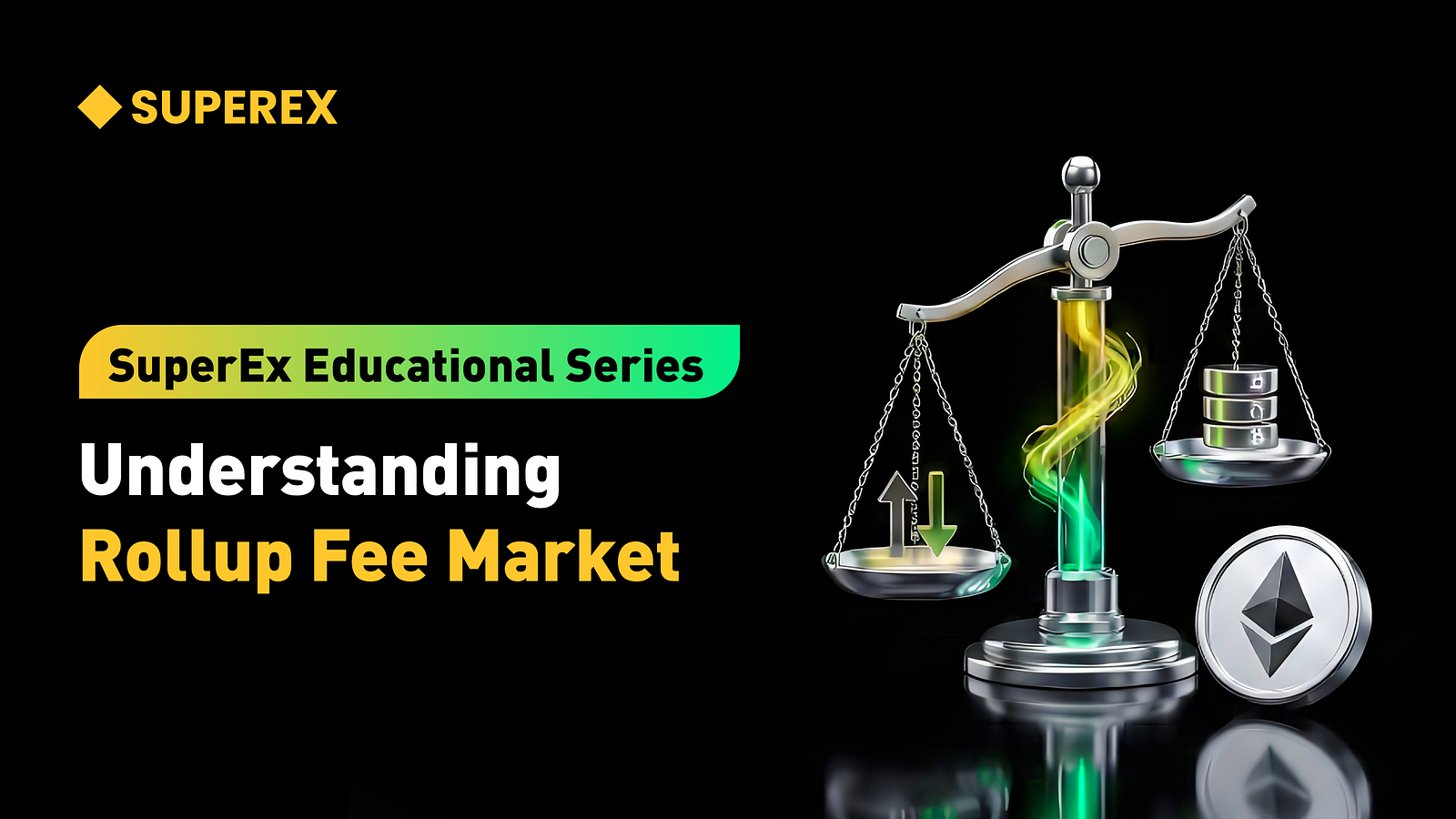
But reality quickly corrects that impression. Rollups haven’t eliminated fees — they’ve merely restructured where fees come from and how they behave.
In most Rollups, the cost of a single transaction consists of at least three components:
- Execution Fee
- Sequencing Fee
- Data Availability (DA) Fee
The “Gas Fee” you see in your wallet or frontend is just a bundle of these three.
Layer One of the Fee Market: Execution Fee Is Not the Bottleneck
If you only look at the gas fee displayed in a transaction confirmation window, you might conclude: “Rollups have solved the cost issue.”
But this is actually the most misleading layer of Rollup design.
Under both Optimistic and ZK architectures:
- Execution happens off-chain
- No direct competition for L1 blockspace
- Execution nodes rely on predictable local resource costs
The marginal cost of executing a transaction becomes negligibly low.
From an engineering perspective, this is a major success. But from an economic standpoint, it can be misleading.
Because execution fees are just the visible cost — not the decisive one.
So when you see L2 gas rising from $0.02 to $0.30, your first thought might be: “Is execution more complex now? Is the network busier?”
The answer is usually: No. Execution hasn’t changed. But competition for non-execution resources has begun.
More importantly: When execution is nearly free, it encourages overuse.
- Apps make more frequent calls
- Bots spam relentlessly
- Users click multiple times “just in case”
This creates a paradox: The cheaper execution becomes, the more likely non-execution costs will spike.
That’s why most Rollups experience fee volatility not as a smooth curve, but as sudden surges, followed by a loss of predictability.
You thought you were paying for computation — but in truth, You’re paying for the moment when scarcity returns — and that scarcity isn’t in execution.
Ordering Power = Pricing Power: Sequencers Are the Heart of the Fee Market
If execution costs create the illusion of cheapness, then sequencers determine how fees spiral out of control.
In nearly all Rollup architectures today, the sequencer plays an “innocent” role:
- Receives transactions
- Sorts them
- Batches them
- Submits results
But from an economic lens, the sequencer is the central pricing node. It doesn’t need to change gas rules — it only needs to control:
- Who gets processed first
- Who gets delayed
- Who is forced to pay more
During idle periods, this power is invisible.Sequencers produce blocks quickly, all transactions are packed in, and users naturally think: “This system is efficient and fair.”
But the moment congestion hits — meme coin hype, airdrop farming, bot frontrunning — the sequencer’s role transforms instantly:Ordering space becomes a scarce resource.It’s no longer about “will your transaction be executed,” but “will it be executed first.”
Gas becomes a bidding tool.You’re not paying the network — you’re bidding for ordering priority.
This mirrors L1 auctions — with three key differences:
- Smaller competition scope
- Less transparent rules
- More centralized control
That’s why single-sequencer Rollups often suffer steep fee spikes during peak periods.It’s not due to poor design — it’s an inherent consequence of centralized ordering.
As for why decentralized sequencers are so slow to arrive? Very practical reasons:
- They slow down block production
- Coordination costs hurt UX
- Once you decentralize sequencing, incentive design becomes very complex
The sequencer is both the performance engine and the economic power node.You can optimize, constrain, or balance it — But under current Rollup paradigms, you can’t ignore it.This is the most sensitive and central layer of the Rollup Fee Market.
The Most Misunderstood Cost: Data Is the True “Hard Cap”
If sequencing governs short-term fee spikes, then data availability (DA) determines the long-term cost floor.
No matter which Rollup you use:
- State commitments must go on-chain
- Transactions must be verifiable
- Data must be visible to the outside world
This step cannot be skipped.So when L1 congestion hits:
- L1 gas rises
- DA costs rise with it
- Rollup fees passively increase
That’s why we often see this “counterintuitive” situation: L2 usage hasn’t changed — but fees are climbing.
It’s not due to L2 itself, but rather the L1 data and security layer it anchors to.
Hence the rise of modular DA solutions like Celestia, EigenDA, and others — These have become core topics in the Rollup ecosystem’s long-term roadmap.The fee market is never isolated.
Different Rollups = Completely Different Fee Market Logic
Zooming out, we see:
- Generalized Rollups → Fee markets are shared-resource auctions
- App-Specific Rollups → Fee models resemble internal pricing systems
- Sovereign Rollups → May rewrite fee logic entirely
For example, some fee experiments include:
- Fixed fee models
- App-subsidized gas for users
- MEV captured to offset user gas
- Fees embedded in user actions, not individual transactions
That’s why we emphasized in earlier articles: Choosing a Rollup model is fundamentally choosing a fee market structure.
Why Fee Markets Define the User Experience
Most users don’t care about technical details — But they do feel:
- Did the payment go through instantly?
- Did the action get stuck?
- Did they get priced out during a surge?
These user experiences all boil down to one question: How are fees being priced?
A well-designed Rollup ensures:
- Fees are predictable
- Volatility is bounded
- Peak behavior is understandable
A poorly designed fee market? Even with great tech — user experience suffers endlessly.
Final Words: The Endgame of Rollups Is Not Zero Gas — But Fee Rationality
Looking back on the entire Rollup series, we see a clear pattern:
- Scaling solves: can it run?
- Architecture solves: who decides?
- Fee Market solves: is it worth using?
A truly mature Rollup ecosystem won’t be defined by just “cheaper gas” —
But by:
- Cost and value alignment
- Power and responsibility alignment
- Sustainable equilibrium between users, apps, and infrastructure
That is the final threshold Rollups must cross to become true infrastructure.


Responses