
SuperEx Educational Series: Understanding How Do Malicious Websites Exploit Approvals, Signatures, or Transaction Requests to Steal Users’ Assets?

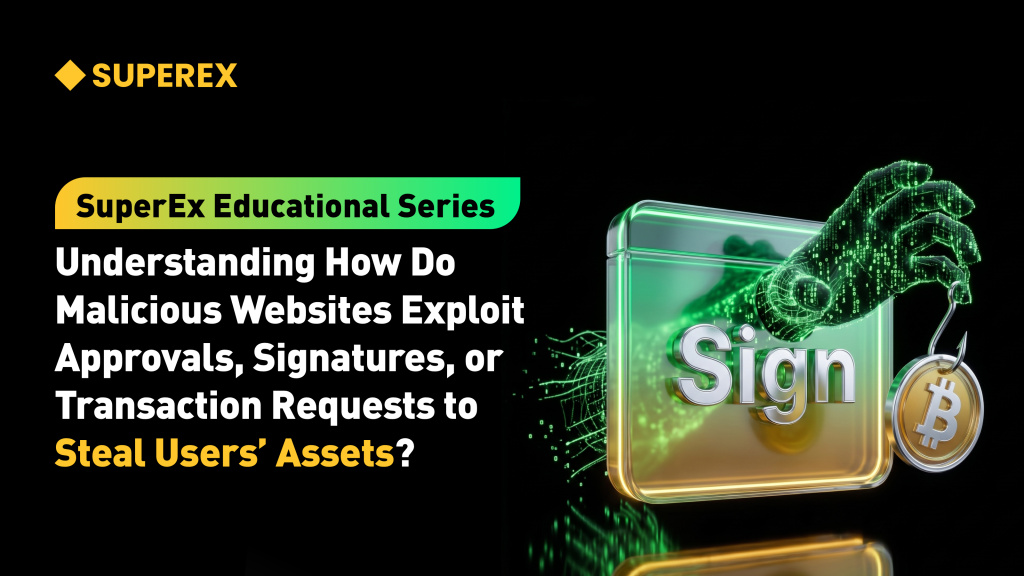
#SuperEx #EducationalSeries #Users’ Assets
Some phishing websites do not look “evil” at all.
They may have polished interfaces, live countdowns, project logos, and a comment section full of people claiming that rewards have arrived. After you connect your wallet, the website does not even ask for your seed phrase. It simply presents an ordinary-looking request: “Verify Wallet,” “Claim Airdrop,” or “Enable Trading.”
Then you click confirm.
A few minutes later, the assets are gone.
These incidents are often described as “wallet hacks” or “blockchain attacks.” In many cases, however, the attacker has neither broken the blockchain nor calculated the user’s private key.
They simply persuaded the user to submit a valid authorization.
The page may say “Claim,” while the wallet is actually signing “Allow this address to control my tokens.” In plain English, you thought you were collecting a coupon, but you were actually signing an asset management mandate.

The Real Vulnerability Is the Gap Between Human Intent and On-Chain Permission.
To understand these attacks, we must first separate three different things: the website interface, the wallet request, and on-chain execution.
A website interface is just a webpage. Its developer decides whether a button says “Claim Reward,” “Verify Account,” or “Earn Now.” That text does not automatically become part of the transaction, and the blockchain has no idea what the user saw.
The wallet popup shows the actual request sent by the website. It may merely ask to read the address, or it may request a message signature, token approval, contract call, or direct transfer.
On-chain execution only cares about the real parameters: which contract is called, who receives permission, how much is authorized, where assets are sent, and which function is executed. A button labeled “Security Verification” does not magically turn a dangerous approval into a safe operation.
So the heart of the attack is often not password theft, but intention disguise.
The malicious website first convinces the user that an action is normal, then embeds dangerous permissions in the wallet request. Once the user confirms it, the blockchain sees a valid instruction signed by the private key and executes it exactly as designed.
There is an important boundary here: merely opening a website is normally not enough to transfer assets. Simply connecting a wallet usually only reveals the public address, selected network, and account status.
The dangerous turning point usually appears when the user signs a message, grants an approval, or confirms a transaction. Connecting a wallet is like telling someone which building you live in. Signing a dangerous permission may be like handing them a spare key.
Three Similar-Looking Requests Can Create Very Different Risks.
Direct Transactions: Assets May Move Immediately
The simplest example is a malicious transaction request.
A website may trick a user into confirming a token transfer or calling a malicious contract. The latter may not clearly display “Send this much USDT to a scammer.” Instead, it may appear as a contract interaction, batch call, claim, swap, or mint.
If the transaction itself contains an asset transfer, the assets may leave the wallet as soon as the transaction is executed. A malicious contract can also combine several actions and complete an approval, swap, and transfer within a single confirmation.
The defining feature is immediacy. The user signs an on-chain transaction, pays gas, and can usually see a pending and confirmed transaction in the wallet.
But “transaction successful” only means the network executed the instruction. It does not mean the result matched the user’s original intention.
The blockchain does not stop and ask, “This person looks phished, should we cancel the transfer?” It verifies signatures, balances, nonces, and contract conditions. It does not verify whether the webpage misled the user.
Token Approvals: No Immediate Transfer Does Not Mean No Future Loss
A more subtle risk comes from token approvals.
ERC-20 allows a holder to give another address a spending allowance. The approved party can later transfer tokens from the holder’s address within that allowance. The mechanism itself is legitimate and is widely used by decentralized exchanges, lending protocols, and payment applications. ERC-20 standard
The problem is that a malicious website may convince the user to approve a contract controlled by the attacker and grant it an extremely large, sometimes effectively unlimited, allowance.
When the approval transaction is executed, the user’s balance may remain unchanged. Many users then relax: “It was only an approval, not a transfer.”
The actual transfer has simply been postponed.
The attacker can wait until the approval is active and then call the delegated transfer function. Even if the wallet holds little at the moment of approval, future deposits of the same token may remain exposed while the allowance is still valid.
This is why closing the website or disconnecting the wallet does not revoke an on-chain approval. A website connection is a session, while a token approval is a permission stored in contract state. The browser may be closed, but the access card still works.
NFTs have a similar risk. The ERC-721 operator approval mechanism can allow an operator to manage all NFTs belonging to the owner under that collection, rather than only one item shown on the webpage. ERC-721 standard
If a user believes they are listing one NFT but actually approves an unknown address to manage the entire collection, one ordinary-looking confirmation may expose multiple assets.
Permit Signatures: “No Gas” Does Not Mean “No Risk”
The third category is especially deceptive because it may not be an immediate on-chain transaction. It may only be an off-chain signature.
ERC-2612 introduced the Permit mechanism, allowing users to modify token allowances through a structured signature. The signer does not have to submit the transaction personally. Another address can relay the signed permit to the token contract. ERC-2612 standard
This was designed to improve user experience. A user can sign first, while an application or relayer pays the gas and completes the operation.
Attackers exploit that convenience. Because the wallet shows no gas fee and no transaction immediately appears on-chain, the user assumes it is “just a login signature.” In reality, the message may authorize a spender to use a large amount of tokens.
After obtaining the signature, the attacker can submit the permit before its deadline and then use the resulting allowance to move the assets.
One detail matters greatly: the deadline in a permit commonly limits when the signed message may be submitted. It does not necessarily mean that the resulting allowance automatically expires at that same time. A far-away deadline should therefore be treated as a potentially long-lived risk.
That is why “this signature costs no gas” is not proof of safety, and “no transaction appeared immediately” is not proof either.
A signature can work like a check. The balance does not change when the check is written, but the holder may cash it later.
A Complete Case: At Which Step Did the User Lose Control?
Suppose Alice sees a social media post claiming, “A major project has opened compensation claims for early users. Limited time only.”
She follows the link to a page almost identical to the official website. The site asks her to connect her wallet. Nothing happens after she connects, and her balance remains unchanged, so she begins to trust the page.
Once connected, the website knows her public address. It can inspect public on-chain data, discover that Alice holds 20,000 stablecoins, and generate a more valuable attack request specifically for her.
The page then says, “Sign to verify eligibility. No gas required.”
The wallet displays a structured message. Alice does not inspect the spender address, token contract, amount, or deadline. She only sees the “Sign” button. What she actually signs grants an unknown contract an effectively unlimited stablecoin allowance.
Minutes later, the attacker submits the permit, activating the allowance on-chain. The malicious contract then transfers the stablecoins using delegated spending authority.
From a technical perspective, every component may have “worked correctly”:
- The website issued a signature request.
- The wallet signed it with Alice’s key.
- The token contract verified the signature.
- The blockchain executed the approval and transfer.
The failure occurred at the intention layer.
Alice thought she was proving, “I am an eligible user.” What she actually proved was, “I authorize this address to spend my tokens.” The blockchain was not broken. Human understanding was bypassed.
At this point, merely disconnecting the website is no longer useful. If the approval is already on-chain, it must be revoked on the relevant network. If assets have already been transferred, revocation can only prevent future use. It cannot reverse completed transfers.
If the seed phrase or private key was exposed, the situation is more serious. The attacker now has the account’s signing authority. The user should move remaining assets to a wallet created with an entirely new seed phrase. Changing the wallet app password does not invalidate an exposed private key.
What Should You Check Before Signing, and What Should You Do After an Incident?
Users do not need to decode every byte of a smart contract, but they should answer at least four questions.
First, is this a connection request, ordinary signature, token approval, or on-chain transaction?
Second, who receives the permission? Is the spender, recipient, or verifying contract the expected address?
Third, which assets can be controlled, in what amount, and for how long? Unlimited amounts, all-NFT access, long validity periods, or batch calls deserve immediate caution.
Fourth, how can the permission be revoked? If a page refuses to explain but keeps shouting “30 seconds remaining,” it may not be improving efficiency. It may be preventing thought.
For daily use, it is wise to separate a long-term storage wallet from a DApp interaction wallet. The vault wallet should rarely connect to unfamiliar applications, while the interaction wallet should only hold the amount needed for current activity.
A hardware wallet helps keep private keys from leaving the device, but it cannot stop a user from approving a malicious transaction on the device itself. A stronger safe is useful, but if the owner unlocks it and willingly hands over the contents, the safe cannot offer much of a counterargument.
If a suspicious request has already been signed, immediately inspect transactions and approvals on the relevant network. Revoke unknown token allowances and NFT operator permissions, and check other networks for similar exposure.
For pending transactions, it may be possible to cancel or replace them depending on the wallet and network. For an exposed permit signature, update the allowance or nonce using methods supported by that token contract. If it is unclear whether the signature remains usable, moving the affected assets to a secure address is safer than waiting for the attacker to appear.
One point deserves repetition: disconnecting a website, clearing browser data, or uninstalling a wallet extension does not revoke on-chain permissions.
No legitimate DApp needs users to enter a seed phrase on a webpage to connect a wallet, claim an airdrop, or synchronize an account. Once a page asks for a seed phrase or private key, there is no need to continue investigating whether it is an official mirror. Leave immediately.
Taking SuperEx as an Example: Wallet Security Is More Than Locking the Private Key.
Take SuperEx Web3 Wallet as an example. It follows a self-managed wallet model in which access and control depend on the user’s seed phrase or private key. SuperEx’s official security guidance also warns users about malicious links, fake airdrops, high-yield schemes, fraudulent wallet approvals, and attempts to steal seed phrases or private keys. SuperEx Web3 Wallet FAQ
The important value of this model is that users do not need to permanently hand final control of their on-chain assets to a centralized custodian. But when control returns to the user, risk judgment cannot be completely outsourced.
A platform can reduce mistakes through risk warnings, transaction displays, DApp connection management, and security education. However, no wallet can guarantee that every permission voluntarily signed by a user matches that user’s true intention.
A more mature security approach does not ask only, “Has my private key leaked?” It also asks, “Who am I authorizing, what can they do, and how long will that permission remain?”
Platforms such as SuperEx provide wallet access and security protections. Users must still protect seed phrases, verify official channels, limit approvals, and separate long-term holdings from frequently used funds. Both sides are necessary.
Conclusion
Malicious websites do not always need sophisticated exploits. Sometimes they only need to disguise a dangerous permission as an ordinary button and wait for the user to provide the final confirmation.
A direct transaction can move assets immediately. A token approval gives an attacker future spending authority. A permit can exist first as an off-chain signature. An NFT operator approval may expose multiple assets at once.
The lesson is not that every signature is dangerous or that users should never connect to DApps.
The real lesson is this: what a website says does not determine what happens on-chain. The permissions inside the signature or transaction do.
The next time a website says “Free Claim,” “No Gas,” or “Verification Only,” pause for ten seconds. Check the spender, amount, affected asset, and duration of the permission.
Ten seconds may look like enough time to miss a countdown. In reality, it may be enough to save an entire wallet.
About SuperEx
SuperEx is committed to building a Web3-centered digital asset ecosystem, offering global users crypto trading, Web3 wallet, DAO, earning, and educational services. Through trading infrastructure, decentralized asset management tools, and continuous security education, SuperEx aims to help users understand the on-chain world and manage digital assets more safely.
Click to register SuperEx
Click to download the SuperEx APP
Click to enter SuperEx CMC
Click to enter SuperEx DAO Academy — Space



Responses