
SuperEx Educational Series: Understanding How Does a New Node Catch Up with the Entire Blockchain Network


#SuperEx #EducationalSeries #Blockchain
Many people run a blockchain node for the first time and expect it to work like opening an app: download, click start, connect.Then reality arrives: syncing, many blocks remaining, disk working, CPU busy, network downloading, progress bar moving calmly. You thought you were starting software. Actually, your computer is catching up on the entire history of the chain.
A new node does not catch up by simply copying someone else’s database. It must find peers, download data, verify blocks, replay transactions, build local state, and reach the latest chain head. In plain English: a node does not just believe what others say the network looks like. It checks the work and reconstructs history.

What Does “Node Sync” Mean?
Node sync means a node starts from what it already knows, downloads and verifies missing blockchain data, and catches up to the network’s current state.
If it is the first run, the node usually only knows the genesis block, chain configuration, and built-in client rules. It does not know recent transactions, latest blocks, current account balances, or the UTXO set.
So synchronization is not merely “downloading blockchain files.” It is a continuous verification process. The node checks that blocks link correctly, transactions are valid, state transitions follow rules, and the final local state matches the network.
In one sentence: syncing is how a new node moves from “I know almost nothing” to “I can independently verify the latest chain head.”
Concept Interpretation
The most important ability of a blockchain node is not storing lots of data. It is verifying data.
If a node only receives a “latest balance sheet” from someone else, it is still trusting that person. A real full node checks blocks, transactions, signatures, state transitions, and consensus proofs according to protocol rules. Only after validation does it store data locally.
This is why syncing can be slow. It is not because the node is lazy. It is checking history. The Bitcoin FAQ also explains that long synchronization mainly affects full node clients because they download and verify historical transactions.
In plain words: a light wallet can ask others “how much do I have?” A full node calculates “why do you have that amount?”
How Does a New Node Catch Up?
First, it loads the genesis block and chain rules.
When a node starts, it knows where the chain begins, which network it is joining, what consensus rules apply, and what chain ID or network parameters are used. Different genesis blocks usually mean different chains.
Second, it discovers peers.
A node needs to connect to other nodes. Bitcoin nodes connect through version handshakes and address discovery. Ethereum nodes use peer discovery for execution-layer and consensus-layer networks. Without peers, the node has no one to request data from.
Third, it downloads block headers.
Block headers are much smaller than full blocks. They include parent hashes, timestamps, difficulty or consensus data, Merkle roots, or state commitments. Bitcoin’s headers-first sync downloads the header chain first, partially validates it, and then downloads corresponding blocks in parallel.
Fourth, it downloads block bodies or state data.
The node needs transactions, receipts, state data, or UTXO information. A Bitcoin full node downloads and validates all blocks from after genesis to the current tip. Ethereum nodes may fully replay history or use snap sync to obtain recent state faster and verify forward, depending on sync mode.
Fifth, it validates and executes.
Bitcoin nodes check proof-of-work, block links, transaction inputs, signatures, double-spend rules, and UTXO updates. Ethereum execution clients execute transactions, run the EVM, update balances and contract storage, and check whether the state root matches.
Sixth, it builds a local database.
The node stores block data, chain-head information, state databases, UTXO sets, transaction indexes, or other required structures. This local database is not blindly copied; it is built through verification.
Seventh, it reaches the latest head and enters live mode.
Once the node catches up to the current tip, it stops catching up on old history and starts receiving new blocks and transactions in real time. It participates in block relay, transaction relay, and network data service.
Bitcoin Case: Initial Block Download
Bitcoin calls the catch-up process Initial Block Download, or IBD.
The Bitcoin Developer Guide explains that before a full node can validate unconfirmed transactions and recently mined blocks, it must download and validate blocks from after the hardcoded genesis block to the current tip of the best blockchain.
Modern Bitcoin Core uses a headers-first approach. The node first requests headers, verifies that they link correctly and satisfy proof-of-work targets, then downloads full blocks. This is more efficient than blindly downloading complete blocks first and helps detect peers feeding incorrect history.
After downloading blocks, a Bitcoin node validates transactions and builds the UTXO database. This UTXO set records which outputs remain unspent, forming the basis of spendable value.
So Bitcoin node syncing is not just “downloading hundreds of gigabytes.” More accurately, it downloads, validates, computes, and builds its own chainstate.
Ethereum Case: Execution Client and Consensus Client
Ethereum’s node structure is more complex today. A full Ethereum node usually needs both an execution client and a consensus client.
The execution client handles the transaction pool, EVM, account state, contract storage, transaction execution, and JSON-RPC. The consensus client handles proof-of-stake consensus, beacon blocks, attestations, fork choice, and finality.
Ethereum.org explains that full nodes verify blocks and state, but usually do not permanently store all historical states. Archive nodes keep complete historical states, making them useful for querying past balances or contract states, but storage cost is high.
Geth documentation distinguishes full sync, snap sync, and archive nodes. Full sync executes every block from genesis to generate current state. Snap sync starts from a recent trusted checkpoint and catches up faster. Archive nodes retain historical state data back to genesis.
In plain words: an Ethereum node catches up with both consensus history and execution state. One side determines which chain is accepted; the other calculates what the chain currently means.
Full Node, Archive Node, and Light Client
Full node does not necessarily store every historical state since genesis.
Many full nodes verify the chain and store current state plus recent data while pruning older state. They can independently verify the current chain, but may not instantly answer “what was this address’s balance at a block five years ago?”
Archive nodes are heavier.
They store historical states and are useful for block explorers, analytics, wallet providers, audit tools, and research platforms. But for normal users, archive nodes are expensive. Do not rush into the heaviest setup just because it sounds more complete.
Light clients are lighter.
They do not download and verify all block bodies. They rely on headers, state roots, proofs, or trusted checkpoints to verify necessary data. Light clients are better for mobile and low-resource devices, but their trust model and data availability assumptions must be clear.
Why Sync Takes So Long
First, history is long.
Bitcoin has been running since 2009, Ethereum since 2015. Blocks, transactions, receipts, and state changes keep growing. A new node is not catching up on one day of news; it is catching up on years of history.
Second, validation matters more than downloading.
Downloading data is not the hard part; checking validity is. Signatures, proof-of-work, state transitions, gas, UTXOs, and contract execution all require computation. Blockchain security is not free.
Third, disk I/O is heavy.
Syncing frequently reads and writes databases. Often the bottleneck is not internet speed, but disk random access. Running a node on a slow disk can feel painfully old-school.
Fourth, peer quality varies.
If connected peers upload slowly, lack data, or disconnect often, syncing slows down. P2P networks are open, and openness means peer quality varies.
Fifth, state keeps growing.
Especially on account-and-contract chains like Ethereum, current state is large. A node must not only catch blocks but also obtain verifiable current state.
A Simple Case
Suppose Alice wants to run her own Ethereum node instead of relying entirely on third-party RPC providers.
She installs an execution client and a consensus client, selects mainnet, and loads genesis plus network configuration. After startup, the node discovers peers. The consensus client may use checkpoint sync to catch up from a recent finalized checkpoint. The execution client may use snap sync to obtain recent state data and verify forward to the head.
During syncing, Alice’s node downloads headers, blocks, state chunks, receipts, and checks them against rules. Once caught up, Alice can use her own RPC to query balances, send transactions, watch new blocks, and even serve data to wallets or DApps.
- From the user experience, she waited for a sync progress bar.
- From the system perspective, her computer moved from being an outsider to being one of the network’s verifiers.
Why This Matters
First, it explains why nodes reduce trust.
A node verifies history itself and does not need to fully trust RPC providers, block explorers, or third-party services.
Second, it explains why decentralization has cost.
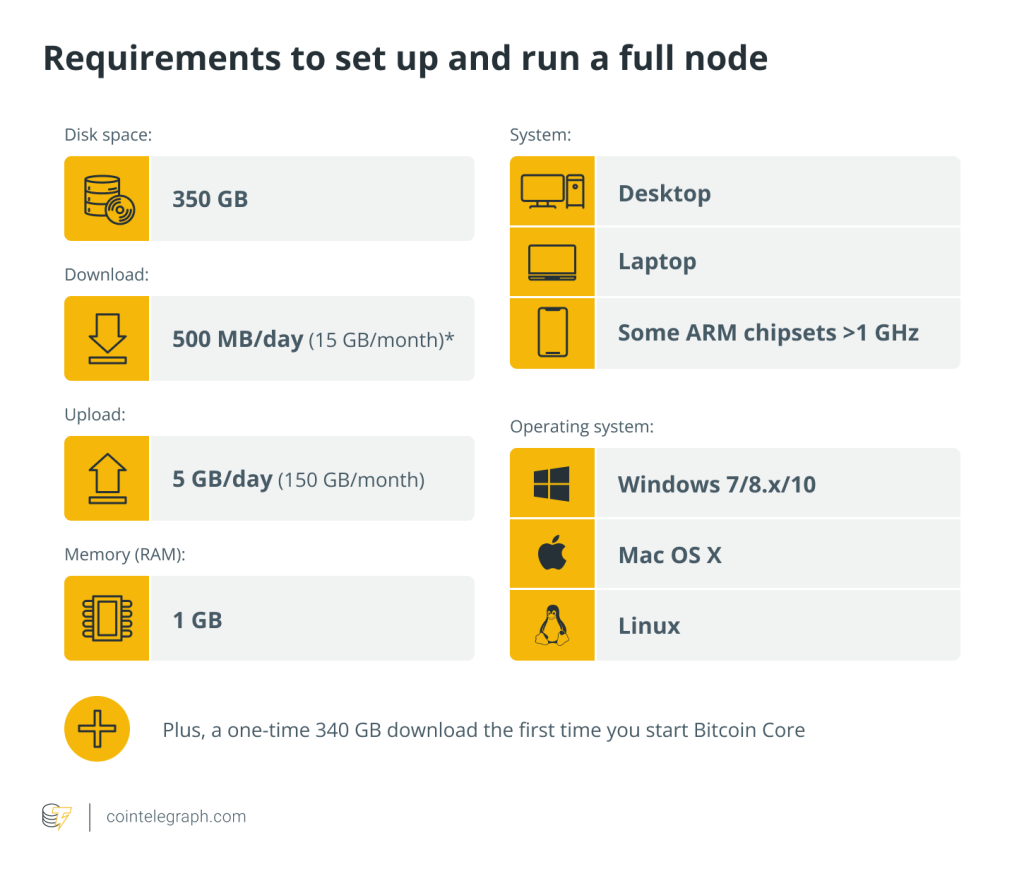
Running nodes requires bandwidth, storage, CPU, memory, and maintenance. Decentralization is not a slogan; someone must actually run infrastructure.
Third, it explains why light wallets depend on nodes.
Most user wallets do not sync the entire chain themselves. They connect to RPC or light-client services. Wallets are convenient, but node data still comes from somewhere.
Fourth, it explains why archive nodes are expensive.
Historical state queries are not always available from normal full nodes by default. Block explorers and analytics platforms need heavier data infrastructure.
Common Misunderstandings
The first misunderstanding: a new node simply downloads someone else’s database.
Wrong. A node downloads data and then verifies it. The value of a full node is that it does not blindly trust someone else’s result.
The second misunderstanding: a full node must store all historical states.
Not necessarily. Many full nodes prune old state and keep current state plus necessary historical data. Archive nodes store full historical state.
The third misunderstanding: a node is useless before sync completes.
Not entirely. It may already verify parts of history or sync consensus information, but before it catches up, it should not be treated as a current-state source. Using an unsynced node to check balances can be misleading.
The fourth misunderstanding: light clients and full nodes have exactly the same security.
Not accurate. Light clients are useful and can verify data through proofs, but they usually rely on additional assumptions, such as trusted checkpoints, full-node data service, or proof availability.
Risks and Design Questions
First, trusted checkpoint risk.
Snap sync and checkpoint sync improve efficiency, but checkpoint sources must be chosen carefully. If the starting point is wrong, careful verification afterward still follows the wrong path.
Second, node centralization risk.
If normal users stop running nodes and rely on a few RPC providers, access points become centralized. Assets remain on-chain, but the user’s view may be shaped by a few gateways.
Third, client diversity risk.
If different clients implement rules inconsistently, consensus problems may happen. Ethereum emphasizes client diversity to reduce the impact of a single client bug.
Fourth, hardware barrier risk.
If chain data grows too fast, ordinary users find it harder to run nodes, weakening decentralization. Block size, state growth, storage optimization, and light-client design all relate to this.
Conclusion
How does a new node catch up with the entire blockchain network? It starts from genesis or a trusted checkpoint, discovers peers, downloads headers, blocks, and state data, verifies history under protocol rules, builds a local database, and finally reaches the latest chain head.
- A Bitcoin node uses IBD to download and validate historical blocks and build the UTXO set.
- An Ethereum node uses execution and consensus clients together, catching up through full sync, snap sync, checkpoint sync, and related strategies.
Understanding node sync explains why blockchain is not “everyone trusts one server,” but “each node can verify for itself.” This is the natural next step after previous articles: transactions enter the network, blocks are created and propagated, candidate chains are selected, and new nodes must catch up on this history to join the shared ledger.
In plain words: a new node does not join by reading only the latest message. It must check the history, rules, ledger changes, and current result to confirm it is on the same history as everyone else. Only then is it not just listening, but truly participating in verification.
About SuperEx
As the world’s first Web3-powered cryptocurrency exchange, SuperEx has remained committed to building the Web3 ecosystem. Over the years, it has introduced a comprehensive range of products and services, including SuperEx DAO, SuperEx Web3 Wallet, Super Start, SuperEx P2P, SuperEx Stock Markets, SuperEx Copy Trading, SuperEx Earn, and SuperEx DAO Academy, creating a full-spectrum ecosystem that spans every major sector of Web3.
Today, SuperEx serves over 10 million users, with a social media community of more than 600,000 followers across 166 countries and regions worldwide. The platform supports 1,000+ cryptocurrencies for both spot and futures trading. Seamlessly integrated with Super Wallet, SuperEx provides decentralized asset custody while combining the trading efficiency of a centralized exchange (CEX) with the security of a decentralized exchange (DEX).
Click to register SuperEx
Click to download the SuperEx APP
Click to enter SuperEx CMC
Click to enter SuperEx DAO Academy — Space


Responses