
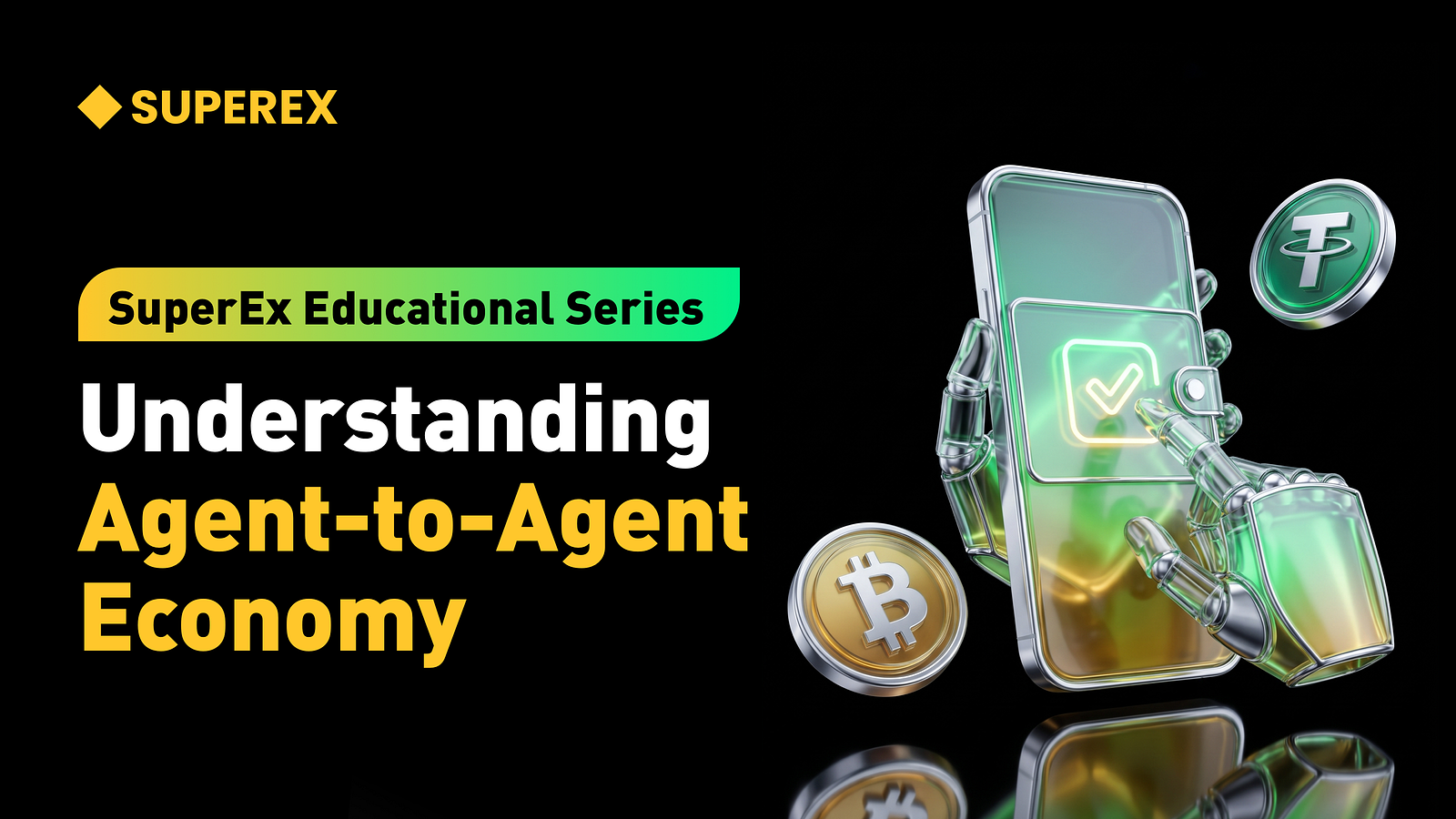
SuperEx Educational Series: Understanding Agent-to-Agent Economy

#SuperEx #EducationalSeries #crypto
Before, when people talked about AI agents, most imagined one assistant helping one human: writing emails, checking data, watching markets, maybe clicking a few buttons.
But Agent-to-Agent Economy is not just “one AI works for one person.” It is about many agents finding tasks, hiring each other, paying each other, delivering services, and settling value.
In plain English: before, you asked your agent to work. In the future, your agent may ask other agents to work.You are still drinking coffee, while they are already coordinating tasks. Nice idea, but it immediately raises questions: who authorized this, who paid, and who is responsible if it goes wrong?
What Is Agent-to-Agent Economy?
Agent-to-Agent Economy refers to an economic network where multiple AI agents can communicate, collaborate, trade services, pay fees, and complete tasks with one another.
It is not just a group chat for agents. A real Agent-to-Agent Economy includes several things:
- agents can discover other agents;
- agents can understand what services others provide;
- agents can negotiate tasks and prices;
- agents can verify delivery;
- agents can pay and settle;
- agent actions have permissions, logs, and accountability boundaries.
In one sentence: Agent-to-Agent Economy moves agents from tools into economic participants that can collaborate and transact with one another.
How Does It Work?
Think of it as an automated outsourcing market.
Your asset-management agent finds a cross-chain yield opportunity, but it is not good at risk modeling. So it calls a risk-analysis agent. The risk agent says: “I can evaluate this pool for 0.5 USDC.”The asset agent pays, receives the risk score, and decides whether to proceed.
For example, a trading agent may need real-time news summaries and call an information agent. A DAO agent may need proposal analysis and call a governance agent. A game agent may need NPC behavior and call a content-generation agent.
There are several core flows:
- Discovery: where do I find an agent that can do this?
- Communication: what protocol do agents use to talk?
- Pricing: pay-per-call, subscription, auction, or outcome-based payment?
- Payment: who pays, with what asset, and on which chain?
- Verification: was the task actually completed?
- Accountability: who is responsible if it fails?
So Agent-to-Agent Economy is not “AI agents chatting.” It is “AI agents doing business.”Sounds advanced, but the basics are simple: order, work, verify, pay.
Why It Matters
It matters because no single agent can do everything.
- One agent may be good at trading, but not compliance.
- Good at compliance, but not cross-chain execution.
- Good at cross-chain, but not valuation.
- Good at valuation, but not governance reports.
A more realistic future is not one super-agent doing everything. It is many specialized agents working together. Each agent handles what it is good at, connected by protocols, payments, and settlement.
This is especially important for Web3. Web3 already has wallets, smart contracts, payments, identity, credentials, on-chain records, and programmable settlement. Agents do not only send web requests; they can actually pay, sign, call contracts, and deliver results.
In plain words, Web3 gives the agent economy a good place to settle accounts.AI does the work, and blockchains handle records and settlement.One handles reasoning; the other handles the ledger.
Key Components
First is agent communication protocol.
Agents need a way to understand one another. Google’s Agent2Agent, or A2A Protocol, is an open direction for agent interoperability and collaboration. Without communication standards, agents become very smart systems that cannot understand each other. Awkward.
Second is identity and reputation.
Agents need identity. Who created it? What has it done before? What is its success rate? Has it been reported? If an agent shows up and says, “Send me money, I am reliable,” that is not enough.
Third is payment and settlement.
Agents need small, frequent, automated payments. Protocols like x402 point toward a world where machines or agents can pay directly when requesting services. Without a payment layer, the agent economy becomes “everyone uses services, nobody pays.”
Fourth is wallets and permissions.
If agents transact, they need wallets. But wallet permissions must be limited: daily caps, allowlisted services, max spend per task, and human approval for large actions. Do not hand the main wallet directly to an agent. That is not futuristic; that is incident material.
Fifth is verification and delivery.
An agent saying “done” does not mean it is done. Results may need signatures, proofs, on-chain state, logs, hashes, oracles, or human review.
Relation to Autonomous Agents
- Autonomous Agent is about how one agent acts around a goal.
- Agent-to-Agent Economy is about how many agents form a market and collaboration network.
One agent can complete some tasks alone.But for complex tasks, it may outsource: data agents, risk agents, trading agents, compliance agents, payment agents.
So
- an Autonomous Agent is a worker that can act.
- Agent-to-Agent Economy is the market formed by those workers.
In plain English: one is the worker; the other is the labor market.Except this labor market may settle on-chain, move fast, and become very exciting when something breaks.
A Simple Case
Suppose Alice has a personal wealth-management agent. She gives it a goal:“Manage my stablecoin yield, but keep risk low, and ask me before large actions.”
This agent does not do everything alone. It starts hiring other agents:
- It asks a data agent for multi-chain yield rates.
- It asks a risk agent to evaluate pool safety.
- It asks a routing agent to calculate migration cost.
- It asks a gas-settlement agent to estimate destination-chain fees.
- It asks an execution agent to perform small transfers.
- Then it sends Alice a report.
Alice sees: “My agent gave me a recommendation, and the small part was handled automatically.”
Behind the scenes: agents communicate, quote, pay, deliver, verify, and log.
The user does not need to see every tiny step, but the system must record each one clearly.
That is the real value of Agent-to-Agent Economy: not letting AI agents chat, but letting complex tasks be completed by a network of specialized agents.
Common Misunderstandings
First misunderstanding: Agent-to-Agent Economy means AI automatically makes money.
No. It is an economic structure where agents trade services and complete tasks. Whether it makes money depends on service value, pricing, and risk control.
Second misunderstanding: agents can remove humans completely.
Not necessarily. High-risk scenarios still need human approval, governance checks, permission limits, and emergency pauses. Especially with funds, identity, compliance, and governance, do not let agents run wild.
Third misunderstanding: on-chain settlement equals trust.
Wrong. The chain can record payments and results, but service quality, model capability, input data, and execution process can still fail. A trustworthy ledger does not make every worker trustworthy.
Fourth misunderstanding: more agents are always better.
Not always. More agents can mean more coordination cost, communication overhead, and accountability problems. At some point, it stops being an intelligent economy and becomes automated blame-shifting.
Risks and Limitations
First is permission-sprawl risk.
One agent calls another, which calls a third. If permission boundaries are unclear, user authorization may spread through the chain, and nobody knows who actually touched the funds.
Second is payment-abuse risk.
Agents can pay automatically, which also means they can spend badly automatically. Budgets, limits, fee caps, and anomaly detection are necessary. Otherwise, the monthly bill may become a horror story.
Third is result-verification risk.
If an agent delivers analysis, scores, predictions, or text, verification is harder than checking a transfer. Systems need proofs, reputation, sampling audits, and dispute mechanisms.
Fourth is responsibility.
If several agents collaborate and fail, who is responsible? The initiating agent, execution agent, payment agent, model provider, or user? If this is not designed early, the post-incident meeting will be long.
Fifth is market concentration risk.
The final result may not be many agents competing freely, but a few large agent platforms controlling traffic, tasks, and payment rails. Then an open economy starts smelling like a platform economy.
Conclusion
The core value of Agent-to-Agent Economy is moving AI agents from isolated task execution toward a network of collaboration, service exchange, and automated settlement.
It is not agents chatting, and it is not AI automatically getting rich. It is a more practical direction: specialized agents doing specialized work, connected by communication protocols, identity and reputation, wallet permissions, payment rails, and verification mechanisms.
In Web3, this is especially interesting because blockchains are naturally good at records, payments, settlement, and audits. Agents can reason and execute off-chain, while using chains for payment and accountability.
But a mature Agent-to-Agent Economy is not unlimited automation. It should be controlled automation: limited permissions, clear budgets, traceable tasks, verifiable results, and accountable failures.
In plain words, the future may not be one human with one agent. It may be your agent coordinating many specialized agents for you.Sounds great.But remember: who can spend, how much they can spend, and who is responsible must be clear first.
About SuperEx
As the world’s first Web3-powered cryptocurrency exchange, SuperEx has remained committed to building the Web3 ecosystem. Over the years, it has introduced a comprehensive range of products and services, including SuperEx DAO, SuperEx Web3 Wallet, Super Start, SuperEx P2P, SuperEx Stock Markets, SuperEx Copy Trading, SuperEx Earn, and SuperEx DAO Academy, creating a full-spectrum ecosystem that spans every major sector of Web3.
Today, SuperEx serves over 10 million users, with a social media community of more than 600,000 followers across 166 countries and regions worldwide. The platform supports 1,000+ cryptocurrencies for both spot and futures trading. Seamlessly integrated with Super Wallet, SuperEx provides decentralized asset custody while combining the trading efficiency of a centralized exchange (CEX) with the security of a decentralized exchange (DEX).
- Cick to register SuperEx
- Cick to downoad the SuperEx APP
- Cick to enter SuperEx CMC
- Cick to enter SuperEx DAO Academy — Space



Responses