
SuperEx Educational Series: Understanding Privacy-Performance Tradeoff

#SuperEx #EducationalSeries
Privacy technology is a bit like adding extra protection before going outside.
You wear a mask, put on a hat, change your route, and turn off location tracking. It may protect you better, but it also takes more effort. Sometimes your friend may say, “You’re just buying coffee. Is all this really necessary?”
Privacy in Web3 works the same way. Shielded transactions, ZK, MPC, FHE, confidential contracts, and anonymous credentials all sound powerful, but they are not free switches. Stronger privacy often brings more computation, storage, communication, gas cost, latency, and user-experience complexity.
This is the Privacy-Performance Tradeoff.
- Cick to register SuperEx
- Cick to downoad the SuperEx APP
- Cick to enter SuperEx CMC
- Cick to enter SuperEx DAO Academy — Space
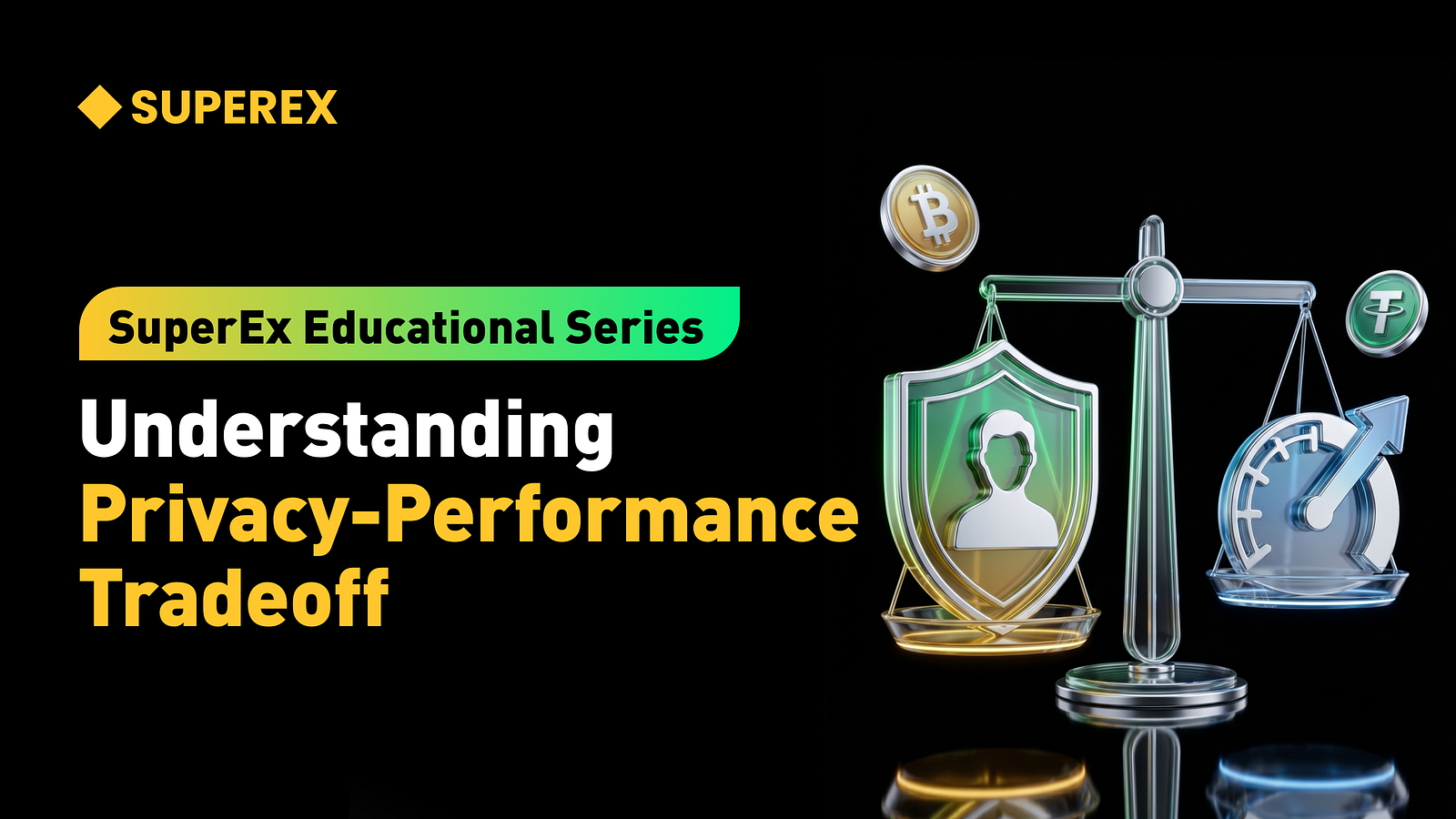
What Is Privacy-Performance Tradeoff?
Privacy-Performance Tradeoff refers to the tension between improving privacy protection and preserving performance, cost efficiency, speed, composability, or usability.
Here, performance does not only mean TPS. It also includes transaction confirmation time, proof generation speed, on-chain verification cost, wallet complexity, node workload, developer difficulty, protocol composability, and user waiting time.
In one sentence: the more privacy a system provides, the more extra work it usually has to do.
How Does It Work?
Why are normal on-chain transactions relatively straightforward? Because the information is mostly public. Nodes can directly see addresses, amounts, state changes, and contract calls, then verify them quickly.
Why are private transactions more complex? Because the system cannot simply reveal everything. It needs encryption, proofs, hiding, aggregation, authorized viewing, or off-chain computation. In other words, something that was once “just look and verify” becomes “do not see the details, but still confirm correctness.”
This creates costs.
- Zero-knowledge proofs may be fast to verify, but heavy to generate.
- FHE can compute on encrypted data, but computation is more expensive.
- MPC protects multiple parties’ inputs, but adds communication and coordination overhead.
- TEEs can offer better performance, but introduce hardware trust assumptions.
- Privacy pools need larger anonymity sets, but users may need to wait for more liquidity.
So the tradeoff is not simply “privacy is good” versus “performance is good.” It is about choosing the right balance for a specific use case.
Why the Tradeoff Exists
The first reason is that when less information is visible, verification becomes harder.
In a public system, verifiers can see full data. In a private system, they may only see proofs, commitments, ciphertexts, or summaries. To keep verification trustworthy, the system must add cryptographic mechanisms.
The second reason is that privacy requires extra computation.
Encryption, decryption, proof generation, encrypted computation, threshold signing, and anonymity set management are not free. They require CPU, memory, bandwidth, storage, and development resources.
The third reason is user experience.
If every transaction requires proof generation, privacy set selection, viewing key management, and disclosure authorization, privacy improves, but ordinary users may find the product difficult to use.
The fourth reason is compliance and auditability.
If a privacy system supports selective disclosure, audit interfaces, risk proofs, and permissioned viewing, it needs more rules and key-management processes.
Technical Dimensions
The tradeoff in zero-knowledge proofs is that verification can be lightweight, while proof generation can be heavy.
This is useful for on-chain verification, because the chain only checks a proof. But users, wallets, or proving services may need stronger hardware or longer waiting time to generate that proof.
The tradeoff in FHE is that it offers strong privacy, but at higher computation cost.
It allows systems to compute without decrypting data, which is powerful for confidential contracts and private data processing. But encrypted computation is usually slower than plaintext computation and harder to develop.
The tradeoff in MPC is that raw data does not need to be centralized, but communication and coordination become more complex.
Multiple parties can compute a result together without revealing inputs. But the more parties and the more complex the computation, the more important communication rounds, fault tolerance, and network reliability become.
The tradeoff in TEEs is that performance is closer to normal computation, but the trust model changes.
They are useful for private execution scenarios that need better performance, but users must accept assumptions around hardware, supply chains, remote attestation, and possible side-channel risks.
The tradeoff in anonymity sets is that more users usually mean better privacy, but also more waiting and liquidity cost.
If only a few users use a privacy pool, privacy is limited. If users need to wait for more people to join, experience and capital efficiency may suffer.
A Simple Case
Suppose Alice wants to participate in an on-chain sealed-bid auction. She does not want to reveal her bid early, because others could front-run or adjust their strategy after seeing it.
- If a normal smart contract is used, Alice’s bid may be public. The benefit is simplicity, lower cost, and fast confirmation. The downside is no bidding privacy.
- If zero-knowledge proofs are used, Alice can prove that she submitted a valid bid without revealing the amount. Privacy improves, but she needs to generate a proof, the contract needs to verify it, and development complexity and cost increase.
- If a confidential contract or TEE is used, bids can be processed in a private environment, possibly with better performance. But the system needs to trust the execution environment and attestation mechanism.
- If MPC is used, multiple nodes can jointly process the auction result without any single node seeing all data. But the nodes need communication and coordination, making the system more complex.
This is what the Privacy-Performance Tradeoff really looks like: no solution is always best. Every solution exchanges something among privacy, speed, cost, trust, and usability.
Common Misunderstandings
The first misunderstanding is that stronger privacy is always better.Not necessarily. Payments, voting, identity, trading, gaming, and enterprise collaboration need different privacy levels. Excessive privacy can increase cost and affect compliance or usability.
The second misunderstanding is that performance optimization always sacrifices privacy.Not always. Good design can improve both, through batch proofs, hardware acceleration, off-chain computation, verification caching, layered disclosure, and better wallet flows.
The third misunderstanding is that users will tolerate anything for privacy. Usually, they will not. Ordinary users will not wait ten minutes, click ten approvals, and manage five types of keys just because the cryptography is elegant. Privacy must feel usable.
Limitations
There is no universal answer to the Privacy-Performance Tradeoff. A privacy design suitable for institutional settlement may not work for small payments. A design suitable for high-value voting may not work for high-frequency trading.
Second, performance is not the only metric. Systems also need to consider security models, user trust, regulatory interfaces, developer tooling, auditability, and ecosystem compatibility.
Finally, privacy is not only about one transaction. Even if a single transaction is well protected, long-term behavior, timing patterns, fund flows, device fingerprints, and app interactions may still leak information.
Conclusion
The core value of understanding the Privacy-Performance Tradeoff is this: privacy is not free, and adding more technology is not automatically better. A mature privacy system must consider protection level, computation cost, on-chain fees, user experience, compliance needs, and security assumptions.
For Web3, the future will not rely on one privacy solution. ZK, FHE, MPC, TEEs, privacy pools, anonymous credentials, selective disclosure, and off-chain private computation will be combined across different scenarios.
The smarter direction is not maximum privacy everywhere, nor giving up privacy for speed. It is giving each scenario the right privacy boundary: public where needed, hidden where appropriate, proven where necessary, and fast where speed matters.

Responses