
SuperEx Educational Series: Understanding the Blockspace Market

#SuperEx #EducationalSeries
When many people first enter the blockchain space, they often notice something quite directly:
- Sometimes transactions are very cheap
- Sometimes they are extremely expensive
The same transaction might cost just a few cents yesterday, but tens or even hundreds today. Many people’s first reaction is: Is the platform overcharging?
But if you look at it from a different perspective, this situation is actually similar to something in the real world.
For example, when you book a ride during peak hours, the same route might normally cost $10, but during rush hour the price increases.
Why? The reason is simple — not because the distance has changed, but because demand has increased.
Transaction fees in blockchain work in a similar way. They are not fixed — they fluctuate.
The reason behind this is not just technology, but competition for resources.
So the real question is: What exactly are people competing for in blockchain?
The answer is simple, but often overlooked: They are competing for space in a block.
Each block has limited capacity. You can think of it like a vehicle with a fixed number of seats. When more people want to get on, they must queue — or pay more.
This is where an invisible market emerges: the Blockspace Market.
- Click to register SuperEx
- Click to download the SuperEx APP
- Click to enter SuperEx CMC
- Click to enter SuperEx DAO Academy — Space
A Simple Analogy
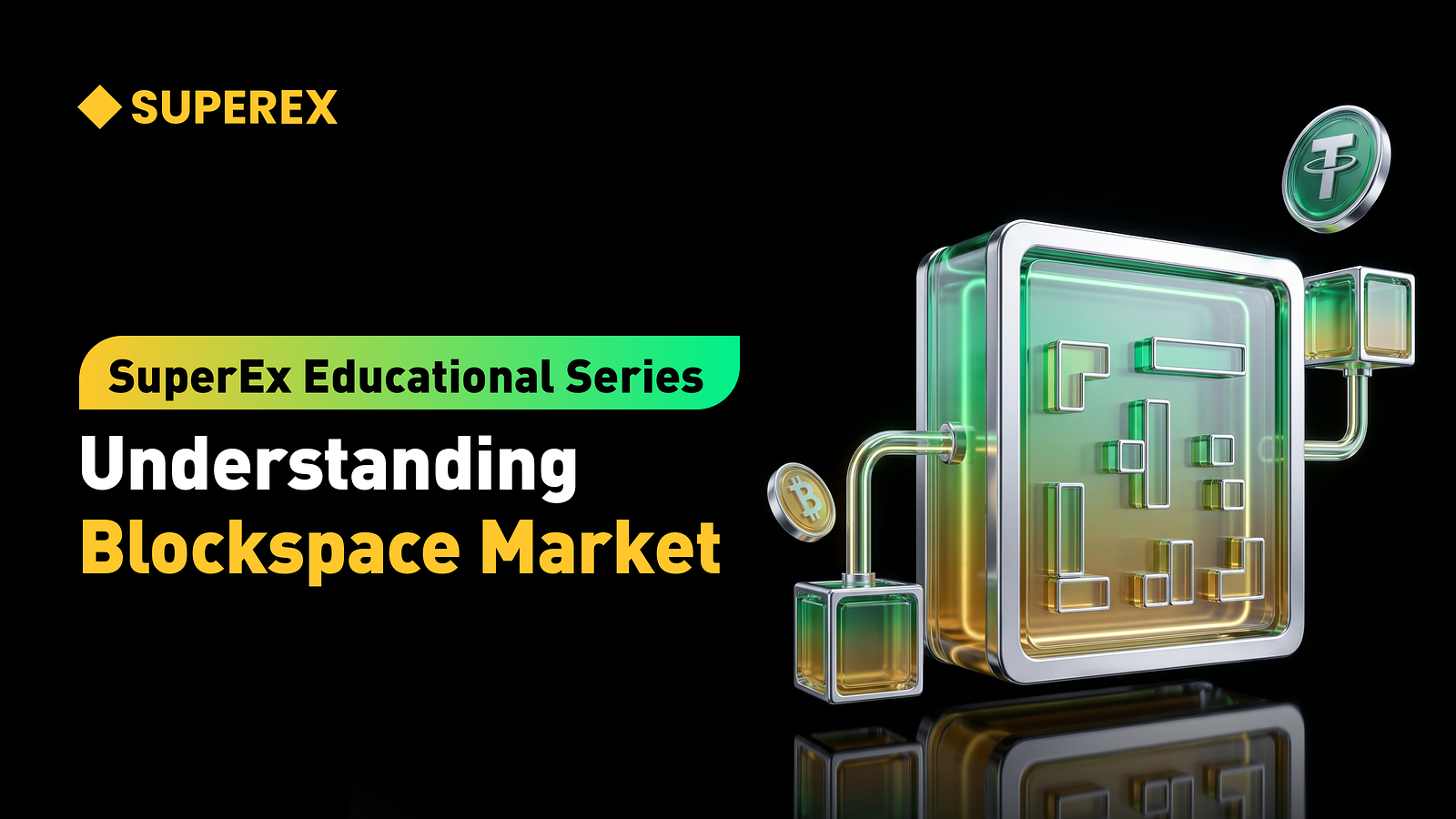
Imagine a boat that departs at regular intervals. The space on the boat is limited, and it can only carry a certain amount of cargo.
Everyone wants to load their goods onto the boat, because it delivers them to their destination.
At first, there are few people. Anyone can load their goods — first come, first served.
There is no competition and no price difference.
But over time, more people arrive:
- Some carry important goods
- Others are just sending small items
What happens then? As expected, space becomes limited.
At this point, something changes: Some people start offering to pay more to get their goods loaded first.
Now the rules shift: It is no longer “first come, first served,” but “whoever pays more gets priority.”
- The boat = the block
- The cargo = transactions
- The price to board = transaction fee
What is the Blockspace Market?
The Blockspace Market is essentially this process.
It is not the system deciding which transactions get included. Instead, users compete through pricing:
- You can choose to pay less and wait longer
- Or pay more for faster confirmation
- The system does not judge — it simply follows rules and sorts by price
Over time, this mechanism naturally forms a market:
- Some users are urgent, others are not
- Some are willing to pay more, others prefer to wait
- Most importantly, this market is decentralized
No single entity sets the price, and no authority decides priority. All outcomes are determined collectively by participants.
In fact, every transaction is a form of bidding.
So when you see fee fluctuations, don’t just look at the numbers — it reflects market sentiment:
- When everyone is in a hurry → fees rise
- When the market calms down → fees fall
This is not a system issue — this is the market at work.
Core of the Blockspace Market: Resource Allocation
In blockchain systems, blockspace is limited. Each block can only contain a certain amount of data and transactions.
This limitation comes from several factors:
- Technical constraints: block size, propagation speed, node processing capacity
- Security considerations: overly large blocks slow synchronization and may affect network stability
As a result, blockspace becomes a scarce resource — and one that all users compete for.
When resources are limited and demand increases, a market naturally forms.
How the Market Works
The process can be broken down into several steps:
Step 1: Transaction Submission
Users attach a fee when submitting a transaction — this acts as a bid.
Step 2: Sorting Mechanism
Transactions are ranked by fee. Higher-fee transactions get priority.
Step 3: Block Formation
Miners or validators select transactions that maximize their rewards.
Step 4: Confirmation
Transactions are included in a block and confirmed on-chain.
In essence, this is a simple market logic: Bid → Sort → Allocate resources
Key Characteristics of the Blockspace Market
Rule-Based
The system does not evaluate importance or user identity. The only criterion is price.
Dynamic
- When the network is congested → fees rise
- When demand drops → fees fall
There is no fixed pricing — changes happen in real time.
Competition-Driven
Users compete for faster inclusion, continuously pushing price adjustments.
Self-Regulating
- When fees are too high → some users exit → demand drops → fees decrease
- When fees are low → more users enter → demand rises → fees increase
This is a classic supply-and-demand equilibrium.
Economic Impact
The Blockspace Market does more than affect user experience — it shapes the entire network’s economic structure.
Transaction fees are:
- A major source of income for validators
- A key component of network security
If fees are too low: → Validator incentives weaken → network stability may be affected
If fees are too high: → Users leave → ecosystem growth is limited
Therefore, the system must balance:
- User costs
- Network security
- System efficiency
This is why different blockchains adopt different fee mechanisms, such as:
- Base fee + tip models
- Dynamic pricing mechanisms
- Blockspace allocation rules
All of these aim to solve the same problem: How to allocate blockspace more efficiently
A New Perspective
Once you understand the Blockspace Market, many phenomena become clearer.
Network congestion
When fees spike, it means demand for blockspace exceeds supply — often during volatile markets or popular applications.
The rise of Layer 2
Scaling solutions reduce reliance on main-chain blockspace by batching transactions and submitting them together, lowering per-transaction cost.
User behavior
Some users wait for lower fees, while others prioritize speed — this diversity is the foundation of the market.
Application design
Projects optimize data structures to reduce space usage, lowering costs and improving efficiency.
An Incentive Mechanism
The Blockspace Market also acts as an incentive system.
It encourages efficient use of resources. Without costs, data could easily be abused, leading to system bloat.
Pricing naturally limits usage and maintains balance.
Long-Term Trends
As the number of users grows, blockspace will become increasingly scarce. This will drive:
- Scaling technologies
- Data compression optimization
- Multi-layer architectures
In many ways, the Blockspace Market is the starting point of these technological evolutions.
Summary
The Blockspace Market is a fundamental and critical mechanism in blockchain.
It solves a simple problem: Who gets priority access to limited blockspace?
Through pricing, the system automatically allocates resources — without central control or subjective judgment.
While this leads to fee fluctuations, it also provides flexibility, allowing the system to adapt dynamically to changing demand.



Responses