
SuperEx Guide: Spot Grid Trading FAQ


#SuperEx #Guide
Terminology and Parameter Explanation for Spot Grid Strategy
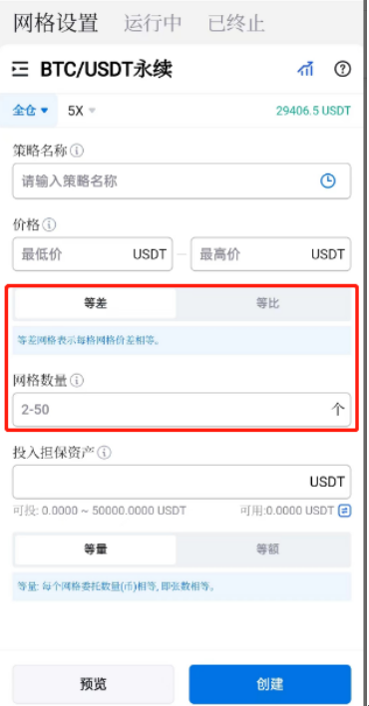
What is an Arithmetic Grid?
An arithmetic grid divides the price range from the lower limit to the upper limit evenly, with equal price intervals (e.g., 1, 2, 3, 4, etc.). The profit for each grid equals the profit of that interval.
What is a Geometric Grid?
An geometric grid has the same percentage increase in price for each grid, meaning the interval spacing is distributed in a geometric manner (e.g., 1, 2, 4, 8, etc.). The profit between each grid is fixed.
- Click to register SuperEx
- Click to download the SuperEx APP
- Click to enter SuperEx CMC
- Click to enter SuperEx DAO Academy — Space

Creation Methods
SUPEREX supports two methods for creating spot grids:
- Manual Creation: Set the spot grid parameters manually based on your judgment of the oscillating market range, including basic and advanced parameters.
- AI Creation: Directly use the AI-recommended grid strategy parameters. AI grid parameters only support basic parameter settings. The logic for recommending parameters is based on backtesting data from 7 days, 30 days, and 180 days, combined with intelligent algorithms.
Parameter Explanation During Creation
- Price Range Lowest: When the market price is below the Lowest price of the range, the strategy will no longer execute order placements.
- Price Range Maximum: When the market price is above the maximum price of the range, the strategy will no longer execute order placements.
- Number of Grids : The number of grids indicates how many small sub-intervals the oscillating range is divided into. For example, for a range of 100–400 with 3 grids, it will be divided into 100–200, 200–300, and 300–400.
- Investment Amount: The amount of base currency invested in the grid strategy. The maximum available for each currency equals the maximum transferable amount in the spot account.
- Arithmetic Grid: The difference in price between each adjacent order is equal (e.g., 1, 2, 3, 4).
- Geometric Grid: The ratio between each adjacent order price is equal (e.g., 1, 2, 4, 8).
- Move Up (optional): Set the price at which the grid will stop moving up as the price rises. For specific details, refer to the “What is Move Up” function.
- Trigger Price (optional): The price at which the grid starts triggering; if not set, it will trigger immediately upon creation.
- Take Profit termination Price (optional): When the price of the currency rises to this level, the strategy will automatically stop.
- Stop Loss termination Price (optional): When the price of the currency falls to this level, the strategy will automatically stop.
- Sell on Termination: Checked by default; can be unchecked.
Order Page Parameter Explanation
Total Investment
The amount invested when creating the grid.
Total Profit:
During operation: Total Profit = Base Currency Amount * Current Price + Quote Currency Amount — Investment Amount
At termination, if sell is chosen: Total Profit = Base Currency Amount * Average Selling Price + Quote Currency Amount — Investment AmountAt termination, if not selling is chosen: Total Profit = Base Currency Amount * Termination Price + Quote Currency Amount — Investment Amount
Grid Profit
Grid profit is the sum of the grid profits generated by matched buy and sell orders that have been executed, measured in quote currency.
The profit from a matched buy and sell order = total amount of sell orders — total amount of buy orders — selling fees + selling price * remaining base currency (if any).
Remaining base currency: Due to the constraints of the delegated parameters, the quantity of base currency bought, after deducting fees, cannot be fully sold because of the precision limit on the quantity of base currency sold.
Matched orders refer to a lower-priced buy order and a higher-priced sell order that have been executed and matched as a pair.
Floating Retums:
Floating Retums = Total Profit — Grid Profit.
Annualized Return :
Annualized Return = Total Profit / Total Investment Amount * 365 days * 24 hours * 60 minutes / Operating Duration (in minutes).
Single Grid Purchase Amount:
Single Grid Purchase Amount = Investment Amount / (Sum of Buy Prices).
Sum of Buy Prices = Total Price of Grids / Number of Grids.
The single grid purchase amount will change after moving up.
Current Price Range / Initial Price Range:
Initial Price Range: The price range when the grid is created.
Current Price Range: The price range during the grid operation.
if no move up is set, the current price range is the same as the initial price range.
Buy Order Average Price / Buy Order Quantity:
The average price and quantity of base currency purchased during the initial setup.
Current Balance
Refers to the base currency assets and quote currency assets occupied in the current grid strategy.

备份-4@2x-1024x576.png)
备份-5@2x-1024x576.png)


Responses