
Behind X’s Crackdown on InfoFi: The Endgame of Traffic Parasitism in Crypto’s Content Economy — and the Road to SocialFi Reconstruction

#SocialFi #InfoFi #X
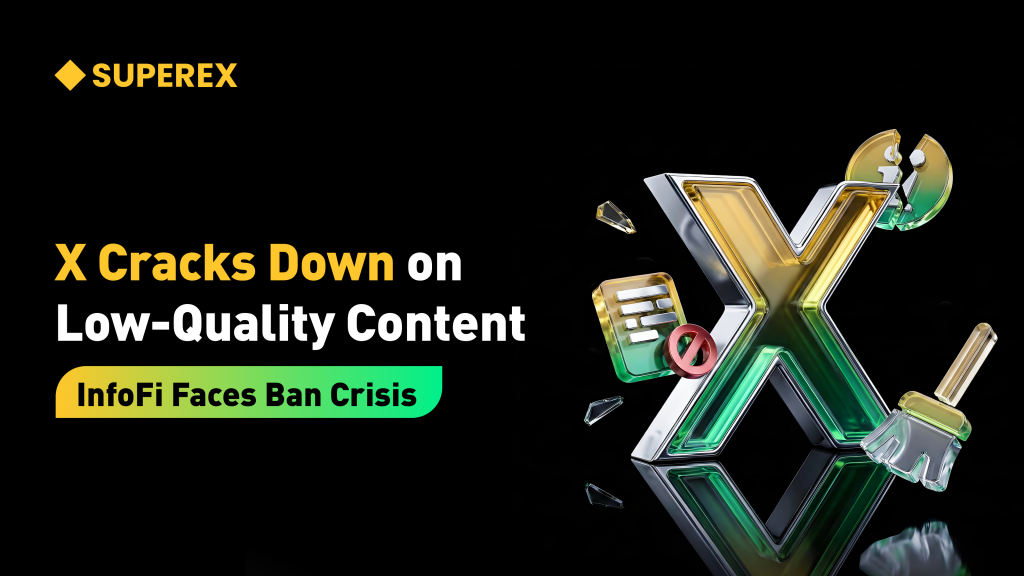
As 2026 began, X (formerly Twitter) pulled off a major move. People often say the crypto world never lacks stories, but rarely does a single platform policy change trigger a chain reaction as intense as X’s “cutoff” of InfoFi.
Overnight, the narrative of “tweet-to-mine” was slammed with a pause button. Dozens of projects dependent on X’s traffic were pushed into a life-or-death moment, and millions of “airdrop grinders” fell from heaven into hell. Market analysts believe this wasn’t a routine rule update — it was a Web2 giant settling accounts with a Web3 parasitic model.
- Click to register SuperEx
- Click to download the SuperEx APP
- Click to enter SuperEx CMC
- Click to enter SuperEx DAO Academy — Space

What happened: API access revoked, millions in “tolls” refused
On January 15, Nikita Bier — X’s product lead and a Solana ecosystem advisor — announced that the platform was revising its developer API policy and would no longer allow apps that reward users for posting, explicitly naming InfoFi. His stance was blunt:InfoFi incentive mechanisms are destroying the platform’s content ecosystem.
From the platform’s perspective, that conclusion wasn’t surprising. Over the past year, crypto timelines have been drowned in templated interactions — mechanical replies like “gm,” “bullish,” and “to the moon” duplicated like an industrial assembly line. AI bots intertwined with “farming studios,” making it hard for the algorithm to distinguish real discussion from task-driven shilling.
InfoFi’s original logic sounded beautiful: use tokens to incentivize quality creation — not only letting ordinary users share in cognitive dividends, but also helping projects build decentralized distribution networks.
But reality went the other way:
- Incentives didn’t drive creation — they drove performance;
- Not deep content, but task metrics.
Once traffic becomes price-tagged, expression inevitably becomes alienated. For X, continuing to tolerate this model was no different than lending the platform’s credibility as an endorsement for a group of token projects. So even if it could collect millions of dollars a year in API fees, it still chose to swing the knife and cut itself — this was an inevitable choice shaped by the platform’s incentive structure.
No wonder Nikita said outright that InfoFi-style incentives were the main culprit behind the flood of AI garbage and meaningless replies on the platform. X has already revoked API access for these apps. Once the bots realize they’re no longer getting paid, the user experience should start improving quickly.
InfoFi’s biggest problem isn’t incentives — it’s a misread of what social networks are
As said earlier, InfoFi’s original logic was beautiful, and that’s one reason it could explode so quickly. But the nature of the internet is not a simple value exchange, and human hearts cannot be bound by simple interest swaps. InfoFi misjudged social networks — and underestimated human nature.
Back to the point: the value of social media, as we understand it, comes from three layers:
- Real relationships
- Trust filtering
- Attention scarcity
Yet InfoFi compressed all of that into: “behavior = tokens = value.”
The result was obvious. Once earnings are tightly bound to interaction counts, the rational user’s optimal strategy becomes:
- High-frequency copying
- Emotional team-picking
- Topic speculation
So content is no longer the goal — it becomes a mining tool.
This model can barely run during the early phase of a bull market, because incoming capital masks efficiency problems. But when the market cools, real users’ tolerance for low-quality information collapses fast, and the conflict of interests between platforms and projects immediately surfaces.
From a more macro perspective, InfoFi is essentially a Web3 repackaging of Web2 traffic:
- Data is still controlled by centralized platforms
- Distribution rules are decided by algorithms
- Projects only own the “incentive layer,” not the “infrastructure layer”
This was destined to be parasitic innovation. It’s no wonder some analysts argue that InfoFi’s original sin is reducing “relationship networks” into “click factories.”
Top projects “cut off an arm to survive” — maybe transformation, maybe narrative reassembly
After the policy landed, top projects almost simultaneously hit the brakes. For example:
- Kaito announced the termination of the Yaps incentive system, pivoting to Kaito Studio;
- Cookie DAO shut down Snaps and doubled down on the intelligence tool Cookie Pro.
On the surface, this looks like product iteration. In reality, it’s narrative reconstruction:
- From “user mining” to “brand services”;
- From “permissionless distribution” to “tiered marketing.”
But what the market cares about most is not the direction of the pivot — it’s the timing.
On-chain monitoring shows that some team addresses transferred large amounts of tokens to exchanges before the policy was announced, sparking suspicion of “selling early.” Whatever the truth is, this kind of trust fracture accelerates the collapse of InfoFi credibility — on a track where “reputation” is the core asset, the thing it fears most is the disintegration of reputation itself.
The more realistic question is: when the X traffic entrance is shut, where is the real moat of these projects? A closer look is even more despairing, because this is an ecosystem that is:
- Not technically high-barrier;
- Dependent on the platform for data assets;
- Highly profit-driven in community relationships,Most InfoFi projects look more like marketing plugins than independent protocols.
This incident reflects three structural conflicts
Platform stance
- Needs to improve content quality
- Protect advertisers and real users
- Prevent the algorithm from being manipulated
Project stance
- Relies on external traffic for cold start
- Needs quantifiable growth metrics
- Pursues a closed-loop token narrative
Creator stance
- Wants monetization
- But doesn’t want to become a paid shill army
- Needs a long-term brand
InfoFi tried to satisfy all three with tokens, but ignored a basic common sense: incentives can accelerate value, but they cannot replace value. When content itself lacks scarcity, even the most sophisticated economic model is just a magnifier.
Many users view this crackdown as “content justice” — the timeline is finally no longer drowned in copied scripts, and real discussion can breathe again.
But the other side must also be acknowledged: the platform’s definition of “what counts as quality” is itself power. While X cleans up InfoFi, it is also strengthening its monopoly over distribution rules.
For creators, the shift from token incentives back to platform algorithms sends a clear message: when Web3 overly relies on Web2 entry points, so-called “decentralization” becomes nothing more than a slogan.
Conclusion
InfoFi’s fade-out is not the failure of crypto content — it is the end of frontier-style growth.
It proved at least three things:
- Attention cannot be simply tokenized
- Platform sovereignty is higher than incentive models
- Real value will ultimately filter out fake demand
The next stage of SocialFi will no longer be about “who subsidizes harder,” but about “who can truly carry relationships.”
When the traffic dividend recedes, the real competition is only just beginning — competition over trust, identity, and the right to speak.





Responses