
From “Swapping into USDT” to “Direct Participation”:How SuperEx Index Futures Trading Is Reshaping Participation in Crypto Derivatives

#USDT #IndexFutures #Derivatives
In the crypto derivatives market, most innovation has historically revolved around two directions: higher leverage, or more complex trading instruments. Yet over the past few years, one long-standing issue has consistently been overlooked — is the barrier to participating in mainstream market movements truly low enough?
For most users, the answer is no.
Whether it is USDT-margined contracts or coin-margined contracts, almost all mainstream derivatives products implicitly require users to complete one key action first: converting their existing assets into an “accepted settlement currency.” In real trading scenarios, this step often entails additional slippage, fees, timing costs, and perhaps most importantly — a psychological barrier.
As a result, many fundamentally valuable small-cap tokens have remained confined to spot trading and long-term holding. Their capital efficiency remains limited, and they struggle to directly participate in movements of the mainstream market.
Reconstructing the way users participate in crypto derivatives — and unlocking the value ceiling of small-cap assets — has quietly become a shared aspiration among many derivatives participants.
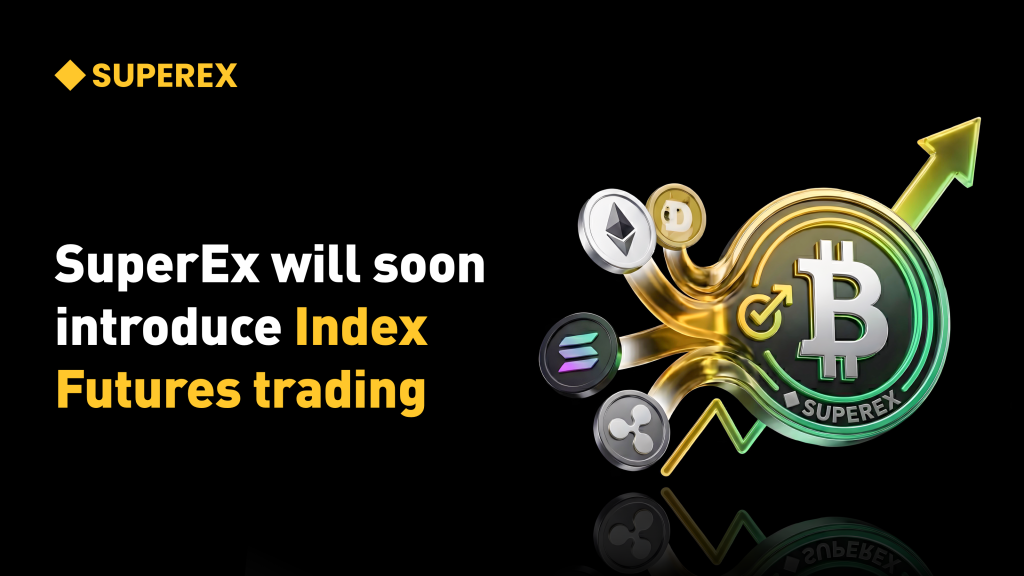
SuperEx’s globally first-of-its-kind product — Index Futures Trading — starts precisely from this long-ignored structural issue and offers a fundamentally different solution: designing around user assets rather than settlement currencies.
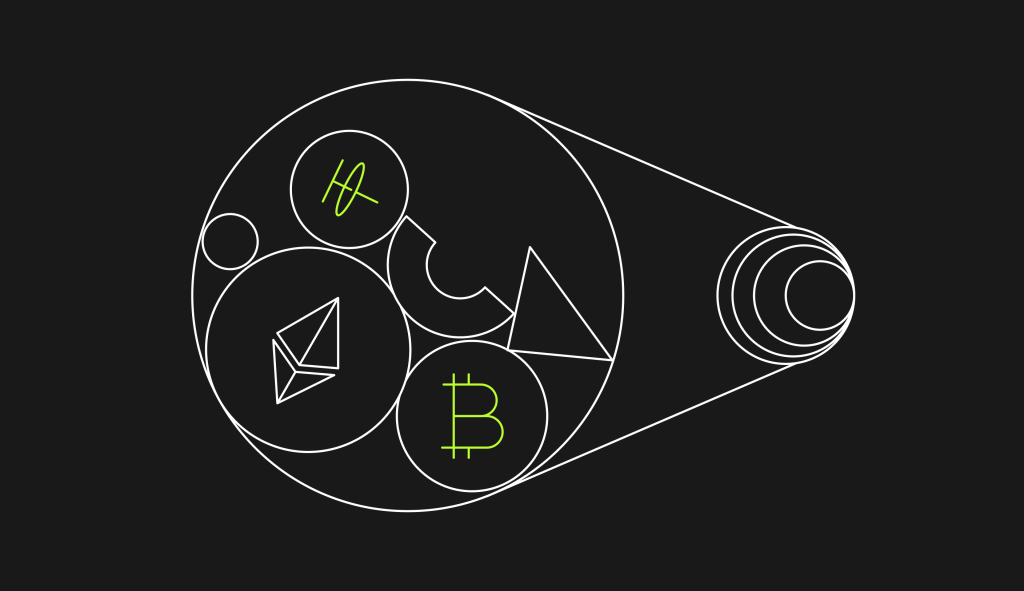
Unlike traditional derivatives products, SuperEx Index Futures Trading does not treat USDT or major assets as the default entry point. Instead, it allows users to directly use small-cap tokens as margin and settlement assets to trade mainstream index markets such as BTC and ETH.
This means that a token which previously could only sit idle in a spot account as a passive holding is now able to directly participate in mainstream market volatility as an active trading instrument.
From a product-logic perspective, this is not merely a change in settlement mechanics, but a shift in perspective. Rather than forcing users to adapt to contract structures, the contract structure is redesigned to adapt to users’ actual asset composition.
In a market environment where small-cap holdings account for a large proportion of user portfolios, while mainstream market trading remains highly concentrated, this design clearly aligns more closely with real demand.
SuperEx Index Futures Trading will officially launch on the app on January 10, 2026. Users can download the app in advance via the App Store or Google Play and click to participate quickly.

Lowering the Capital Barrier to Mainstream Derivatives — No USDT Conversion Required
- No need to convert small-cap tokens into USDT or BTC
- Reduced friction and potential slippage from asset swaps
- More flexible capital management
Simply put, users can enter mainstream market trading scenarios without converting their small-cap tokens into USDT or other assets. This avoids exchange costs and reduces the psychological and decision-making pressure caused by asset conversion.
For many users, small-cap tokens represent long-term strategic holdings, while mainstream assets represent short-term trading opportunities. This product connects the two, balancing long-term investment with flexible trading needs.
Index Pricing + Perpetual Mechanism: Making “Small-Cap Participation in Mainstream Markets” Possible
The key that enables this model lies in SuperEx’s use of a multi-exchange weighted index pricing mechanism, combined with a mature perpetual futures structure.
- Index prices are formed through weighted aggregation across multiple platforms
- Noise and abnormal volatility are effectively filtered out
- Liquidation and settlement are executed based on mark price
- Fairness and stability are both preserved
What users are trading is not the price fluctuation of the small-cap token itself, but the average market movement of mainstream assets such as BTC and ETH across the broader market.
This significantly reduces price distortion caused by insufficient depth in any single trading venue. In particular, when small-cap tokens themselves suffer from limited liquidity and thin order books, they are prone to sudden price spikes, wicks, or extreme anomalies that can lead to unintended liquidations. This structure ensures that trading behavior is anchored to genuine mainstream market trends.
In other words, the small-cap token serves purely as a capital carrier, while price discovery is anchored to mainstream market consensus.
This structure delivers a trading experience closer to traditional financial “index futures,” while retaining the flexibility of crypto-native assets and open settlement boundaries.
For Users: An Upgrade in Asset Efficiency
Under traditional models, small-cap holders often face a dilemma: continue holding long-term and miss cyclical opportunities, or sell and swap into USDT to trade, thereby giving up exposure to the original asset.
The emergence of Index Futures Trading makes these two choices no longer mutually exclusive.
Users can participate directly in mainstream market movements without selling or swapping assets. Profits and losses are settled in the original token, avoiding the complexity of frequent asset transitions. For users who are long-term believers in small-cap ecosystems but also want exposure to mainstream trends, this offers a more balanced path.
From this perspective, this is not merely “a new derivatives product,” but a transition from passive holding toward active asset management.
For the Industry: A Structural Loosening of Derivatives Design
More importantly, the significance of Index Futures Trading extends beyond a single platform.
For a long time, crypto derivatives markets have been heavily concentrated around a small number of settlement assets. While this improves liquidity, it also compresses the participation space for asset diversity. Through the combination of index anchoring and multi-asset settlement, SuperEx provides a new structural reference for derivatives markets.
It demonstrates a simple truth: the right to trade mainstream market movements does not have to be bound to a single settlement currency.
If this model gains broader acceptance, the derivatives market may gradually evolve from “settlement-currency centralization” toward “diversified asset entry points.”
Final Thoughts
On the surface, SuperEx Index Futures Trading addresses the question of “which asset to trade with.” At a deeper level, it touches on a more fundamental issue: who can participate in the market naturally.
- When contracts no longer require users to convert assets first
- When small-cap tokens are no longer peripheral positions
- When trading structures are designed around real asset distribution
The way participants engage with the crypto market is quietly changing. And this may be the most noteworthy aspect of this product.




Responses