
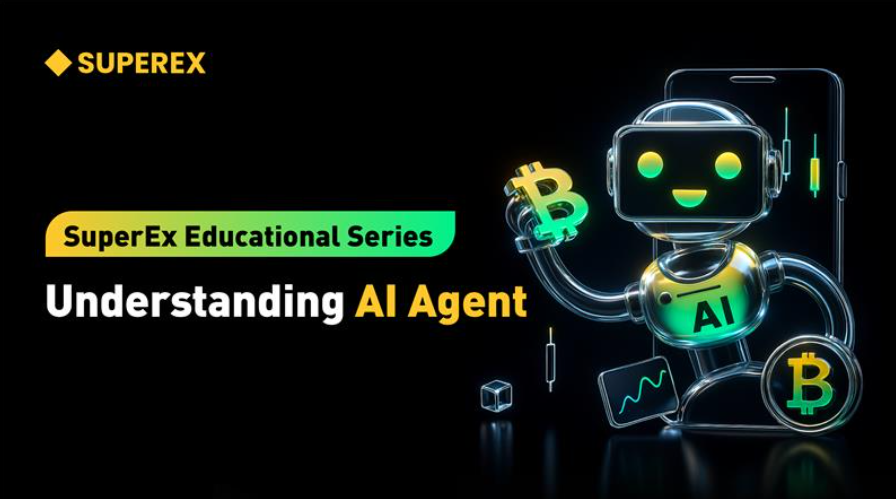
SuperEx Educational Series: Understanding AI Agent — The Brain of Web3 Automation

#Educational Series # AIAgent #AI
In 2025, everyone is talking about AI Agents — from crypto traders automating their DeFi moves, to on-chain data tools that act like your personal assistant. But what exactly is an AI Agent, and why is it becoming one of the most talked-about trends in both AI and blockchain?
Let’s break it down the easy way — in plain English and from a Web3 perspective.
https://news.superex.com/articles/12521.html

What Is an AI Agent?
Think of an AI Agent as a digital “brain” that can make decisions and take actions without needing you to manually click anything.It’s not just a chatbot like ChatGPT or a trading bot that follows simple rules — an AI Agent can observe, plan, and act on its own.
For example:
- A trading agent can monitor hundreds of tokens, read market signals, and decide when to buy or sell.
- A DeFi agent can move assets across blockchains, rebalance portfolios, or claim yield farming rewards — all automatically.
- A social agent can manage communities, reply to users, or even create on-chain campaigns based on engagement data.
In short: An AI Agent is like your personal on-chain assistant, powered by intelligence, not just code.
Core Structure of an AI Agent
To understand how it works, imagine four key parts:
1. Perception (Input Layer)
This is how the agent “sees” the world.It collects data — prices, blockchain transactions, user behavior, or even tweets.
2. Reasoning (Brain)
This is where AI comes in.The model uses natural language understanding, reasoning, and past experience to analyze what’s happening.
3. Decision-Making (Logic Engine)
Based on its reasoning, it decides what to do — buy a token, move liquidity, post a message, etc.
4. Action (Execution Layer)
The final step — it interacts with the blockchain (smart contracts, wallets, DEXs) to execute that decision autonomously.
So when you see a project saying “AI-powered DeFi automation,” what they really mean is: They’ve built an AI Agent that can think, decide, and act on-chain.
The Rise of AI Agents in Web3
AI Agents are not new — the idea of autonomous digital entities that can observe, think, and act dates back to the early days of computer science in the 1990s. Back then, researchers talked about software agents — programs that could perform tasks on behalf of users, like filtering emails or monitoring stock prices.
But in the Web2 world, those agents were limited by centralization. They relied on cloud servers, had no real ownership, and could be shut down anytime by the companies that built them.
Fast forward to today — and the picture has completely changed.
Thanks to blockchain technology, these agents are evolving into something far more powerful and independent: Web3 AI Agents — digital entities that live on-chain, own their data, and interact directly with decentralized systems without middlemen.
Why AI + Blockchain Is a Game-Changer
When AI meets blockchain, the result is not just smarter systems — it’s trustless automation. Let’s break down why this combination is so important:
1️⃣ Transparency
In traditional AI systems, you can’t really see what’s going on inside the black box. You don’t know what data it’s using, what decisions it’s making, or who controls it.
But when an AI Agent operates on-chain, every action it takes — every trade, transfer, or interaction — can be verified on a public ledger. This transparency creates auditability, a crucial element for finance, governance, and decentralized ecosystems.Imagine being able to verify exactly how your AI trading bot made decisions — not because the company says so, but because the proof is on-chain.
2️⃣ Autonomy
AI Agents can operate 24/7, 365 days a year — no coffee breaks, no maintenance downtime. By integrating with blockchain smart contracts, they can execute complex workflows automatically, without needing approval or manual input.
For example:
- An AI Agent could detect liquidity shifts in the DeFi market, automatically rebalance your portfolio, and send confirmations — all without human supervision.
- A DAO management agent could monitor treasury proposals, suggest optimizations, and execute approved transactions autonomously.
This is what makes AI Agents so exciting for Web3 — they remove human bottlenecks, making DeFi truly decentralized and intelligent.
3️⃣ Ownership
Here’s where Web3 changes the entire paradigm: You can actually own your AI Agent.
Through NFTs, DIDs (Decentralized IDs), or wallet-linked identities, users can create AI Agents that belong exclusively to them — not to a company. That means:
- You control its data.
- You set its permissions.
- You decide how it acts, and even monetize its services.
Imagine minting your own trading AI as an NFT — your personal “financial brain” that executes strategies on your behalf, learns over time, and could even be sold or licensed to others.
That’s not sci-fi. Projects like Fetch.ai, SingularityNET, and Autonolas are already building frameworks where AI Agents can trade, collaborate, and get paid on-chain using tokens.
4️⃣ Programmable Trust
Blockchain adds another critical ingredient — smart contracts.
AI Agents powered by smart contracts can act within strict parameters: they can’t lie, fake data, or take unauthorized actions because the contract code defines the exact rules.This creates programmable trust — a world where you can delegate financial or operational power to AI, knowing that every action is bound by transparent, verifiable logic.
For example:
- A lending protocol could use AI Agents to assess creditworthiness from on-chain data — but lending execution still follows contract logic.
- A decentralized insurance agent could automatically trigger payouts based on verified oracle data, without human bias.
This blend of intelligence + immutability makes AI Agents the backbone of what we call AIFI — Autonomous Intelligent Finance.
AIFI: The New Frontier of Web3 Finance
AIFI, short for Autonomous Intelligent Finance, represents the next step after DeFi. If DeFi made finance permissionless, AIFI will make it self-operating.
Instead of traders setting up strategies manually or yield farmers constantly chasing higher APRs, AI Agents will:
- Read on-chain data in real time
- Identify profitable moves
- Execute transactions instantly
- Manage risk and compliance autonomously
Imagine connecting your SuperEx wallet, deploying your AI Agent, and letting it handle the trading logic, liquidity rotation, and gas optimization — while you just monitor performance dashboards.
That’s AIFI in action: finance that runs itself, governed by code, optimized by intelligence.
Why This Matters Now
The timing couldn’t be better. As DeFi grows more complex, manual participation is becoming harder for newcomers. Yield farming, cross-chain strategies, liquidity provision — they all require constant attention and technical skill.
AI Agents simplify that. They turn crypto from something that demands “constant watching” into something that works for you.
⚙️ Use Cases: Where AI Agents Are Already Making Waves
Let’s see how AI Agents are already reshaping the crypto ecosystem ?
1️⃣ Trading and Portfolio Management
AI Agents can:
- Track multiple exchanges at once
- Read news sentiment
- Execute strategies automatically based on real-time data
Example: Some platforms are integrating agents that can detect early liquidity movements or unusual whale activity — something even skilled traders can’t do 24/7.
2️⃣ DeFi Yield Optimization
Imagine an AI Agent that:
- Finds the best yield farming pools
- Moves liquidity when APY drops
- Claims and reinvests rewards automatically
That’s not a fantasy — it’s already happening on protocols like Yearn and Instadapp, and future AI-driven versions will be even smarter.
3️⃣ NFT and Creator Economy
For creators, AI Agents can:
- Manage fan communities
- Drop NFT collections based on trending topics
- Auto-reply to collectors or manage royalties
These agents turn Web3 creators into “self-operating brands.”
4️⃣ Web3 Customer Service
Projects now deploy AI Agents that can:
- Identify scam reports
- Guide users through DeFi processes
- Detect and block suspicious activities
This reduces support costs and increases trust — especially in exchanges and on-chain platforms.
5️⃣ On-Chain Governance
DAOs are starting to use AI Agents as “voting assistants” that:
- Summarize proposals
- Suggest votes based on the DAO’s constitution
- Execute transactions after consensus
That’s decentralized governance — powered by intelligence.
The Link Between AI Agents and Decentralized Identity (DID)
Here’s a deep but important connection: Every AI Agent needs an identity — a way to represent itself on-chain.That’s where DID (Decentralized ID) and Soulbound Tokens (SBTs) come in.
Your AI Agent could hold:
- Your credentials (verified wallet history, achievements, or DAO votes)
- Your on-chain preferences
- Your ownership rights
And since it’s tied to your DID, it becomes your on-chain twin — working for you, earning for you, learning from you. This opens the door to Agent Economy — a new layer of Web3 where every user has personal AI agents managing assets, identity, and reputation.
The Challenges Behind the Hype
Of course, not everything is perfect yet.
AI Agents face several challenges before they can go mainstream:
Security & Control
Giving an AI Agent private key access is risky.The 402Bridge attack and other key-leak incidents remind us that “automation” can’t come at the cost of safety.
Ethical Use
Who’s responsible if an AI Agent causes a loss or executes a wrong trade?
The line between user intent and AI action is still blurry.
Computation Cost
Running AI on-chain is expensive.Many projects rely on off-chain AI, which creates a trust tradeoff.
Regulation
As AI Agents start managing financial assets, regulators will need to redefine what counts as “autonomous trading” or “AI-driven advisory.”
The Future: Agentic Web3 Is Coming
Here’s where it gets exciting.Imagine logging into SuperEx in the near future and seeing:“Activate your Trading Agent.”
You connect your wallet, set your risk profile, and your AI Agent handles:
- Spot trades
- Perpetual contracts
- Risk control
- Yield farming
All while learning your preferences and adapting over time. That’s the Agentic Exchange future — one where users interact not through manual clicks, but through intelligent agents.
It’s not science fiction. It’s the next step of DeFi evolution — AI-native, user-owned, transparent automation.
Final Thoughts
AI Agents represent the next frontier of crypto automation — where intelligence meets decentralization.
They will:
- Redefine how we trade, invest, and manage assets.
- Enable personalized finance at scale.
- Create a new layer of digital ownership — not just of tokens, but of autonomous systems that work for us.
The Web3 world is moving from “smart contracts” to “smart actions.” And as platforms like SuperEx explore this frontier, understanding AI Agents is the first step toward the Agentic Era of Crypto.
In summary
AI Agents are not just tools — they are your digital partners in the decentralized future. And when intelligence, transparency, and ownership combine — that’s when Web3 truly becomes autonomous.



Responses