
Kanye’s Meme Coin YZY: From a $3 Billion Myth to Market Manipulation Suspicions, a Capital Carnival Fueled by Celebrity Effect

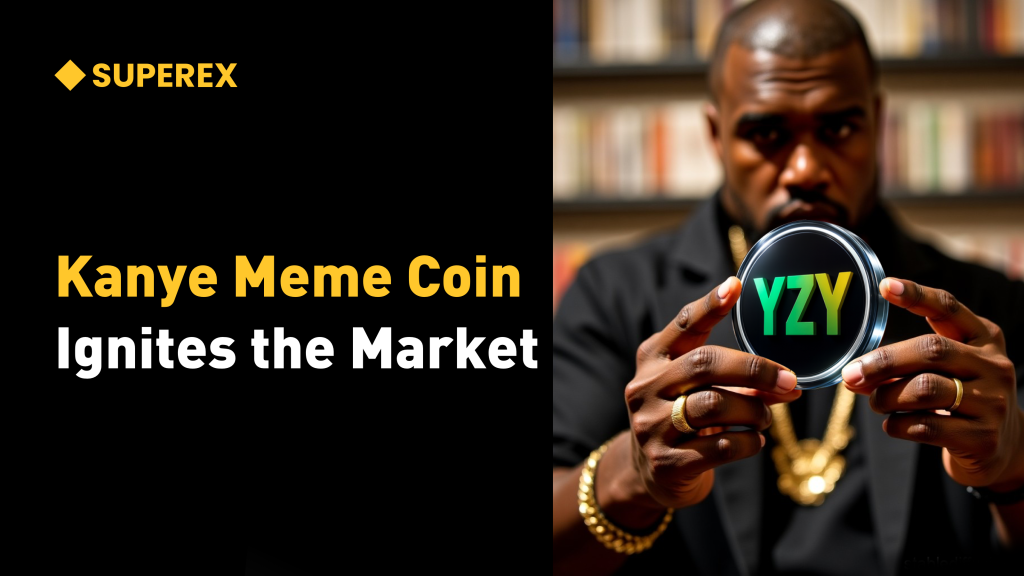
#Kanye #MemeCoin #YZY
Introduction: All analysis in this article is based on facts that have already occurred in the market and quotes from market analysts. SuperEx is only providing hot-topic commentary and does not express any stance.
Half a year of anticipation. Finally, on August 21, 2025, Kanye West officially announced on social media: “YEEZY MONEY IS HERE”, launching his own meme coin YZY on Solana.
In the video, Kanye himself appeared to endorse it, and the token was listed on the Moonshot platform simultaneously. In just 15 minutes, YZY made it to the trending list.
The market performance was insane:
- Market cap skyrocketed from $200 million to $3.4 billion,
- Then quickly fell back below $1 billion,
- Daily trading volume exceeded $380 million,
- And transaction fees alone surpassed 2,500 SOL.
On-chain, it was a roller-coaster carnival. Some people became millionaires overnight with YZY, while others lost more than $700,000 in just three hours. This is the charm — and the cruelty — of meme coins.
Celebrity-launched meme coins are not new. Trump’s TRUMP coin just created a frenzy, followed by Cardi B, Ariana Grande, and others releasing their own tokens. Now the spotlight finally fell on Kanye West — a hip-hop titan who has dominated the music industry for decades, and in fashion, Yeezy has long been a cultural symbol.
But, as with most celebrity meme coins, under the heat lies turbulence: some investors suspect market manipulation by the project team or whales. The pump-and-dump pattern trapped countless latecomers. Upon deeper digging, more alarming details surfaced: highly concentrated token allocations, suspicious on-chain operations, and even similarities with the notorious rug-pull token LIBRA. The party quickly turned dark, and YZY shifted from “crypto’s hottest new star” to “the center of manipulation suspicions.”
- Click to register SuperEx
- Click to download the SuperEx APP
- Click to enter SuperEx CMC
- Click to enter SuperEx DAO Academy — Space

The Explosion of YZY: Celebrity Effect + Meme Culture + Liquidity Chase
Kanye West’s token launch was not entirely unexpected. As early as February this year, rumors circulated about him launching a Yeezy token (YZY). At that time, due to the LIBRA rug scandal, the plan was postponed. He even swore on social media that he would “never issue a coin.” But months later, he reversed course, leaving the community hanging in suspense.
On August 21, Kanye finally made it official: the YZY MONEY brand was launched, with the token YZY issued on Solana. To reduce skepticism, he even filmed a personal endorsement video. Meanwhile, the project announced partnerships with major Solana ecosystems such as Meteora, Jupiter, and MoonPay — a gesture of “we’re serious this time.”
In crypto, this kind of celebrity-driven hype is all too familiar: a single tweet or video can bring in hundreds of thousands of investors rushing in. Looking back, YZY’s rise followed the classic “meme coin explosion formula.”
1. Celebrity Effect: Kanye West’s own traffic
In traditional entertainment, Kanye is a topic machine. From music to fashion to controversial statements on social media, his influence is massive. Once bound with crypto, it easily triggers FOMO. At YZY’s launch, many investors didn’t even care about tokenomics — just the fact that “Kanye launched a coin” was enough to light the fire.
2. Meme Culture: Consensus first, logic later
Meme coins have never been about technological breakthroughs, but about collective narrative. From DOGE to SHIB to PEPE, each boom was a community carnival. YZY captured the dual consensus of “celebrity + meme,” enough for masses to buy in regardless of fundamentals.
3. Liquidity Chase: Self-reinforcing hot money
In a bullish sentiment backdrop, capital was hunting for the next big thing. Once YZY showed massive trading volume and sharp rallies, a self-reinforcing loop emerged: volume → hype → more buyers chasing → price surging again.
Thus, YZY became an instant hit. But then the real question arose: is the structure behind this hype really solid?
Tokenomics: Fair on Paper, “Insider Control” in Reality?
If launching a token is a poker game, tokenomics is the rulebook. YZY’s rules looked polished, but under the surface, too many tricks.
According to official disclosures:
- 20% for public sale,
- 10% for liquidity pool,
- 30% to Yeezy Investments LLC (3-month lock + 24-month linear release),
- 20% to team (6-month lock + 24-month release),
- 20% to ecosystem development fund (12-month lock + 24-month release).
Looks transparent, but what does it mean? Over 70% of tokens are in insider hands, with only 30% in circulation. That basically means: most of the chips are controlled internally, and retail is playing the game of “we decide whether you get liquidity.”
Add to that the so-called “25 contracts randomly assigned mechanism.” The team said it was to prevent sniping, but the result?
- Some users picked wrong addresses, losing $700,000.
- Insiders, however, seemed to know the right path ahead of time, making precise plays.
In other words, this “fair lottery” felt more like a pre-written script.
This inevitably reminded the community of LIBRA meme coin months earlier: same insider control, same staged releases, ending in a collapse. Quickly, suspicion spread — was YZY just “LIBRA 2.0 with a celebrity face”?
On-Chain Data: Insider Wallets Exposed — Who’s Really Cashing Out?
If token allocation can be sugar-coated, on-chain flows don’t lie.
On-chain analyst Lookonchain revealed shocking data:
- At launch, insider wallets made large YZY buys, with pinpoint timing.
- Wallet 6MNWV8 spent $450,000 USDC to buy 1.89 million YZY, then sold at $2.12 each, netting $3.37 million USDC.
- Another wallet paid 129 SOL (~$24,000) in priority fees just to ensure it was first in line.
Coinbase director Conor Grogan also pointed out: 94% of YZY was held internally, with 87% controlled by a single multisig wallet.
What does that mean? It means almost all chips were controlled by insiders, and retail “competition” was just window dressing.
Even more intriguing, crypto KOL Scooter claimed that LIBRA’s notorious advisor Hayden Davis was involved in YZY. Coincidentally, just hours before YZY’s launch, Hayden’s frozen funds were unfrozen. The timing looked like a seamless continuation of LIBRA’s playbook.
Risk Control Design: Class Action Waiver, Hard for Investors to Sue
Even more shocking were YZY’s legal terms: the whitepaper explicitly stated “class action waiver.”
In other words: if the project blows up, investors cannot file a collective lawsuit, only sue individually. Worse, if the team launches legal counterattacks, investors might end up paying legal fees themselves.
This clause basically told investors upfront: “We know there will be risks, but don’t even think about suing us together.”
This made YZY look even more like a capital operation — using celebrity halo for traffic, while designing legal shields to protect insiders’ exits.
Kanye’s Contradictions: From Rejecting Tokens to Full Endorsement
If we only look at the project, it might still seem like just another capital game. But put it against Kanye’s past words and it becomes ironic.
- Earlier this year, Kanye said publicly: “I will never issue a coin, hype is deceiving fans.”
- He revealed that someone offered him $2 million to promote a rug coin, but he refused.
- Yet months later, he not only launched YZY but personally endorsed it, even rolling out a payment system and cards.
This sharp reversal raised doubts: had Kanye’s account been compromised or “taken over”? Some users even pointed to odd signs: sudden increase in crypto KOL follows, profile settings changes, etc. Though Kanye denied it, the inconsistency made his motives questionable.
So was YZY really Kanye’s personal business experiment — or a capital team’s manipulation using his brand? Only he knows the truth.
Final Thoughts: Cold Reflection Behind the Frenzy
Kanye West’s YZY is undoubtedly one of the most sensational crypto stories of August 2025. From a $3 billion market cap myth, to on-chain insider exposures, to legal clauses shielding the project team, this celebrity-fueled crypto experiment looks like a massive capital gamble.
For investors, there are some takeaways:
- Celebrity aura ≠ investment value. Don’t let fandom cloud judgment.
- On-chain data never lies. Insider manipulation is more telling than any announcement.
- Beware of legal clauses. If a project tells you “you can’t sue us,” take it as a red flag.
- Celebrity tokens = high-risk speculation. Good for short-term trades, not long-term value.
Ultimately, will YZY evolve into a genuine ecosystem success — or collapse like LIBRA? Only time will tell.






Responses